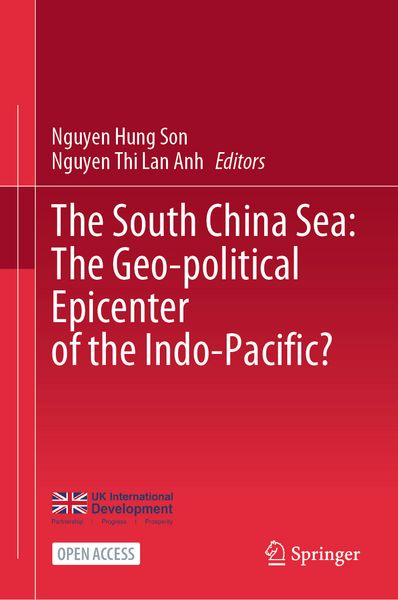
The South China Sea: The Geo-political Epicenter of the Indo-Pacific?
-
- Englisch ausgewählt
49,99 €
inkl. gesetzl. MwSt.,
Beschreibung
Produktdetails
Einband
Gebundene Ausgabe
Erscheinungsdatum
17.01.2025
Abbildungen
XIV, 160 p. 6 illus., 5 illus. in color.
Herausgeber
Nguyen Hung Son + weitereVerlag
Springer SingaporeSeitenzahl
160
Maße (L/B/H)
24,1/16/1,6 cm
Gewicht
434 g
Auflage
1. Auflage
Sprache
Englisch
ISBN
978-981-9782-08-6
This open access book focuses on the geopolitical competition in the South China Sea, an area with highly concentrated choke points in the Indo-Pacific, presenting ideas and recommendations to manage this competition and foster cooperation to maintain a peaceful and stable environment and promote sustainable governance of the South China Sea and of the Indo-Pacific in a broader sense.
The increasingly complex geopolitics of the Indo-Pacific has made the South China Sea the epicenter of strategic competition between the great powers, with a rising China on the one hand and the United States, its allies, and partners on the other. In this strategic chessboard, the South China Sea is a test of resilience of the rules-based international order, such as versus grey zone operations, as well as disruptive technological developments in both traditional and non-traditional domains.
The book incorporates foreign policy analysis methods to analyze and forecast key players' goals, intentions, and behaviors within the competitive strategic environment of the South China Sea. The success or failure of managing major power competition in the South China Sea, one of the hot spots of the Indo-Pacific region, will determine the future structure of international relations. In addition, as a dynamically developing region of the world, promoting collaborative ideas, particularly in areas related to conflict management is essential for maintaining a peaceful and stable environment, restoring economic growth, and progressing toward a sustainable future.
This book is of interest to politicians, policy-makers, experts, scholars, researchers, and other readers who are interested in how regional issues can shape the global order.
Noch keine Bewertungen vorhanden
Verfassen Sie die erste Bewertung zu diesem Artikel
Helfen Sie anderen Kundinnen und Kunden durch Ihre Meinung.
Kurze Frage zu unserer Seite
Vielen Dank für dein Feedback
Wir nutzen dein Feedback, um unsere Produktseiten zu verbessern. Bitte habe Verständnis, dass wir dir keine Rückmeldung geben können. Falls du Kontakt mit uns aufnehmen möchtest, kannst du dich aber gerne an unseren Kund*innenservice wenden.
zum Kundenservice