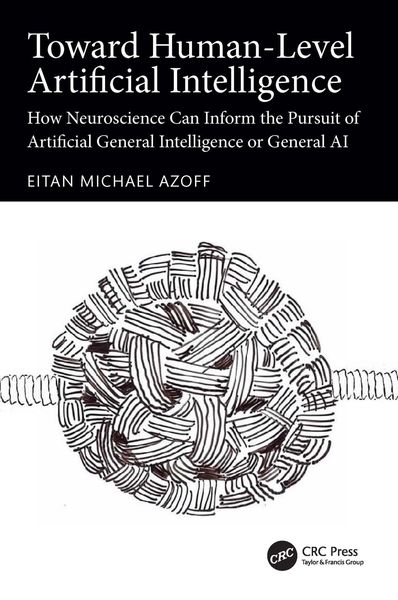
Toward Human-Level Artificial Intelligence How Neuroscience Can Inform the Pursuit of Artificial General Intelligence or General AI
-
- Hardcover
- Taschenbuch
- eBook ausgewählt
-
Form:Einzelkauf Download
-
Sprache:Englisch
-
eBook Format:PDF
- PDF 64,49 € ausgewählt
- ePUB 64,49 €
64,49 €
inkl. gesetzl. MwSt.Beschreibung
Produktdetails
Format
Kopierschutz
Ja
Family Sharing
Nein
Text-to-Speech
Nein
Erscheinungsdatum
18.09.2024
Verlag
Taylor & Francis eBooksSeitenzahl
192 (Printausgabe)
Auflage
1. Auflage
Sprache
Englisch
EAN
9781040130544
Is a computer simulation of a brain sufficient to make it intelligent? Do you need consciousness to have intelligence? Do you need to be alive to have consciousness? This book has a dual purpose. First, it provides a multi-disciplinary research survey across all branches of neuroscience and AI research that relate to this book's mission of bringing AI research closer to building a human-level AI (HLAI) system. It provides an encapsulation of key ideas and concepts and provides in-depth surveys of neuroscience and AI research related to the book's mission, providing all the references for the reader to delve deeper; much of the survey coverage is of recent pioneering research. Second, the final part of this book brings together key concepts from the survey and makes suggestions for building HLAI. This book provides accessible explanations of numerous key concepts from neuroscience and artificial intelligence research, including:
- The focus on visual processing and thinking and the possible role of brain lateralization toward visual thinking and intelligence.
- Diffuse decision making by ensembles of neurons.
- The inside-out model to give HLAI an inner "life" and the possible role for cognitive architecture implementing the scientific method through the plan-do-check-act cycle within that model (learning to learn).
- A neuromodulation feature such as a machine equivalent of dopamine that reinforces learning.
- The embodied HLAI machine, a neurorobot, that interacts with the physical world as it learns.
This book concludes by explaining the hypothesis that computer simulation is sufficient to take AI research further toward HLAI and that the scientific method is our means to enable that progress. This book will be of great interest to a broad audience, particularly neuroscientists and AI researchers, investors in AI projects, and lay readers looking for an accessible introduction to the intersection of neuroscience and artificial intelligence.
Kundinnen und Kunden meinen
Verfassen Sie die erste Bewertung zu diesem Artikel
Helfen Sie anderen Kund*innen durch Ihre Meinung
Kurze Frage zu unserer Seite
Vielen Dank für dein Feedback
Wir nutzen dein Feedback, um unsere Produktseiten zu verbessern. Bitte habe Verständnis, dass wir dir keine Rückmeldung geben können. Falls du Kontakt mit uns aufnehmen möchtest, kannst du dich aber gerne an unseren Kund*innenservice wenden.
zum Kundenservice