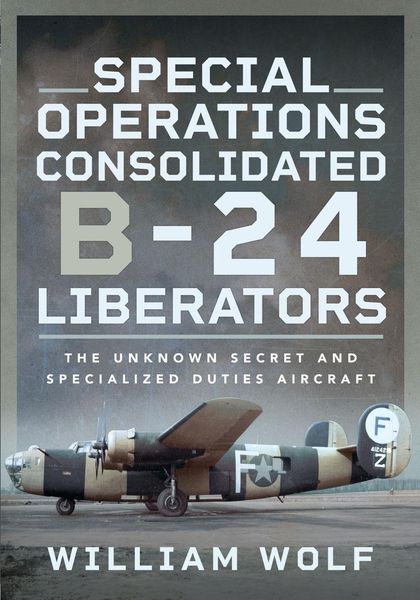
Special Operations Consolidated B-24 Liberators The Unknown Secret and Specialized Duties Aircraft
-
Form:Einzelkauf Download
-
Sprache:Englisch
-
eBook Format:ePUB
- PDF 11,99 €
- ePUB 11,99 € ausgewählt
11,99 €
inkl. gesetzl. MwSt.Beschreibung
Produktdetails
Format
ePUB
Kopierschutz
Ja
Family Sharing
Ja
Text-to-Speech
Ja
Erscheinungsdatum
30.01.2024
Verlag
Pen & SwordSeitenzahl
256 (Printausgabe)
Dateigröße
20604 KB
Sprache
Englisch
EAN
9781399057783
Despite being America's most produced bomber, the Consolidated B-24 Liberator has forever flown in the shadow of its more famous and glamorous B-17 rival. The workmanlike B-24 performed multiple unheralded roles in all theatres beyond its also multiple offensive missions, making it the war's most versatile heavy bomber. Besides its offensive bombing, anti-submarine, and mining missions, the Liberator performed many little known "inoffensive" duties.
Undoubtedly the most colorful of all Liberators were the so-called assembly ships of the Groups of the 2nd Air Division. Their unique paint schemes of stripes, polka dots, and checkerboard, were designed to make them ultra-conspicuous for their task of acting as leaders on which a Group formation could assemble their combat formations more quickly for a combat mission
The Consolidated F-7 was a photographic reconnaissance version of the B-24 Liberator. The F-7 saw service in most theatres of the war. The long range of the Liberator also made it well suited to mapping missions during the war and post-war.
Beginning in early 1944, to aid the Allied liberation of Europe, Carpetbagger B-24s were utilized to parachute spies, called "Joes" or "Janes", or provide aerial supply of weapons and other matériel to resistance fighters in occupied Europe. Liberators also participated in the dropping of 2.75 billion propaganda leaflets using various techniques and delivery devices.
Electronic Warfare played an important part in Allied global pre-invasion plans to discover the location of enemy radars, and, if possible, destroy them. This interception and analysis of an enemy electronic radiation was the origin of present day ELINT (ELectonicINTelligence). Modified RAF B-24D Airborne Electronic Reconnaissance Liberators, codenamed Ferret, were Radio Counter Measures and Electronic Intelligence aircraft that played a major role in European air opera¬tions.
During 1942 the AAF became interested in aerial refueling as a means to bombing Japan. A shorter-range B-17E was selected as the receiver aircraft while the more spacious B-24D acted as the tanker. Although these tests were considered to be successful, the availability of longer-ranging B-29s and bases ever closer to Japan diminished the urgency of wartime aerial refueling.
During the war, eighty-three B-24s crashed or made forced landings in Switzerland, sixty in Sweden, and several in Russia, Spain, Portugal, and Turkey. Many of these Liberators landed undamaged or were repaired to be flown by these nations. Of particular interest are the six Liberators that were captured and flown by the Luftwaffe.
Packed with a unique collection of photographs. Special Operations Consolidated B-24 Liberators reveals the most unusual and little-known facets of the Second World War's most versatile bomber.
Undoubtedly the most colorful of all Liberators were the so-called assembly ships of the Groups of the 2nd Air Division. Their unique paint schemes of stripes, polka dots, and checkerboard, were designed to make them ultra-conspicuous for their task of acting as leaders on which a Group formation could assemble their combat formations more quickly for a combat mission
The Consolidated F-7 was a photographic reconnaissance version of the B-24 Liberator. The F-7 saw service in most theatres of the war. The long range of the Liberator also made it well suited to mapping missions during the war and post-war.
Beginning in early 1944, to aid the Allied liberation of Europe, Carpetbagger B-24s were utilized to parachute spies, called "Joes" or "Janes", or provide aerial supply of weapons and other matériel to resistance fighters in occupied Europe. Liberators also participated in the dropping of 2.75 billion propaganda leaflets using various techniques and delivery devices.
Electronic Warfare played an important part in Allied global pre-invasion plans to discover the location of enemy radars, and, if possible, destroy them. This interception and analysis of an enemy electronic radiation was the origin of present day ELINT (ELectonicINTelligence). Modified RAF B-24D Airborne Electronic Reconnaissance Liberators, codenamed Ferret, were Radio Counter Measures and Electronic Intelligence aircraft that played a major role in European air opera¬tions.
During 1942 the AAF became interested in aerial refueling as a means to bombing Japan. A shorter-range B-17E was selected as the receiver aircraft while the more spacious B-24D acted as the tanker. Although these tests were considered to be successful, the availability of longer-ranging B-29s and bases ever closer to Japan diminished the urgency of wartime aerial refueling.
During the war, eighty-three B-24s crashed or made forced landings in Switzerland, sixty in Sweden, and several in Russia, Spain, Portugal, and Turkey. Many of these Liberators landed undamaged or were repaired to be flown by these nations. Of particular interest are the six Liberators that were captured and flown by the Luftwaffe.
Packed with a unique collection of photographs. Special Operations Consolidated B-24 Liberators reveals the most unusual and little-known facets of the Second World War's most versatile bomber.
Kundinnen und Kunden meinen
Verfassen Sie die erste Bewertung zu diesem Artikel
Helfen Sie anderen Kund*innen durch Ihre Meinung
Kurze Frage zu unserer Seite
Vielen Dank für dein Feedback
Wir nutzen dein Feedback, um unsere Produktseiten zu verbessern. Bitte habe Verständnis, dass wir dir keine Rückmeldung geben können. Falls du Kontakt mit uns aufnehmen möchtest, kannst du dich aber gerne an unseren Kund*innenservice wenden.
zum Kundenservice