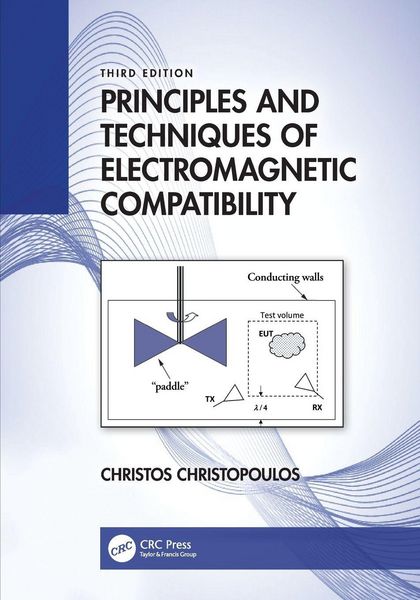
Principles and Techniques of Electromagnetic Compatibility
-
- Hardcover
- Taschenbuch ausgewählt
- eBook
-
Sprache:Englisch
56,99 €
UVP
75,80 €
inkl. gesetzl. MwSt.,
Beschreibung
Produktdetails
Einband
Taschenbuch
Erscheinungsdatum
26.08.2024
Abbildungen
305 SW-Abb., 35 SW-Fotos, 270 SW-Zeichn., 11 Tabellen
Verlag
Taylor & FrancisSeitenzahl
486
Maße (L/B/H)
25,4/17,8/2,7 cm
Gewicht
906 g
Auflage
3. Auflage
Sprache
Englisch
ISBN
978-1-03-231721-2
This book provides a sound grasp of the fundamental concepts, applications, and practice of EMC. Developments in recent years have resulted in further increases in electrical component density, wider penetration of wireless technologies, and a significant increase in complexity of electrical and electronic equipment. New materials, which can be customized to meet EMC needs, have been introduced. Considerable progress has been made in developing numerical tools for complete system EMC simulation. EMC is now a central consideration in all industrial sectors. Maintaining the holistic approach of the previous edition of Principles and Techniques of Electromagnetic Compatibility, the Third Edition updates coverage of EMC to reflects recent important developments.
What is new in the Third Edition?
- A comprehensive treatment of new materials (meta- and nano-) and their impact on EMC
- Numerical modelling of complex systems and complexity reduction methods
- Impact of wireless technologies and the Internet of Things (IoT) on EMC
- Testing in reverberation chambers, and in the time-domain
- A comprehensive treatment of the scope and development of stochastic models for EMC
- EMC issues encountered in automotive, railway, aerospace, and marine applications
- Impact of EMC and Intentional EMI (IEMI) on infrastructure, and risk assessment
In addition to updating material, new references, examples, and appendices were added to offer further support to readers interested in exploring further. As in previous editions, the emphasis is on building a sound theoretical framework, and demonstrating how it can be turned to practical use in challenging applications. The expectation is that this approach will serve EMC engineers through the inevitable future technological shifts and developments.
Noch keine Bewertungen vorhanden
Verfassen Sie die erste Bewertung zu diesem Artikel
Helfen Sie anderen Kundinnen und Kunden durch Ihre Meinung.
Kurze Frage zu unserer Seite
Vielen Dank für dein Feedback
Wir nutzen dein Feedback, um unsere Produktseiten zu verbessern. Bitte habe Verständnis, dass wir dir keine Rückmeldung geben können. Falls du Kontakt mit uns aufnehmen möchtest, kannst du dich aber gerne an unseren Kund*innenservice wenden.
zum Kundenservice