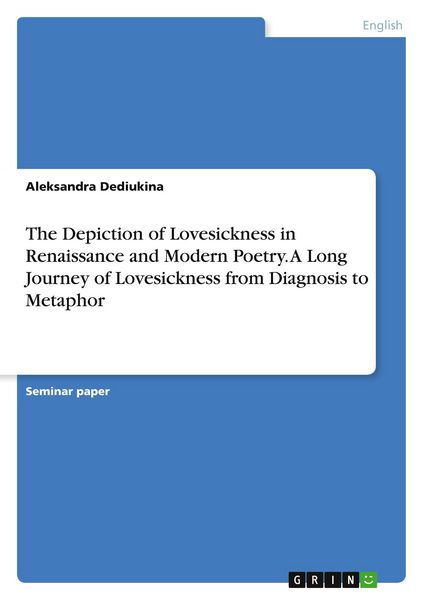
The Depiction of Lovesickness in Renaissance and Modern Poetry. A Long Journey of Lovesickness from Diagnosis to Metaphor
-
- Taschenbuch ausgewählt
- eBook
-
Sprache:Englisch
16,95 €
inkl. gesetzl. MwSt.,
Beschreibung
Produktdetails
Einband
Taschenbuch
Erscheinungsdatum
20.05.2024
Verlag
GRINSeitenzahl
24
Maße (L/B/H)
21/14,8/0,3 cm
Gewicht
51 g
Auflage
1. Auflage
Sprache
Englisch
ISBN
978-3-389-02587-1
Once commonly perceived as a serious medical condition, lovesickness transformed into a widely used fruitful metaphor in poetry and song lyrics. The Renaissance doctors viewed erotic passion as an unwanted condition with a range of symptoms, certain pattern of development, and suitable ways of treatment. This can be stated with certainty by virtue of a wide number of specialised texts focused on the subject that were written at that time. Among them, in particular, there is "Treatise on Lovesickness" (quoted as T.L.) by a French physician Jacques Ferrand - in the first part of the theory chapter titled "Renaissance Physicians Warn", the most relevant key points of this work would be provided. Similar findings from other medical works of the time will also be briefly mentioned. Apart from scientific texts concerned with lovesickness, a clinical approach to love and its manifestation in the 'patient's' body can be registered in Renaissance drama and poetry. William Shakespeare's most famous texts, such as "Romeo and Juliet", "Othello", as well as his love sonnets, are evidence to that. The second part of the theory chapter titled "Renaissance Lovers Suffer" introduces the analysis of such instances in Shakespeare's and Sir Philip Sydney's works. The symptoms of lovesickness found in their texts will be explored in comparison with the medical description given by Ferrand. Today, the scientific community does not identify romantic passion as a disease any longer. However, we widely and often unconsciously conceptualise love as such. For poets, it opens a richest source of metaphoric language. 'Love is sickness' rapidly became one of the most common metaphors in love poetry, allowing for endless artistic solutions, but at the same time engendering the risk of repetitiveness and the effect of 'familiarisation', in Viktor Shklovsky's terms.
Noch keine Bewertungen vorhanden
Verfassen Sie die erste Bewertung zu diesem Artikel
Helfen Sie anderen Kundinnen und Kunden durch Ihre Meinung.
Kurze Frage zu unserer Seite
Vielen Dank für dein Feedback
Wir nutzen dein Feedback, um unsere Produktseiten zu verbessern. Bitte habe Verständnis, dass wir dir keine Rückmeldung geben können. Falls du Kontakt mit uns aufnehmen möchtest, kannst du dich aber gerne an unseren Kund*innenservice wenden.
zum Kundenservice