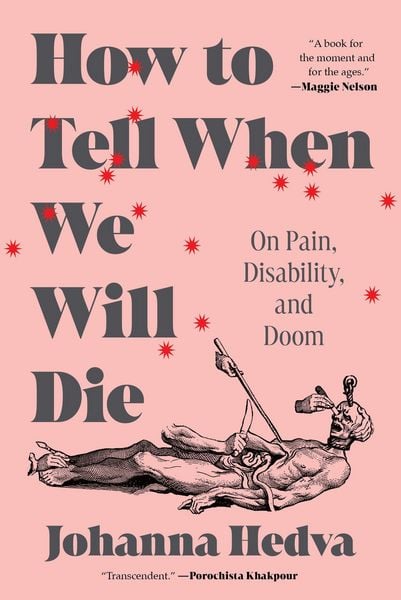
How to Tell When We Will Die On Pain, Disability, and Doom
-
- Hardcover ausgewählt
- Taschenbuch
- eBook
-
Sprache:Englisch
21,99 €
UVP
27,00 €
inkl. gesetzl. MwSt.,
Lieferung nach Hause
Beschreibung
Produktdetails
Verkaufsrang
40332
Einband
Gebundene Ausgabe
Erscheinungsdatum
24.09.2024
Verlag
Random House LLC USSeitenzahl
68
Maße (L/B/H)
23,4/15,3/3,3 cm
Gewicht
610 g
Farbe
Altrosa
Sprache
Englisch
ISBN
978-1-63893-116-4
“A book for the moment and for the ages. It’s questing, pissed, propulsive, funny, generous, pervy, and original—full of love and pain in all their entwined glory.” —Maggie Nelson, author of The Argonauts
WINNER OF THE AMBER HOLLIBAUGH AWARD FOR LGBTQ+ SOCIAL JUSTICE WRITING
The long-awaited essay collection from one of the most influential voices in disability activism that detonates a bomb in our collective understanding of care and illness, showing us that sickness is a fact of life.
In the wake of the 2014 Ferguson riots, and sick with a chronic condition that rendered them housebound, Johanna Hedva turned to the page to ask: How do you throw a brick through the window of a bank if you can’t get out of bed? It was not long before this essay, “Sick Woman Theory”, became a seminal work on disability, because in reframing illness as not just a biological experience but a social one, Hedva argues that under capitalism—a system that limits our worth to the productivity of our bodies—we must reach for the revolutionary act of caring for ourselves and others.
How to Tell When We Will Die expands upon Hedva’s paradigm-shifting perspective in a series of slyly subversive and razor-sharp essays that range from the theoretical to the personal—from Deborah Levy and Susan Sontag to wrestling, kink, mysticism, death, and the color yellow. Drawing from their experiences with America’s byzantine healthcare system, and considering archetypes they call The Psychotic Woman, The Freak, and The Hag in Charge, Hedva offers a bracing indictment of the politics that exploit sickness—relying on and fueling ableism—to the detriment of us all.
With the insight of Anne Boyer’s The Undying and Leslie Jamison’s The Empathy Exams, and the wit of Samantha Irby, Hedva’s debut collection upends our collective understanding of disability. In their radical reimagining of a world where care and pain are symbiotic, and our bodies are allowed to live free and well, Hedva implores us to remember that illness is neither an inconvenience or inevitability, but an enlivening and elemental part of being alive.
Noch keine Bewertungen vorhanden
Verfassen Sie die erste Bewertung zu diesem Artikel
Helfen Sie anderen Kundinnen und Kunden durch Ihre Meinung.
Kurze Frage zu unserer Seite
Vielen Dank für dein Feedback
Wir nutzen dein Feedback, um unsere Produktseiten zu verbessern. Bitte habe Verständnis, dass wir dir keine Rückmeldung geben können. Falls du Kontakt mit uns aufnehmen möchtest, kannst du dich aber gerne an unseren Kund*innenservice wenden.
zum Kundenservice