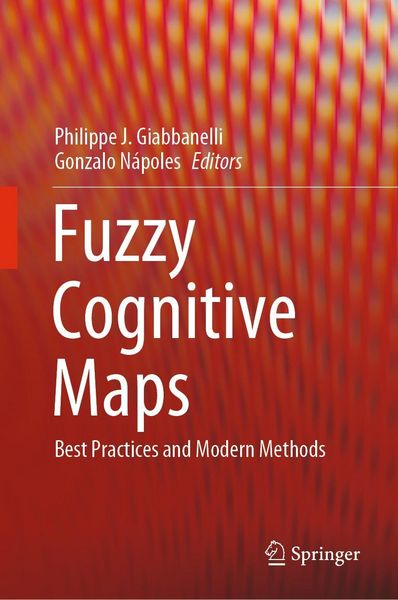
Fuzzy Cognitive Maps Best Practices and Modern Methods
-
- Hardcover
- Taschenbuch
- eBook ausgewählt
-
Form:Einzelkauf Download
-
Sprache:Englisch
128,39 €
inkl. gesetzl. MwSt.Beschreibung
Produktdetails
Format
Kopierschutz
Nein
Family Sharing
Nein
Text-to-Speech
Nein
Erscheinungsdatum
29.01.2024
Herausgeber
Philippe J. Giabbanelli + weitereVerlag
SpringerSeitenzahl
219 (Printausgabe)
Dateigröße
6804 KB
Sprache
Englisch
EAN
9783031489631
This book starts with the rationale for creating an FCM by contrast to other techniques for participatory modeling, as this rationale is a key element to justify the adoption of techniques in a research paper. Fuzzy cognitive mapping is an active research field with over 20,000 publications devoted to externalizing the qualitative perspectives or "mental models" of individuals and groups. Since the emergence of fuzzy cognitive maps (FCMs) back in the 80s, new algorithms have been developed to reduce bias, facilitate the externalization process, or efficiently utilize quantitative data via machine learning. It covers the development of an FCM with participants through a traditional in-person setting, drawing from the experience of practitioners and highlighting solutions to commonly encountered challenges. The book continues with introducing principles of simulations with FCMs as a tool to perform what-if scenario analysis, while extending those principles to more elaborated simulation scenarios where FCMs and agent-based modeling are combined. Once an FCM model is obtained, the book then details the analytical tools available for practitioners (e.g., to identify the most important factors) and provides examples to aid in the interpretation of results. The discussion concerning relevant extensions is equally pertinent, which are devoted to increasing the expressiveness of the FCM formalism in problems involving uncertainty. The last four chapters focus on building FCM models from historical data. These models are typically needed when facing multi-output prediction or pattern classification problems. In that regard, the book smoothly guides the reader from simple approaches to more elaborated algorithms, symbolizing the noticeable progress of this field in the last 35 years. Problems, recent references, and functional codes are included in each chapter to provide practice and support further learning from practitioners and researchers.
Noch keine Bewertungen vorhanden
Verfassen Sie die erste Bewertung zu diesem Artikel
Helfen Sie anderen Kundinnen und Kunden durch Ihre Meinung.
Kurze Frage zu unserer Seite
Vielen Dank für dein Feedback
Wir nutzen dein Feedback, um unsere Produktseiten zu verbessern. Bitte habe Verständnis, dass wir dir keine Rückmeldung geben können. Falls du Kontakt mit uns aufnehmen möchtest, kannst du dich aber gerne an unseren Kund*innenservice wenden.
zum Kundenservice