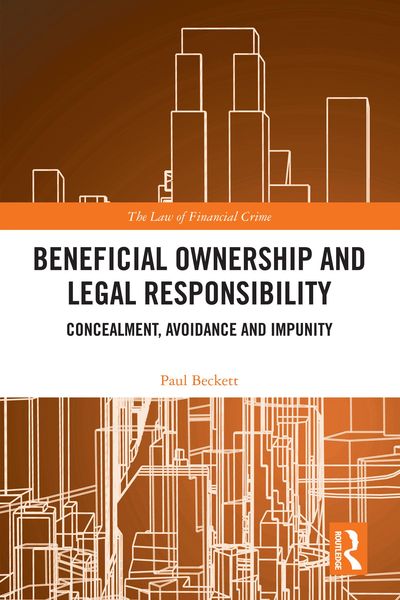
Beneficial Ownership and Legal Responsibility Concealment, Avoidance and Impunity
-
- Hardcover
- Taschenbuch
- eBook ausgewählt
-
Form:Einzelkauf Download
-
Sprache:Englisch
-
eBook Format:PDF
- PDF 63,99 € ausgewählt
- ePUB 3 63,99 €
63,99 €
inkl. gesetzl. MwSt.Beschreibung
Produktdetails
Format
Kopierschutz
Ja
Family Sharing
Nein
Text-to-Speech
Nein
Erscheinungsdatum
12.03.2024
Verlag
Taylor & Francis eBooksSeitenzahl
362 (Printausgabe)
Auflage
1. Auflage
Sprache
Englisch
EAN
9781040000489
This book explores the connection between ownership, on one hand, and immunity from legal responsibility, on the other. It presents a definition of the concept of beneficial ownership, the reasons for its concealment, and failures in international legal structures and arrangements.
Globally, states confront complex crimes, such as corruption, tax evasion, doctrinal fanaticism, slave trafficking, terrorism and, war. At the personal level, men and women may seek to escape their creditors, to disinherit unwanted heirs, to cheat divorced partners, and to appear straightforward when this is not the case. The response of politicians and regulators has been a global state initiative to identify beneficial owners via public registers to promote transparency and accountability. Yet, at the same time, there is an equally powerful global and personal counter-initiative to promote beneficial ownership avoidance. Where there is no owner, there is no accountability.
This book examines what "ownership" means in legal terms across multiple legal systems and explains why singling out ownership as being pivotal to state and personal accountability is a strategy both flawed and disingenuous. It is argued that an apparent lack of political will coupled with shape-shifting definitions of ownership have resulted in tokenism. Particular attention is paid to those "orphan" structures which have evolved from standard models, or which have been designed for the purpose in each case of facilitating ownership concealment and avoidance. The author explains how the virtual world of the blockchain, crypto-assets and cryptocurrency, and virtual entities such as the Decentralised Autonomous Organisations (DAOs), all of which elude legal classification, have opened a new world of possibilities.
Applicable across all jurisdictions and legal systems, the book will be a valuable resource for academics, researchers, and policy-makers working in the areas of financial crime, regulation, compliance, business, and accountancy.
Noch keine Bewertungen vorhanden
Verfassen Sie die erste Bewertung zu diesem Artikel
Helfen Sie anderen Kundinnen und Kunden durch Ihre Meinung.
Kurze Frage zu unserer Seite
Vielen Dank für dein Feedback
Wir nutzen dein Feedback, um unsere Produktseiten zu verbessern. Bitte habe Verständnis, dass wir dir keine Rückmeldung geben können. Falls du Kontakt mit uns aufnehmen möchtest, kannst du dich aber gerne an unseren Kund*innenservice wenden.
zum Kundenservice