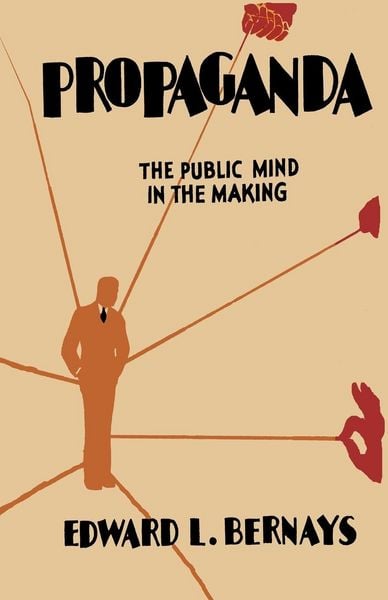
Propaganda
-
- Hardcover
- Taschenbuch ausgewählt
- eBook
- Hörbuch
-
Sprache:Englisch
16,19 €
inkl. gesetzl. MwSt.,
Lieferung nach Hause
Beschreibung
Produktdetails
Verkaufsrang
39935
Einband
Taschenbuch
Erscheinungsdatum
01.01.2024
Verlag
Martino Fine BooksSeitenzahl
140
Maße (L/B/H)
21,6/14/0,8 cm
Gewicht
186 g
Farbe
Karamell / Schwarz
Sprache
Englisch
ISBN
978-1-68422-841-6
2024 Reprint of the 1928 Edition. Propaganda, an influential book written by Bernays in 1928, incorporated the literature from social science and psychological manipulation into an examination of the techniques of public communication. Bernays wrote the book in response to the success of some of his earlier works such as Crystallizing Public Opinion (1923) and A Public Relations Counsel (1927). Propaganda explored the psychology behind manipulating masses and the ability to use symbolic action and propaganda to influence politics, consumer choices and corporate image, which we now call "branding". Walter Lippmann was Bernays' unacknowledged American mentor and his work The Phantom Public greatly influenced the ideas expressed in Propaganda a year later. The work propelled Bernays into media historians' view of him as the "father of public relations." Bernay's manual of mass manipulation provides a detailed examination of how public discourse and opinion are shaped and controlled in politics, business, art, education, and science. In a world dominated by political spin and media manipulation, Propaganda is an essential read for all who wish to understand how power is used by the ruling elite of our society. The nephew of Sigmund Freud, Edward Bernays (1891-1995) pioneered the scientific technique of shaping and manipulating public opinion, which he called "engineering of consent.'" During World War I, he was an integral part--along with Walter Lippmann--of the U.S. Committee on Public Information (CPI), a powerful propaganda machine that advertised and sold the war to the American people as one that would "Make the World Safe for Democracy." The marketing strategies for all future wars would be based on the CPI model. Over the next half century, Bernays, combining the techniques he had learned in the CPI with the ideas of Lippmann and Freud, fashioned a career as an outspoken proponent of the engineering of consent for political and corporate influence of the population, earning the moniker "father of public relations." Among his powerful clients were President Calvin Coolidge, Procter & Gamble, CBS, the American Tobacco Company, and General Electric, and the United Fruit Company.
Noch keine Bewertungen vorhanden
Verfassen Sie die erste Bewertung zu diesem Artikel
Helfen Sie anderen Kundinnen und Kunden durch Ihre Meinung.
Kurze Frage zu unserer Seite
Vielen Dank für dein Feedback
Wir nutzen dein Feedback, um unsere Produktseiten zu verbessern. Bitte habe Verständnis, dass wir dir keine Rückmeldung geben können. Falls du Kontakt mit uns aufnehmen möchtest, kannst du dich aber gerne an unseren Kund*innenservice wenden.
zum Kundenservice