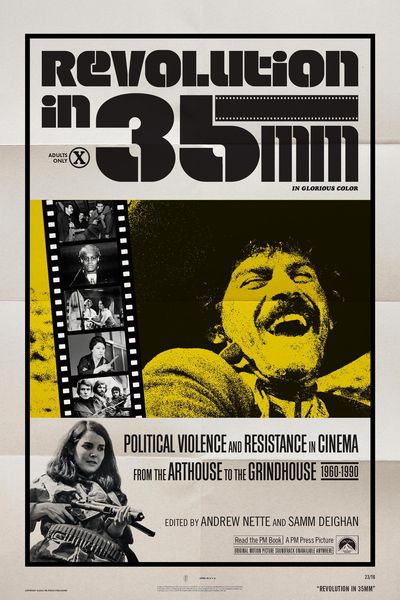
Revolution in 35mm Political Violence and Resistance in Cinema from the Arthouse to the Grindhouse, 1969-1990
-
- Taschenbuch ausgewählt
- eBook
-
Sprache:Englisch
36,99 €
inkl. gesetzl. MwSt.,
Beschreibung
Produktdetails
Einband
Taschenbuch
Erscheinungsdatum
17.09.2024
Abbildungen
200 Illustrations, unspecified
Herausgeber
Andrew Nette + weitereVerlag
Ingram Publishers ServicesSeitenzahl
384
Maße (L/B/H)
23/15,6/2,7 cm
Gewicht
642 g
Sprache
Englisch
EAN
9798887440606
Revolution in 35mm: Political Violence and Resistance in Cinema from the Arthouse to the Grindhouse, 1960–1990 examines how political violence and resistance was represented in arthouse and cult films from 1960 to 1990.
This historical period spans the Algerian war of independence and the early wave of post-colonial struggles that reshaped the Global South, through the collapse of Soviet Communism in the late ‘80s. It focuses on films related to the rise of protest movements by students, workers, and leftist groups, as well as broader countercultural movements, Black Power, the rise of feminism, and so on. The book also includes films that explore the splinter groups that engaged in violent, urban guerrilla struggles throughout the 1970s and 1980s, as the promise of widespread radical social transformation failed to materialize: the Weathermen, the Black Liberation Army and the Symbionese Liberation Army in the United States, the Red Army Faction in West Germany and Japan, and Italy’s Red Brigades.
Many of these movements were deeply connected with and expressed their values through art, literature, popular culture, and, of course, cinema. Twelve authors, including academics and well know film critics, deliver a diverse examination of how filmmakers around the world reacted to the political violence and resistance movements of the period and how this was expressed on screen. This includes looking at the financing, distribution, and screening of these films, audience and critical reaction, the attempted censorship or suppression of much of this work, and how directors and producers eluded these restrictions.
Including over two hundred illustrations, the book examines filmmaking movements like the French, Japanese, German, and Yugoslavian New Waves; subgenres like spaghetti westerns, Italian poliziotteschi, Blaxploitation, and mondo movies; and films that reflect the values of specific movements like feminists, Vietnam War protesters, and Black militants. The work of influential and well-known political filmmakers such as Costa-Gavras, Gillo Pontecorvo, and Glauber Rocha is examined side by side with grindhouse cinema and lessor known titles by a host of all-but forgotten filmmakers, including many from the Global South, that are deserving of rediscovery.
Noch keine Bewertungen vorhanden
Verfassen Sie die erste Bewertung zu diesem Artikel
Helfen Sie anderen Kundinnen und Kunden durch Ihre Meinung.
Kurze Frage zu unserer Seite
Vielen Dank für dein Feedback
Wir nutzen dein Feedback, um unsere Produktseiten zu verbessern. Bitte habe Verständnis, dass wir dir keine Rückmeldung geben können. Falls du Kontakt mit uns aufnehmen möchtest, kannst du dich aber gerne an unseren Kund*innenservice wenden.
zum Kundenservice