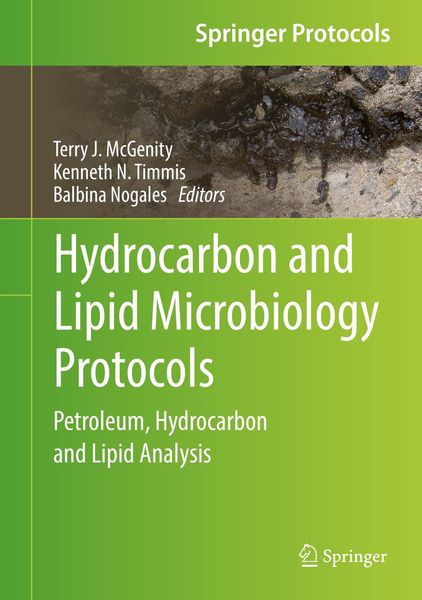
Hydrocarbon and Lipid Microbiology Protocols Petroleum, Hydrocarbon and Lipid Analysis
-
- Hardcover
- Taschenbuch
- eBook ausgewählt
-
Form:Einzelkauf Download
-
Sprache:Englisch
96,29 €
inkl. gesetzl. MwSt.Beschreibung
Produktdetails
Format
Kopierschutz
Nein
Family Sharing
Nein
Text-to-Speech
Nein
Erscheinungsdatum
29.12.2016
Herausgeber
Terry J. McGenity + weitereVerlag
SpringerSeitenzahl
317 (Printausgabe)
Dateigröße
9442 KB
Sprache
Englisch
EAN
9783662527931
This Volume presents methods for analysing and quantifying petroleum, hydrocarbons and lipids, based on their chemical and physical properties as well as their biological effects. It features protocols for extracting hydrocarbons from solid matrices, water and air, and a dedicated chapter focusing on volatile organic compounds. Several approaches for separating and detecting diverse classes of hydrocarbons and lipids are described, including: (tandem) gas chromatography (GC) coupled with mass spectrometry (MS) or flame-ionisation detection, Fourier-transform induction-coupled-resonance MS, and fluorescence-based techniques. The book details high-performance liquid chromatography MS for microbial lipids, as well as a combination of techniques for naphthenic acids. Two chapters focus on quantifying bioavailable hydrocarbon fractions by using cyclodextrin sorbents and bacterial bioreporters, respectively, while a closing chapter explains how compound-specific stable-isotope analysis can be used to measure the fate of hydrocarbons in the environment.
Hydrocarbon and Lipid Microbiology Protocols
There are tens of thousands of structurally different hydrocarbons, hydrocarbon derivatives and lipids, and a wide array of these molecules are required for cells to function. The global hydrocarbon cycle, which is largely driven by microorganisms, has a major impact on our environment and climate. Microbes are responsible for cleaning up the environmental pollution caused by the exploitation of hydrocarbon reservoirs and will also be pivotal in reducing our reliance on fossil fuels by providing biofuels, plastics and industrial chemicals. Gaining an understanding of the relevant functions of the wide range of microbes that produce, consume and modify hydrocarbons and related compounds will be key to responding to these challenges. This comprehensive collection of current and emerging protocols will facilitate acquisition of this understanding and exploitation of useful activities of such microbes.
Kundinnen und Kunden meinen
Verfassen Sie die erste Bewertung zu diesem Artikel
Helfen Sie anderen Kund*innen durch Ihre Meinung
Kurze Frage zu unserer Seite
Vielen Dank für dein Feedback
Wir nutzen dein Feedback, um unsere Produktseiten zu verbessern. Bitte habe Verständnis, dass wir dir keine Rückmeldung geben können. Falls du Kontakt mit uns aufnehmen möchtest, kannst du dich aber gerne an unseren Kund*innenservice wenden.
zum Kundenservice