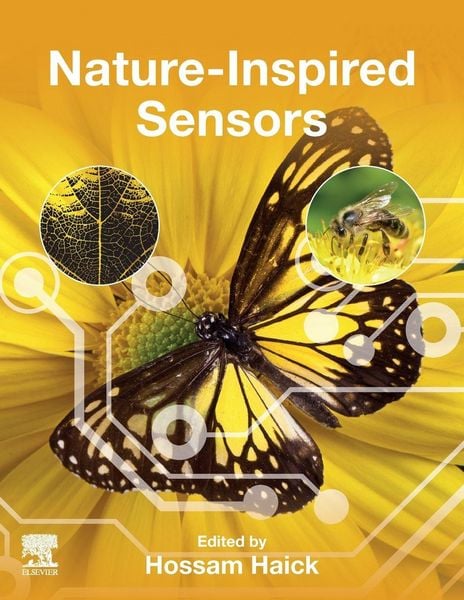
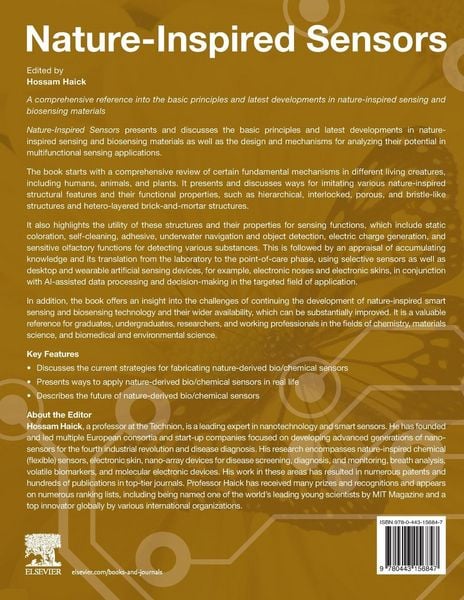
• Produktbild: Nature-Inspired Sensors
  • Produktbild: Nature-Inspired Sensors

Nature-Inspired Sensors

229,99 €

inkl. gesetzl. MwSt., Versandkostenfrei

Lieferung nach Hause

Portrait

Hossam Haick, professor at the Technion, is an expert in the field of nanotechnology and smart sensors. He is the founder and leader of six European consortia and five start-up companies for developing advanced generations of nanosensors for the fourth industrial revolution and disease diagnosis. His research expertise includes nature-inspired chemical (flexible) sensors, electronic skin, nano-array devices for screening, diagnosis and monitoring of disease, breath analysis, volatile biomarkers, and molecular electronic devices. His studies in these fields have generated more than 52 patents, 280 publications in top-level journals, and one book. Prof. Haick is the recipient of more than 82 prizes and recognitions and on more than 42 ranking lists, including the world’s 35 leading young scientists by MIT Magazine (2008), top-100 innovators in the world (2015-2018) by various international organizations

Produktdetails

Einband

Taschenbuch

Erscheinungsdatum

25.10.2024

Herausgeber

Hossam Haick

Verlag

Elsevier

Seitenzahl

616

Maße (L/B/H)

27,9/21,6/3,1 cm

Gewicht

1408 g

Sprache

Englisch

ISBN

978-0-443-15684-7

Portrait

Produktdetails

Einband

Taschenbuch

Erscheinungsdatum

25.10.2024

Herausgeber

Hossam Haick

Verlag

Elsevier

Seitenzahl

616

Maße (L/B/H)

27,9/21,6/3,1 cm

Gewicht

1408 g

Sprache

Englisch

ISBN

978-0-443-15684-7

Herstelleradresse

Libri GmbH
Europaallee 1
36244 Bad Hersfeld
DE

Email: gpsr@libri.de

Noch keine Bewertungen vorhanden

Verfassen Sie die erste Bewertung zu diesem Artikel

Helfen Sie anderen Kundinnen und Kunden durch Ihre Meinung.

Kundinnen und Kunden meinen

Bewertungen (0)

Die Leseprobe wird geladen.
  • Produktbild: Nature-Inspired Sensors
  • Produktbild: Nature-Inspired Sensors
  • Section I Principles of nature

    1. Insights from animals for building services
    2. Plants
    3. From alalus to sapiens: human evolution and uniqueness
    4. Principles of nature on human sensing capabilities
    Section II: Inspirations by architecture and structure
    1. Naturally ordered cracks
    2. Particle-based islands and nanowire interconnections
    3. Hierarchical structures
    Section III: Inspirations by function
    1. Stretchability
    2. Biocompatibility
    3. Biodegradability
    4. Natural-inspired self-healing sensors
    5. Waterproofing function
    6. Self-cleaning function
    Section IV: Inspiration by recognition elements
    1. Nucleic acid detection for microbial diagnostics
    2. Nanozymes
    3. Peptides
    4. Aptamers, DNAzymes and aptazymes
    5. Molecularly imprinted polymers
    6. Ionic molecules
    Section V Nature-inspired sensors
    1. Electrochemical sensors
    2. Chemiresistors
    3. Colorimetric sensors
    4. Optical sensors
    5. Fluorescent sensors
    6. Pressure tactile sensors
    7. Medical sensors
    8. Computation sensors
    Section VI Nature-inspired artificial senses
    1. Visual-based electronic sensory system
    2. Auditory based electronic sensory system
    3. Electronic nose
    4. Electronic tongues: basics, materials, and applications
    5. Gustatory-based electronic tongues
    6. Electronic skin
    Section VII Towards application if real-life
    1. Fabrication strategies
    2. Mass production of nature inspired sensors
    3. Stand-alone maintenance-free long-life sensory system
    4. Artificial intelligence-assisted data fusion
    Section VIII Future perspectives
    1. Future perspectives