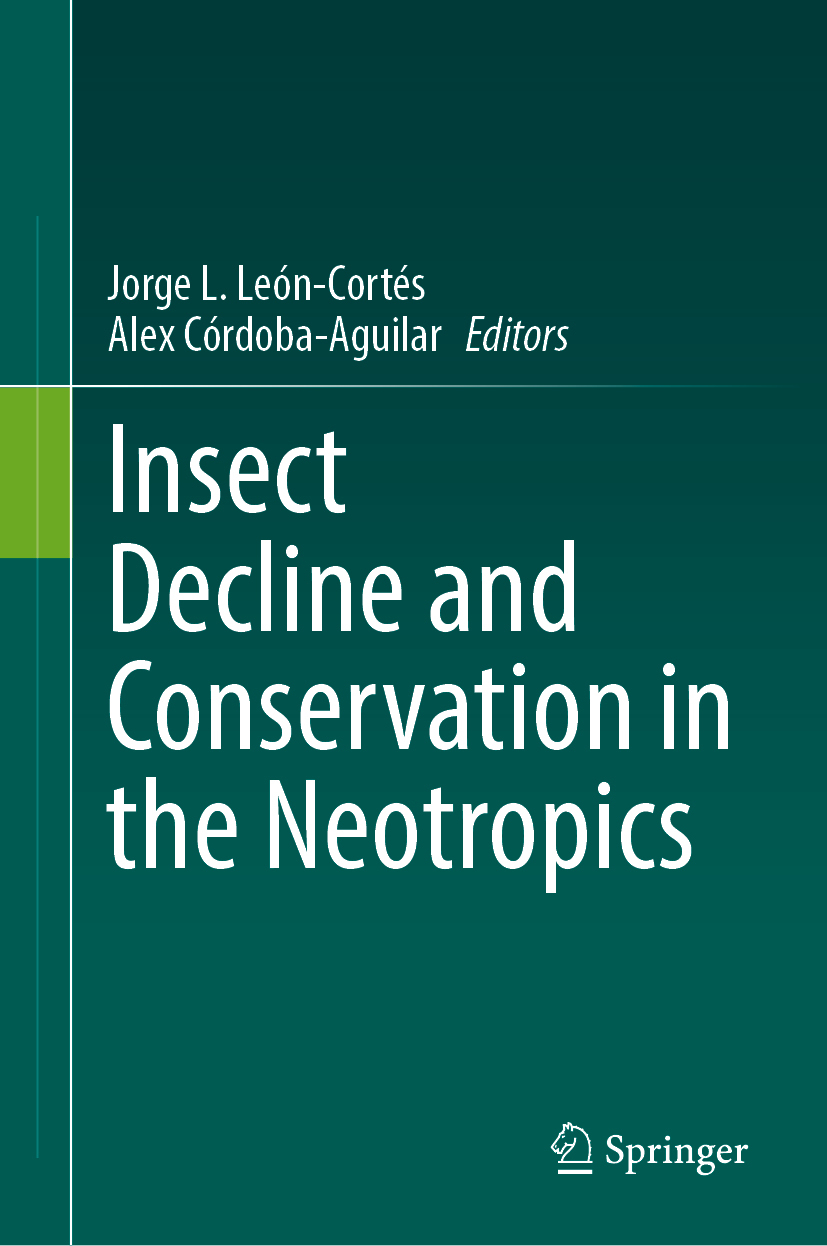
Produktbild: Insect Decline and Conservation in the Neotropics
- 12%

Insect Decline and Conservation in the Neotropics

12% sparen

159,99 € UVP 181,89 €

inkl. gesetzl. MwSt., Versandkostenfrei

Lieferung nach Hause

Beschreibung

Produktdetails

Einband

Gebundene Ausgabe

Erscheinungsdatum

22.04.2024

Herausgeber

Jorge L. León-Cortés + weitere

Verlag

Springer

Seitenzahl

311

Maße (L/B/H)

24,1/16/2,2 cm

Gewicht

711 g

Sprache

Englisch

ISBN

978-3-031-49254-9

Beschreibung

Portrait

Jorge L. León-Cortés is a senior ecologist working on insect conservation, population dynamics, and landscape ecology, with an international publication record in entomology, insect ecology and biodiversity conservation. He is Co-Editor-in-Chief of the Journal of Insect Conservation, reviewer of several relevant ecological and conservation journals and Coeditor of the book ‘Biodiversity and Conservation of the Yucatán Peninsula’ (2015, Springer).

Alex Córdoba-Aguilar  is a senior ecologist working on insect conservation, behavior, physiology and evolution, and insect vector control. He is author of over 150 scientific papers and coeditor of three books (e.g. Insect Behavior: from mechanisms to ecological and evolutionary mechanisms). He serves as editorial member of the following journals: Ecological Entomology, Acta Tropica and Odonatologica.

Produktdetails

Einband

Gebundene Ausgabe

Erscheinungsdatum

22.04.2024

Herausgeber

Verlag

Springer

Seitenzahl

311

Maße (L/B/H)

24,1/16/2,2 cm

Gewicht

711 g

Sprache

Englisch

ISBN

978-3-031-49254-9

Herstelleradresse

Springer-Verlag KG
Sachsenplatz 4-6
1201 Wien
AT

Email: [email protected]

Kundinnen und Kunden meinen

0 Bewertungen

Informationen zu Bewertungen

Zur Abgabe einer Bewertung ist eine Anmeldung im Konto notwendig. Die Authentizität der Bewertungen wird von uns nicht überprüft. Wir behalten uns vor, Bewertungstexte, die unseren Richtlinien widersprechen, entsprechend zu kürzen oder zu löschen.

Die Bewertungen sind nach Format, Anzahl Sterne und Datum sortiert.

Verfassen Sie die erste Bewertung zu diesem Artikel

Helfen Sie anderen Kund*innen durch Ihre Meinung

Kundinnen und Kunden meinen

0 Bewertungen filtern

Weitere Artikel findest du in

  • Produktbild: Insect Decline and Conservation in the Neotropics
  • Part I. Introduction.- Chapter 1. Conservation and Threats That Insects Face in the Neotropics.- Part II. Stressors of Decline on Selected Taxa.- Chapter 2. Habitat Fragmentation and Insect Biodiversity Change in Mexican Landscapes.- Chapter 3. Neotropical Wasps: Identifying Trends and Gaps for Their Conservation.- Chapter 4. Arachnids at the Edge: View and Perspectives, with Emphasis on Spiders and Scorpions.- Chapter 5. Declining Dung Beetle (Coleoptera: Scarabaeidae) Abundance and Diversity in the Neotropics: Causes and Conservation Strategies.- Chapter 6. Monarch Butterfly Forest Occupation at the Mexican Overwintering Sites: A New Reality.- Chapter 7. Habitat Loss and Fragmentation in Chaco Forests: A Review of the Responses of Insect Communities and Consequences for Ecosystem Processes.- Chapter 8. Urban Insect Communities in the Neotropics: A Systematic Literature Review and a Green Path to Promote Biodiversity Conservation.- Chapter 9. Insect Diversity Changesin Mexican Agro-Landscapes.- Part III. Decline and Conservation of Insects in Neotropical Biodiversity Hotspots.- Chapter 10. Fruit-Feeding Butterfly Assemblages: Trends, Changes, and the Importance of Monitoring Schemes in Neotropical Environments.- Chapter 11. Diversity and Conservation of Mesoamerican Bees: Relative Effects of Three Major Threats Within the Potential Distribution of Bee Species.- Chapter 12. Threats to Ant Diversity in Mesoamerica.- Chapter 13. The Role of Endemism and Biodiversity Hotspots In Conservation: A Case Study with Neotropical Leaf Litter Weevils.- Chapter 14. Natural History Collections as Resources for Assessing Biodiversity Hotspots and Insect Declines: Case Studies, Opportunities and Challenges.- Chapter 15. Biodiversity of Aquatic Insects in the Neotropics: Perspectives and Challenges.