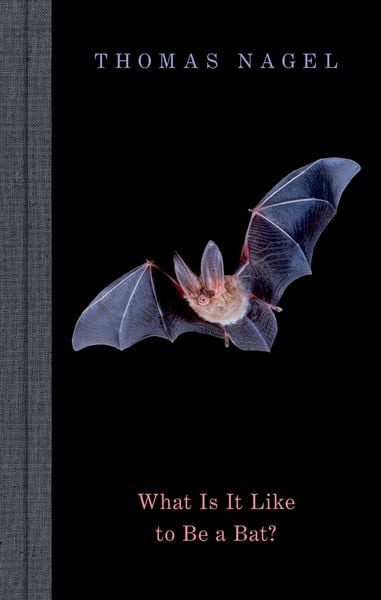
What Is It Like to Be a Bat?
14,99 €
inkl. gesetzl. MwSt.,
Lieferung nach Hause
Beschreibung
Produktdetails
Verkaufsrang
18335
Einband
Gebundene Ausgabe
Erscheinungsdatum
30.09.2024
Verlag
Oxford AcademicSeitenzahl
80
Maße (L/B/H)
18,3/11,9/1,2 cm
Gewicht
159 g
Sprache
Englisch
ISBN
978-0-19-775279-1
A 50th anniversary edition of one of the most widely influential articles of 20th Century philosophy
"Consciousness is what makes the mind-body problem really intractable." So begins Thomas Nagel's classic 1974 essay "What is it Like to be a Bat?" Nagel's essay initiated the now widespread attention to consciousness as a central problem for philosophy, psychology, and neuroscience; it also influenced the recognition of the consciousness of nonhuman creatures as an important subject of study. Nagel argued that the essential subjectivity of conscious experience -- what it is like for the creature undergoing it -- means that reductionist theories of mind, which attempt to analyze it in physical terms, can never succeed. It follows that the physical sciences cannot provide a complete description of reality, and that the physical conception of objective reality must be transcended if science is going to comprehend the mind.
This edition reissues this classic and widely influential article on its 50th anniversary, along with a new preface discussing the origins and influence of the essay, as well as "Further Thoughts: The Psychophysical Nexus," a supplementary essay which describes Nagel's later thoughts about how to respond to the problem posed by "What Is It Like to Be a Bat?" This second essay suggests that the most promising path forward for the mind-body problem, if one accepts the irreducible subjectivity of consciousness, is to seek a necessary connection between mental and neurophysiogical states through a more fundamental type of state which is neither mental nor physical but necessitates them both as essential aspects. In other words, a state that is physical from the outside and mental from the inside, just as we are. This would be a form of monism, requiring the formation of new concepts, since our present concepts of the mental and the physical do not entail such a necessary connection. The essay explains why the relation between the mental and the physical may be necessary, even though our present concepts make it appear contingent.
Kundinnen und Kunden meinen
Verfassen Sie die erste Bewertung zu diesem Artikel
Helfen Sie anderen Kund*innen durch Ihre Meinung
Kurze Frage zu unserer Seite
Vielen Dank für dein Feedback
Wir nutzen dein Feedback, um unsere Produktseiten zu verbessern. Bitte habe Verständnis, dass wir dir keine Rückmeldung geben können. Falls du Kontakt mit uns aufnehmen möchtest, kannst du dich aber gerne an unseren Kund*innenservice wenden.
zum Kundenservice