KI-Beratung Beta

  • Produktbild: Towards Tree-level Evapotranspiration Estimation with Small UAVs in Precision Agriculture
  • Produktbild: Towards Tree-level Evapotranspiration Estimation with Small UAVs in Precision Agriculture
- 10%

Towards Tree-level Evapotranspiration Estimation with Small UAVs in Precision Agriculture

10% sparen

133,99 € UVP 149,79 €

inkl. gesetzl. MwSt., Versandkostenfrei


Beschreibung

Estimating evapotranspiration (ET) has been one of the most critical research areas in agriculture because of water scarcity, the growing population, and climate change. The accurate estimation and mapping of ET are necessary for crop water management. Traditionally, researchers use water balance, soil...

Beschreibung

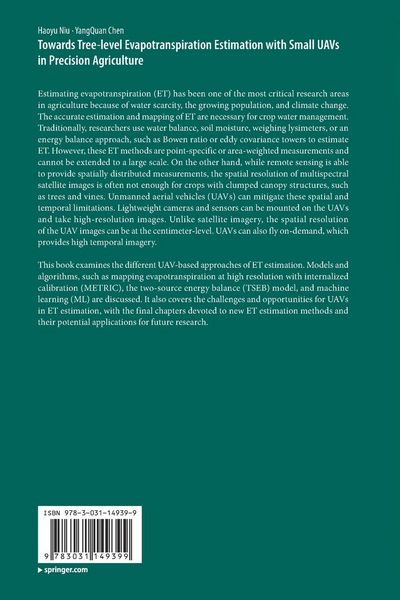
Estimating evapotranspiration (ET) has been one of the most critical research areas in agriculture because of water scarcity, the growing population, and climate change. The accurate estimation and mapping of ET are necessary for crop water management. Traditionally, researchers use water balance, soil moisture, weighing lysimeters, or an energy balance approach, such as Bowen ratio or eddy covariance towers to estimate ET. However, these ET methods are point-specific or area-weighted measurements and cannot be extended to a large scale. On the other hand, while remote sensing is able to provide spatially distributed measurements, the spatial resolution of multispectral satellite images is often not enough for crops with clumped canopy structures, such as trees and vines. Unmanned aerial vehicles (UAVs) can mitigate these spatial and temporal limitations. Lightweight cameras and sensors can be mounted on the UAVs and take high-resolution images. Unlike satellite imagery, the spatial resolution of the UAV images can be at the centimeter-level. UAVs can also fly on-demand, which provides high temporal imagery. 
This book examines the different UAV-based approaches of ET estimation. Models and algorithms, such as mapping evapotranspiration at high resolution with internalized calibration (METRIC), the two-source energy balance (TSEB) model, and machine learning (ML) are discussed. It also covers the challenges and opportunities for UAVs in ET estimation, with the final chapters devoted to new ET estimation methods and their potential applications for future research.

Produktdetails

Einband

Taschenbuch

Erscheinungsdatum

29.10.2023

Abbildungen

XXIV, 156 p. 60 illus., 56 illus. in color.

Verlag Springer

Produktdetails

Einband

Taschenbuch

Erscheinungsdatum

29.10.2023

Abbildungen

XXIV, 156 p. 60 illus., 56 illus. in color.

Verlag Springer
Seitenzahl

156

Maße (L/B/H)

23,5/15,5/1,1 cm

Gewicht

283 g

Auflage

1st edition 2022

Sprache

Englisch

ISBN

978-3-031-14939-9

Herstelleradresse

Springer-Verlag GmbH
Tiergartenstr. 17
69121 Heidelberg
DE

Email: ProductSafety@springernature.com

Noch keine Bewertungen vorhanden

Verfassen Sie die erste Bewertung zu diesem Artikel

Helfen Sie anderen Kundinnen und Kunden durch Ihre Meinung.

Kundinnen und Kunden meinen

Bewertungen (0)

  • Produktbild: Towards Tree-level Evapotranspiration Estimation with Small UAVs in Precision Agriculture
  • Produktbild: Towards Tree-level Evapotranspiration Estimation with Small UAVs in Precision Agriculture
  • Chapter 1:  Introduction.- Chapter 2:  ET Estimation Methods with UAVs:  A Comprehensive Review.- Chapter 3:  Existing ET Estimation Methods with UAVs: Results and Discussions.- Chapter 4: Estimating Actual Crop Evapotranspiration Using Deep Stochastic Configuration Networks Model and UAV-based Crop Coefficients in A Pomegranate Orchard.- Chapter 5: Reliable Tree-level Evapotranspiration Estimation of Pomegranate Trees Using Lysimeter and UAV Multispectral Imagery.- Chapter 6: Tree-level Water Status Inference Using UAV Thermal Imagery and Machine Learning.- Chapter 7: Conclusion and Future Research.