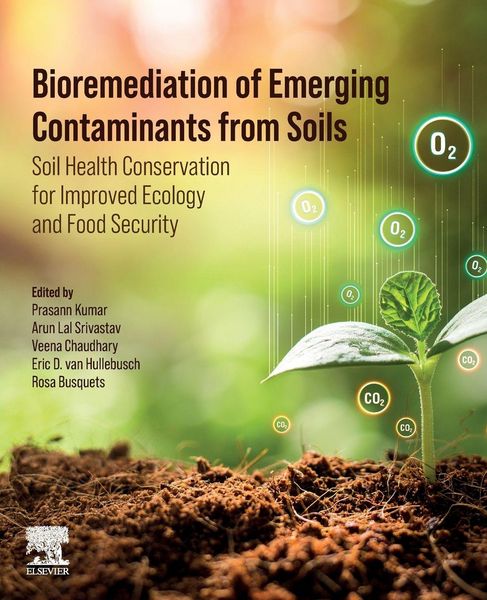
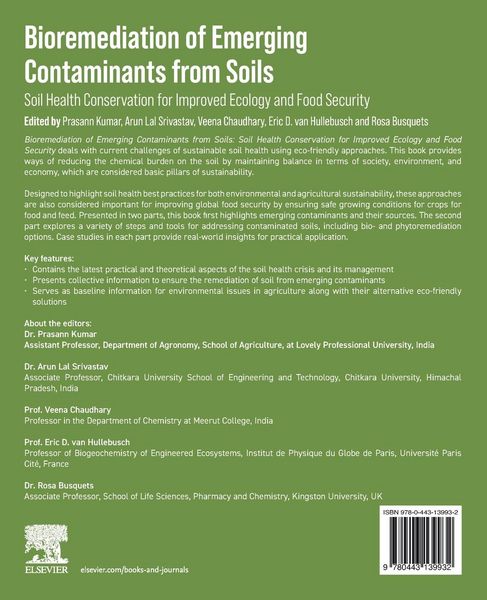
• Produktbild: Bioremediation of Emerging Contaminants from Soils
  • Produktbild: Bioremediation of Emerging Contaminants from Soils

Bioremediation of Emerging Contaminants from Soils Soil Health Conservation for Improved Ecology and Food Security

171,99 €

inkl. gesetzl. MwSt., Versandkostenfrei

Lieferung nach Hause

Beschreibung

Produktdetails

Einband

Taschenbuch

Erscheinungsdatum

20.05.2024

Herausgeber

Prasann Kumar + weitere

Verlag

Elsevier Science & Technology

Seitenzahl

724

Maße (L/B/H)

23,5/19,1/3,7 cm

Gewicht

1460 g

Sprache

Englisch

ISBN

978-0-443-13993-2

Beschreibung

Portrait

Dr. Prasann Kumar, assistant professor cum research intensive faculty in the
Department of Agronomy, School of Agricultural (ICAR-Accredited), Lovely
Professional University, Punjab, specializes in stress physiology, plant tissue culture,
physiology of plant?microbe/pathogen interaction, and biodiversity management.
Dr. Kumar has completed the International Agricultural Rural Development
Programme from Cornell University, Ithaca, New York, United States. He has
received a doctorate from Banaras Hindu University, Varanasi. He also has
authored 40 books published by national and international publishers, which find
a place in national as well as various Overseas Institutions' libraries. He has
guided 19 MSc students for their thesis. Prof. Veena Chaudhary is working as an associate professor in the Department
of Chemistry at Meerut College, Meerut, affiliated with CCS University, Meerut.
Dr. Chaudhary is deeply attached to chemistry, with a specialization in environmental
chemistry. She has to her credit more than 50 research papers, 2 book
chapters, and 20 abstracts. She received numerous awards, including a Young
Scientist Award, a Fellow Scientist Award, and numerous others, for her contributions
to the environmental field for the advancement of the social, welfare, and
agricultural sectors. She is a life member of several scientific societies. She also
visited abroad several times to attend international conferences and seminars for
the purpose of gathering and sharing scientific knowledge. She is handling several
research projects funded by DST, UP-CST, and higher education in Uttar
Pradesh. Eric D. van Hullebusch is a Full Professor in Biogeochemistry of Engineered Ecosystems at the Institut de Physique du Globe de Paris, Université Paris Cité, France. He holds a Ph.D. in Aquatic Chemistry and Microbiology from
Université de Limoges. After a Marie Curie fellowship at Wageningen University & Research, where he worked on optimizing anaerobic sludge reactorswith respect to trace metal
speciation and bioavailability, he was appointed Associate Professor in 2005 at Université Gustave Eiffel. A very prolific researcher and author, his key interests lie in the biogeochemistry of metals and metalloids in engineered systems, pollutant remediation, and circular resource recovery through biohydrometallurgical techniques. He is especially focused on sustainable strategies
for waste treatment, soil remediation, and recovering technology-critical elements
from agricultural and industrial wastes. Dr. Rosa Busquets is currently working as an Associate Professor in the School
of Life Sciences, Pharmacy and Chemistry, Faculty of Health Science Social Care
and Education, Kingston University, Penrhyn Road Campus, Kingston upon
Thames, United Kingdom. She works toward pushing the barriers of analytical
chemistry and achieving significant improvements in monitoring molecules of
special environmental relevance. Rosa is a specialist in chromatography-mass spectrometry and
in the analysis of complex matrices. She is particularly interested in environmental monitoring and
remediation. She carries out research to remove contaminants that pose a major
threat to ecosystems due to their toxicity and high mobility and can therefore contaminate
fresh water and affect our health. Nanoparticles, pesticides, plastic degradation
products, and pharmaceuticals are among these contaminants.
xxx About the editors
Kumar-BECS- Dr. Arun Lal Srivastav is an Professor and Associate Dean (Research)Department of Applied Sciences and EngineeringTula's Institute Dehradun - 248011, Uttarakhand, India

Produktdetails

Einband

Taschenbuch

Erscheinungsdatum

20.05.2024

Herausgeber

Verlag

Elsevier Science & Technology

Seitenzahl

724

Maße (L/B/H)

23,5/19,1/3,7 cm

Gewicht

1460 g

Sprache

Englisch

ISBN

978-0-443-13993-2

EU-Ansprechpartner

Zeitfracht Medien GmbH
Ferdinand-Jühlke-Straße 7
99095 Erfurt
DE
produktsicherheit@zeitfracht.de

Herstelleradresse

Elsevier Science & Technology
London Wall 125
EC2Y 5AS London
GB
tradeorders@elsevier.com

Noch keine Bewertungen vorhanden

Verfassen Sie die erste Bewertung zu diesem Artikel

Helfen Sie anderen Kundinnen und Kunden durch Ihre Meinung.

Kundinnen und Kunden meinen

Bewertungen (0)

Die Leseprobe wird geladen.
  • Produktbild: Bioremediation of Emerging Contaminants from Soils
  • Produktbild: Bioremediation of Emerging Contaminants from Soils
  • 1 Exponential population growth and global food security: challenges and alternatives
    2 Agricultural soil contamination due to industrial discharges: challenges for public
    health protection and food security
    3 Traditional approaches of agriculture soil remediation: boon or bane for global food security
    4 Polycyclic aromatic hydrocarbons bioremediation mechanisms by nonligninolytic fungi: a multiscale approach
    5 Phenolic compounds: a significant threat to agricultural soils
    6 Pharmaceutical compounds: a recent threat to agricultural soils (sources, transport, and negative impacts on the crop’s quality and other adjacent ecosystems)
    7 Sources of inorganic nonmetallic contaminants (synthetic fertilizers, pesticides) in agricultural soil and their impacts on the adjacent ecosystems
    8 Sources of inorganic metallic contaminants (lead, cadmium, arsenic, etc.) in agricultural soil and their impacts on the adjacent ecosystems
    9 Environmental threats posed by xenobiotics
    10 Bioremediation of xenobiotic contamination in soil
    11 Transgenic plants as a source of xenobiotic remediation
    12 Xenobiotic stress management by microbial endophytes
    13 Case studies on emerging contamination of soil
    14 Bioremediation of metal-contaminated soil: comparison of microbial agents with plants
    15 Phytoremediation of metal contaminated soil using energy crops: soil health maintenance along with biofuel production
    16 Phytoremediation of phenolic compounds from soil
    17 Phytoremediation of pharmaceutical compounds in soil
    18 Alternative natural options of synthesized agrochemicals
    19 Role of enzymes in the optimization of traditional phytoremediation processes of soil
    20 Optimized phytoremediation process for the sustainable management radionuclides
    21 Role of indigenous knowledge in agricultural soil reclamation without disturbing other ecosystems
    22 Role of hyperaccumulators in the reduction of emerging industrial pollutants from soil
    23 Microbes-assisted bioaugmentation process in the reduction of emerging industrial pollutants from soil
    24 Application of genetically modified crops against metallic contaminations
    25 Crop rotation patterns and soil health management
    26 Application of microphytes for soil reclamation
    27 Utilization of genetically modified weed plants against industrial contaminants: a promising tool of phytoremediation
    28 Case studies on management practices for emerging contamination of soil, challenges and future scope