• Produktbild: Geomorphic Risk Reduction Using Geospatial Methods and Tools
  • Produktbild: Geomorphic Risk Reduction Using Geospatial Methods and Tools
- 12%

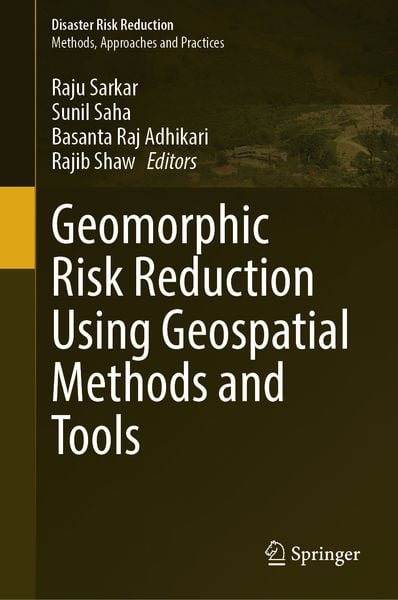
Geomorphic Risk Reduction Using Geospatial Methods and Tools

Aus der Reihe Disaster Risk Reduction
12% sparen

139,99 € UVP 160,49 €

inkl. gesetzl. MwSt., Versandkostenfrei

Lieferung nach Hause

Beschreibung

Produktdetails

Einband

Gebundene Ausgabe

Erscheinungsdatum

05.05.2024

Herausgeber

Raju Sarkar + weitere

Verlag

Springer Singapore

Seitenzahl

325

Maße (L/B/H)

24,1/16/2,5 cm

Gewicht

682 g

Auflage

2024

Sprache

Englisch

ISBN

978-981-9977-06-2

Beschreibung

Portrait

Dr. Raju Sarkar is a professor in the Department of Civil Engineering, Delhi Technological University (DTU). Prior to returning to his parent organization, DTU, Dr. Sarkar was a professor in the Department of Civil Engineering and Architecture, College of Science and Technology, Royal University of Bhutan (RUB), under the Ministry of External Affairs, Government of India on deputation to Bhutan. During his tenure in Bhutan, he established the Center for Disaster Risk Reduction and Community Development Studies and also worked as the team leader to start the new undergraduate programme of Engineering Geology in the RUB. Currently, he is also the Chair of the Commission on Education and Outreach and the Co-chair of the Commission on Earthquake Hazard, Risk and Strong Ground Motion in the International Association of Seismology and Physics of the Earth's Interior (IASPEI)-IUGG. He has vast experience in working in the Hindu-Kush Himalayas region both at the government and community level. He has published many original research articles in peer-reviewed journals, books, book chapters and proceedings of international societies, and he serves as an editorial member of several journals. Prof. Sarkar is collaborating in a number of research projects funded by the International Science Council (ISC), the World Bank and NERC-GCRF among others. He has a keen interest in geotechnics for natural disaster mitigation, geohazards risk management, landslides, seismology, community resilience against cataclysmic events, vulnerability and risk assessment and disaster management education.


Dr. Sunil Saha is an assistant professor of geography at the University of Gour Banga, India, and is specialized in the field of environmental geography. His research interests include fluvial landforms, natural hazards (gully erosion, landslides and floods), surface and sub-surface hydrological conditions and their impacts on land use in regard to both time and space. He is also interested in the applications of remote sensing and GIS in geo-hazard modelling and management. He has more than 7 years of teaching and research experience. His name has been listed in the top 2% of world scientists (2021, 2022 &2023) published by Stanford University, USA. He has guided many Ph.D. scholars in the field of geo-hazard management. More than 36 students have completed their dissertations under his guidance at the post-graduate level. He has published 72 peer-reviewed research papers in international journals of Elsevier, Springer, Taylor and Francis and the Multidisciplinary Digital Publishing Institute (MDPI). He has also published 5 book chapters. He is a reviewer of research articles assigned by leading international journals such as the Journal of Cleaner Production, Science of the Total Environment, Environmental Development and Sustainability, Geocarto International, Geomorphology, etc.


Dr. Basanta Raj Adhikari is working as a director at the Centre for Disaster Studies, Institute of Engineering, Tribhuvan University, Nepal, and is also an assistant professor of engineering geology in the same university. Moreover, he is also a high-level foreign associate professor at Sichuan University, China and Guest Professor at Keio University, Japan. Dr. Adhikari has a research interest in the tectonics of the Himalaya, climate change, hill-slope movement and human interaction, Himalayan sediment flux generation and disaster risk reduction. He is the author of more than 50 scientific articles and book chapters and has received various expressions of recognition for his work in the field of earth science including Young Scientist (Integrated Research on Disaster Risk), “young affiliates” (The World Academy of Sciences) and Sichuan 1000 Talents (Sichuan Province, China). Currently, he serves as an editor of the Journal of Coastal and Riverine Flood Risk and the thematic article collections of Environmental Change Driven by Climate Change, Tectonism and Landslide.

Dr. Rajib Shaw is a professor in the Graduate School of Media and Governance of Keio University, Japan. He is also a distinguished professor in the Institute of Disaster Management and Reconstruction (IDMR) of Sichuan University and Indian Institute of Technology (IIT) Guwahati and Indian Institute of Science (IISc). He did his studies in Yokohama National University and Osaka city University in Japan and University of Allahabad and Burdwan University of India. He is a co-founder of a Delhi-based social entrepreneur startup, the Resilience Innovation Knowledge Academy (RIKA), and the chair of the board of two Japanese non-government agencies: SEEDS Asia and CWS Japan. He is the co-chair of the Asia-Pacific Scientific and Technical Advisory Group (AP-STAG). He is also the coordinating lead author (CLA) for the Asia chapter’s 6th Assessment Report of the Intergovernmental Panel on Climate Change (IPCC). Professor Shaw has published 65 books and over 400 research papers in the field of environment, disaster management and climate change. Professor Shaw is the recipient of “Pravasi Bharatiya Samman Award (PBSA)” in 2021 for his contribution in education sector. PBSA is the highest honor conferred on overseas Indian and person of Indian origin from the President of India. He also received United Nations Sasakawa Award in 2022 for his lifetime contributions in the field of disaster risk reduction.

Produktdetails

Einband

Gebundene Ausgabe

Erscheinungsdatum

05.05.2024

Herausgeber

Verlag

Springer Singapore

Seitenzahl

325

Maße (L/B/H)

24,1/16/2,5 cm

Gewicht

682 g

Auflage

2024

Sprache

Englisch

ISBN

978-981-9977-06-2

Herstelleradresse

Springer-Verlag KG
Sachsenplatz 4-6
1201 Wien
AT

Email: [email protected]

Kundinnen und Kunden meinen

0 Bewertungen

Informationen zu Bewertungen

Zur Abgabe einer Bewertung ist eine Anmeldung im Konto notwendig. Die Authentizität der Bewertungen wird von uns nicht überprüft. Wir behalten uns vor, Bewertungstexte, die unseren Richtlinien widersprechen, entsprechend zu kürzen oder zu löschen.

Die Bewertungen sind nach Format, Anzahl Sterne und Datum sortiert.

Verfassen Sie die erste Bewertung zu diesem Artikel

Helfen Sie anderen Kund*innen durch Ihre Meinung

Kundinnen und Kunden meinen

0 Bewertungen filtern

  • Produktbild: Geomorphic Risk Reduction Using Geospatial Methods and Tools
  • Produktbild: Geomorphic Risk Reduction Using Geospatial Methods and Tools
  • Landslide Susceptibility Assessment Based on Machine Learning Techniques.- Measuring landslide susceptibility in Jakholi region of Garhwal Himalaya applying novel ensembles of statistical and machine learning algorithms.- Landslide Susceptibility Mapping using GIS-based Frequency Ratio, Shannon Entropy, Information Value and Weight-of-Evidence approaches in part of Kullu district, Himachal Pradesh, India.- An advanced hybrid machine learning technique for assessing the susceptibility to landslides in the Meenachil river basin of Kerala, India.- Novel ensemble of M5P and Deep learning neural network for predicting landslide susceptibility: A cross-validation approach.- Artificial neural network ensemble with General linear model for modeling the Landslide Susceptibility in Mirik region of West Bengal, India.- Modeling gully erosion susceptibility using advanced machine learning method in Pathro River Basin, India.- Quantitative Assessment of Interferometric Synthetic Aperture 2 Radar(INSAR) for Landslide Monitoring and Mitigation.- Assessment of Landslide Vulnerability using Statistical and Machine Learning Methods in Bageshwar District of Uttarakhand, India.- Assessing the shifting of the River Ganga along Malda District of West Bengal, India.- An ensemble of J48 Decision Tree with AdaBoost, and Bagging for flood susceptibility mapping in the Sundarban of West Bengal, India.- Assessment of mouza level flood resilience in lower part of Mayurakshi River basin, Eastern India.- Spatial flashflood modeling in Beas River Basin of Himachal Pradesh, India using GIS-based machine learning algorithms.- Geospatial study of river shifting and erosion deposition phenomenon along a selected stretch of River Damodar, West Bengal, India.- An Evaluation of Hydrological Modeling Using CN Method in Ungauged Barsa River Basin of Pasakha, Bhutan.- The Adoption of Random Forest (RF) and Support Vector Machine (SVM) with Cat Swarm Optimization (CSO) to Predict the Soil Liquefaction.