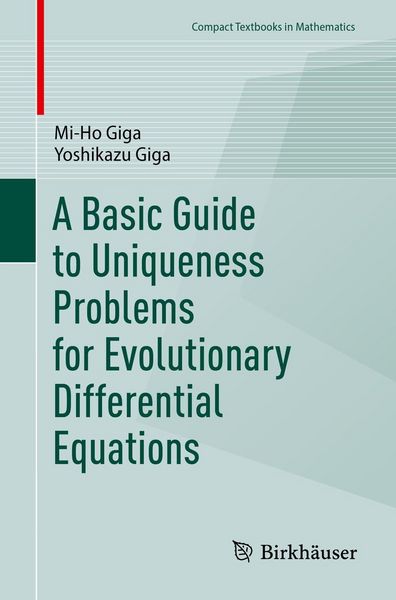
A Basic Guide to Uniqueness Problems for Evolutionary Differential Equations
-
- Taschenbuch
- eBook ausgewählt
-
Form:Einzelkauf Download
-
Sprache:Englisch
64,19 €
inkl. gesetzl. MwSt.Beschreibung
Produktdetails
Format
Kopierschutz
Nein
Family Sharing
Nein
Text-to-Speech
Nein
Erscheinungsdatum
14.09.2023
Verlag
SpringerSeitenzahl
155 (Printausgabe)
Dateigröße
4259 KB
Sprache
Englisch
EAN
9783031347962
This book addresses the issue of uniqueness of a solution to a problem - a very important topic in science and technology, particularly in the field of partial differential equations, where uniqueness guarantees that certain partial differential equations are sufficient to model a given phenomenon.
This book is intended to be a short introduction to uniqueness questions for initial value problems. One often weakens the notion of a solution to include non-differentiable solutions. Such a solution is called a weak solution. It is easier to find a weak solution, but it is more difficult to establish its uniqueness. This book examines three very fundamental equations: ordinary differential equations, scalar conservation laws, and Hamilton-Jacobi equations. Starting from the standard Gronwall inequality, this book discusses less regular ordinary differential equations. It includes an introduction of advanced topics like the theory of maximal monotone operators as wellas what is called DiPerna-Lions theory, which is still an active research area. For conservation laws, the uniqueness of entropy solution, a special (discontinuous) weak solution is explained. For Hamilton-Jacobi equations, several uniqueness results are established for a viscosity solution, a kind of a non-differentiable weak solution. The uniqueness of discontinuous viscosity solution is also discussed. A detailed proof is given for each uniqueness statement.
The reader is expected to learn various fundamental ideas and techniques in mathematical analysis for partial differential equations by establishing uniqueness. No prerequisite other than simple calculus and linear algebra is necessary. For the reader's convenience, a list of basic terminology is given at the end of this book.
Noch keine Bewertungen vorhanden
Verfassen Sie die erste Bewertung zu diesem Artikel
Helfen Sie anderen Kundinnen und Kunden durch Ihre Meinung.
Kurze Frage zu unserer Seite
Vielen Dank für dein Feedback
Wir nutzen dein Feedback, um unsere Produktseiten zu verbessern. Bitte habe Verständnis, dass wir dir keine Rückmeldung geben können. Falls du Kontakt mit uns aufnehmen möchtest, kannst du dich aber gerne an unseren Kund*innenservice wenden.
zum Kundenservice