
Recent Advances in Computational Optimization Results of the Workshop on Computational Optimization WCO 2021
-
- Hardcover
- Taschenbuch ausgewählt
- eBook
-
Sprache:Englisch
-
Auflage:23001 Auflage 1st ed. 2022
- 22001 Auflage 1st ed. 2022 159,99 €
- 1st ed. 2020 95,99 €
- 1st ed. 2021 97,99 €
- Softcover reprint of the original 1st ed. 2016 95,99 €
- Softcover reprint of the original 1st ed. 2016 95,99 €
- Softcover reprint of the original 1st ed. 2015 95,99 €
- Softcover reprint of the original 1st ed. 2019 97,99 €
- 23001 Auflage 1st ed. 2022 139,99 € ausgewählt
- Softcover reprint of the original 1st ed. 2018 97,99 €
139,99 €
UVP
160,49 €
inkl. gesetzl. MwSt.,
Beschreibung
Produktdetails
Einband
Taschenbuch
Erscheinungsdatum
18.09.2023
Abbildungen
X, 388 p. 62 illus., 39 illus. in color.
Herausgeber
Stefka FidanovaVerlag
SpringerSeitenzahl
388
Maße (L/B/H)
23,5/15,5/2,2 cm
Gewicht
604 g
Auflage
23001 Auflage 1st ed. 2022
Sprache
Englisch
ISBN
978-3-031-06841-6
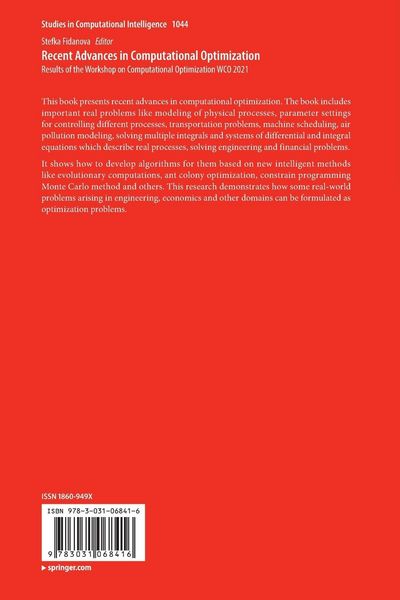
This book presents recent advances in computational optimization. The book includes important real problems like modeling of physical processes, parameter settings for controlling different processes, transportation problems, machine scheduling, air pollution modeling, solving multiple integrals and systems of differential and integral equations which describe real processes, solving engineering and financial problems.
It shows how to develop algorithms for them based on new intelligent methods like evolutionary computations, ant colony optimization, constrain programming Monte Carlo method and others. This research demonstrates how some real-world problems arising in engineering, economics and other domains can be formulated as optimization problems.
Noch keine Bewertungen vorhanden
Verfassen Sie die erste Bewertung zu diesem Artikel
Helfen Sie anderen Kundinnen und Kunden durch Ihre Meinung.
Kurze Frage zu unserer Seite
Vielen Dank für dein Feedback
Wir nutzen dein Feedback, um unsere Produktseiten zu verbessern. Bitte habe Verständnis, dass wir dir keine Rückmeldung geben können. Falls du Kontakt mit uns aufnehmen möchtest, kannst du dich aber gerne an unseren Kund*innenservice wenden.
zum Kundenservice