
KI-Beratung Beta

  • Produktbild: Introducing Language and Intercultural Communication
  • Produktbild: Introducing Language and Intercultural Communication

Introducing Language and Intercultural Communication

76,99 €

inkl. gesetzl. MwSt., Versandkostenfrei


Beschreibung

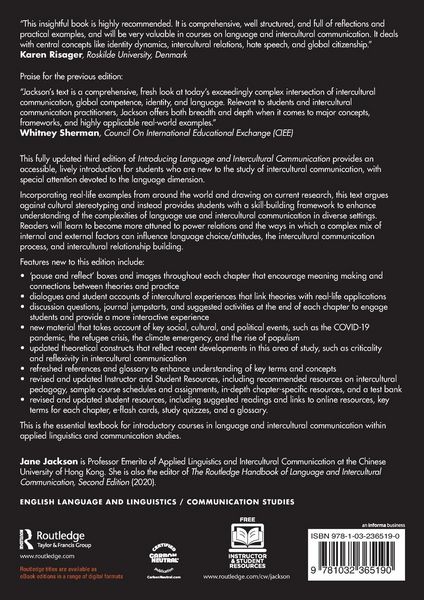
This fully updated third edition of Introducing Language and Intercultural Communication provides an accessible, lively introduction for students who are new to the study of intercultural communication, with special attention devoted to the language dimension.

Incorporating real-life examples from around...

Beschreibung

This fully updated third edition of Introducing Language and Intercultural Communication provides an accessible, lively introduction for students who are new to the study of intercultural communication, with special attention devoted to the language dimension.

Incorporating real-life examples from around the world and drawing on current research, this text argues against cultural stereotyping and instead provides students with a skill-building framework to enhance understanding of the complexities of language use and intercultural communication in diverse settings. Readers will learn to become more attuned to power relations and the ways in which a complex mix of internal and external factors can influence language choice/attitudes, the intercultural communication process, and intercultural relationship building.

Features new to this edition include:

  • 'pause and reflect' boxes and images throughout each chapter that encourage meaning making and connections between theories and practice
  • dialogues and student accounts of intercultural experiences that link theories with real-life applications
  • discussion questions, journal jumpstarts, and suggested activities at the end of each chapter to engage students and provide a more interactive experience
  • new material that takes account of key social, cultural, and political events, such as the COVID-19 pandemic, the refugee crisis, the climate emergency, and the rise of populism
  • updated theoretical constructs that reflect recent developments in this area of study, such as criticality and reflexivity in intercultural communication
  • refreshed references and glossary to enhance understanding of key terms and concepts
  • revised and updated Instructor and Student Resources, including recommended resources on intercultural pedagogy, sample course schedules and assignments, in-depth chapter-specific resources, and a test bank
  • revised and updated student resources, including suggested readings and links to online resources, key terms for each chapter, e-flash cards, study quizzes, and a glossary

This is the essential textbook for introductory courses in language and intercultural communication within applied linguistics and communication studies.

Rezension

This insightful book is highly recommended. It is comprehensive, well-structured, and full of reflections and practical examples, and will be very valuable in courses on language and intercultural communication. It deals with central concepts like identity dynamics, intercultural relations, hate-speech, and global citizenship.

Professor Emerita Karen Risager, Roskilde University, Denmark

Praise for the previous edition:

This is an excellent introduction to the field of intercultural communication, as equally useful for anybody working internationally as to the university classroom.

Allan Goodwin, Nagoya University of Foreign Studies, Japan

Educators will find this a timely and wide-ranging resource that tackles difficult issues in challenging times.

John Corbett, University of São Paulo, Brazil

Jackson's text is a comprehensive, fresh look at today's exceedingly complex intersection of intercultural communication, global competence, identity, and language. Relevant to students and intercultural communication practitioners, Jackson offers both breadth and depth when it comes to major concepts, frameworks, and highly applicable real-world examples.

Whitney Sherman, Council On International Educational Exchange (CIEE)

Produktdetails

Einband

Taschenbuch

Erscheinungsdatum

10.11.2023

Abbildungen

4 Tables, black and white; 5 Line drawings, black and white; 96 Halftones, black and white; 101 Illustrations, black and white

Verlag Taylor & Francis

Produktdetails

Einband

Taschenbuch

Erscheinungsdatum

10.11.2023

Abbildungen

4 Tables, black and white; 5 Line drawings, black and white; 96 Halftones, black and white; 101 Illustrations, black and white

Verlag Taylor & Francis
Seitenzahl

438

Maße (L/B/H)

24,6/17,4/2,3 cm

Gewicht

775 g

Farbe

Mokka / Messing

Auflage

3. Auflage

Sprache

Englisch

ISBN

978-1-03-236519-0

Herstelleradresse

Libri GmbH
Europaallee 1
36244 Bad Hersfeld
DE

Email: gpsr@libri.de

Noch keine Bewertungen vorhanden

Verfassen Sie die erste Bewertung zu diesem Artikel

Helfen Sie anderen Kundinnen und Kunden durch Ihre Meinung.

Kundinnen und Kunden meinen

Bewertungen (0)

Die Leseprobe wird geladen.
  • Produktbild: Introducing Language and Intercultural Communication
  • Produktbild: Introducing Language and Intercultural Communication
  • List of plates

    List of figures

    List of tables

    Preface

    Acknowledgments

    Chapter 1. Imperatives for intercultural dialogue

    Introduction

    What is intercultural communication?

    What is intercultural dialogue?

    The importance of intercultural competency today

    Ethical intercultural communication

    Summary

    Discussion questions

    Journal jumpstarts

    Activities

    Instructor and Student Resources

    Chapter 2. Culture, language, and primary socialization

    Introduction

    Conceptions of culture

    Primary socialization (Cultural and linguistic)

    Facets of culture

    The text's conception of culture

    Summary

    Discussion questions

    Journal jumpstarts

    Activities

    Instructor and Student Resources

    Chapter 3. Communication, culture, and power in context

    Introduction

    Human communication and language

    Components in the human communication process

    Properties of human communication

    Culture and communication styles

    Communication accommodation theory (CAT)

    Characteristics of effective intercultural communicators in second-language situations

    Summary

    Discussion questions

    Journal jumpstarts

    Activities

    Instructor and Student Resources

    Chapter 4. Nonverbal communication

    Introduction

    What is nonverbal communication?

    Why study nonverbal communication?

    The relationship between verbal and nonverbal communication

    Functions of nonverbal communication

    Culture and types of nonverbal communication

    The nonverbal expectancy violation theory

    Nonverbal intercultural communicative competence

    Summary

    Discussion questions

    Journal jumpstarts

    Activities

    Instructor and Student Resources

    Chapter 5. Identity and belonging

    Introduction

    Conceptions of identity

    Fundamental characteristics of identities

    Types of identities

    Identities and intercultural competence: Applying your knowledge

    Summary

    Discussion questions

    Journal jumpstarts

    Activities

    Instructor and Student Resources

    Chapter 6. The dark sides of identities: Barriers to intercultural communication

    Introduction

    Social categorization

    Ethnocentricism

    Othering

    Ingroups and outgroups

    Stereotyping

    Bias and prejudice

    Discrimination

    Racism

    Hateful rhetoric and acts of violence

    Xenophobia

    Pushing past ethnocentricism and identity biases

    Summary

    Discussion questions

    Journal jumpstarts

    Activities

    Instructor and Student Resources

    Chapter 7. Intercultural adaptation

    Introduction

    Transit