KI-Beratung Beta

Gutscheinbedingungen

**Gültig vom 23.11. bis 30.11.2026 | Gültig für nicht preisgebundene fremdsprachige Bücher | Einzelne Artikel können ausgeschlossen sein | Online auf www.bücher.de einlösbar | Click & Collect nur mit Online-Zahlung (Paypal/Kreditkarte) vorab | Nicht kombinierbar mit anderen Gutscheinen oder Preisaktionen | Nur einmal pro Einkauf einlösbar | Gutschein wird auf max. 500€ Bestellwert angerechnet | Keine Barauszahlung | Nicht gültig für Versandkosten und Services

  • Produktbild: Democracies in Peril?
  • Produktbild: Democracies in Peril?

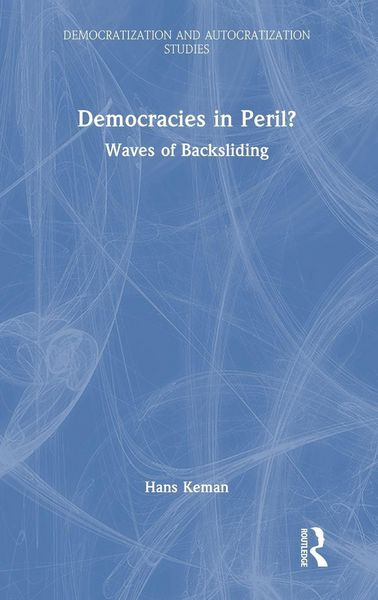
Democracies in Peril? Waves of Backsliding

276,99 €

inkl. gesetzl. MwSt., Versandkostenfrei


Beschreibung

This insightful text rigorously examines and accounts for contemporary developments - and crucially a reversal of "democraticness" - in democratic polities and related political processes comparing 38 democracies across the world. The focus is on contemporary developments and recent volatile levels of...

Beschreibung

This insightful text rigorously examines and accounts for contemporary developments - and crucially a reversal of "democraticness" - in democratic polities and related political processes comparing 38 democracies across the world. The focus is on contemporary developments and recent volatile levels of democraticness.

Democracies in Peril? introduces theoretical backgrounds of what makes democracy tick and scrutinises empirical trends and development in "democraticness" in an accessible manner. It explores what "democracy" as a political regime implies and how the liberal democratic model developed, as well as examining the present state of affairs in democracies, the challenges democracies encounter and the perils of democracy as a legitimate system of governance in the 21st century. The book provides a "systemic" approach to adjudicate the effects of this assumed reversal in democratisation in terms of popular preferences, party behaviour, institutional architecture and policy performance. The effects of public policy formation and the role of the state on actual democratic performance are also analysed.

Finally, case studies on the Covid pandemic and the development of social welfare demonstrate the complex relationship between government capacities - under pressure - and the quality of democracy, approaching the question: How do 38 democratic states cope with societal problems, populist tendencies and a fast-changing world without degrading their institutional quality and legitimacy?

This text will be of key interest to students, scholars, journalists and interested readers of comparative politics, democratisation, public administration, political economy, constitutional law and the social sciences in general.

Rezension

'Democracies in Perilproceeds with the evenhandedness of a diplomat and the incisive analytical insight of a superbly informed scholar. In it Hans Keman explains the value of democracy, with all its limitations, and how the rising menaces of anti-pluralism and populism are slowly derailing liberal democratic practices from within. All who care to understand what is at stake-and we all should-will gain a clear-eyed appreciation of the stakes by pondering the ideas Keman puts on offer.'

Michael McDonald, Professor of Political Science, State University of New York at Binghamton, USA

'This is a thoughtful and realistic account of the much discussed crisis of democracies today making us to understand their weaknesses and defects with ensuing diminishing policy performance and a loss of trust in government. The comprehensive analysis of democracies allows the author to suggest ways out of the current legitimacy crisis by making proposals for building higher levels of confidence in the democratic system. The book sets new standards in the discussion on the democratic backlash. A must read!'

Dietmar Braun,Professor of Political Science, University of Lausanne, Switzerland

"This insightful book by a longstanding scholar of comparative politics examines contemporary democratic backsliding from various perspectives. Focusing on 38 cases from around the world, Keman uses liberal democracy as the central point of analysis... The book draws on an extensive, up-to-date literature, and each chapter summarizes its key points and provides selected suggested readings. Individual chapters provide useful material for discussion. That said, this is not an introductory work. Recommended for upper-level and graduate courses, especially seminars.

Alan Siaroff, The University of Lethbridge, CanadaSumming Up: Recommended. Advanced undergraduates through faculty.

"Democracies in Peril? is an essential contribution to the field. Keman successfully highlights the double problem facing the current model: it is being hollowed out internally by illiberalism and pressured externally by globalisation and the consequences of neoliberalism. By providing a robust theoretical grounding for these "demand-side" and "supply-side" pressures, the book offers vital insights for scholars, students, and practitioners seeking to navigate this global negative trend of democracy."

Produktdetails

Einband

Gebundene Ausgabe

Erscheinungsdatum

19.12.2023

Abbildungen

10 SW-Abb., 1 Farbabb., 1 Farbfotos, 10 SW-Zeichn., 22 Tabellen

Verlag Taylor & Francis

Produktdetails

Einband

Gebundene Ausgabe

Erscheinungsdatum

19.12.2023

Abbildungen

10 SW-Abb., 1 Farbabb., 1 Farbfotos, 10 SW-Zeichn., 22 Tabellen

Verlag Taylor & Francis
Seitenzahl

278

Maße (L/B/H)

24/16,1/2 cm

Gewicht

534 g

Sprache

Englisch

ISBN

978-1-03-202990-0

Herstelleradresse

Libri GmbH
Europaallee 1
36244 Bad Hersfeld
DE

Email: gpsr@libri.de

Noch keine Bewertungen vorhanden

Verfassen Sie die erste Bewertung zu diesem Artikel

Helfen Sie anderen Kundinnen und Kunden durch Ihre Meinung.

Kundinnen und Kunden meinen

Bewertungen (0)

Die Leseprobe wird geladen.
  • Produktbild: Democracies in Peril?
  • Produktbild: Democracies in Peril?
  • List of tables

    List of figures

    List of boxes

    Preface

    1 Prologue: democracy in the 21st century

    1.1 Democracies in peril: backsliding and de-democratisation

    1.2 The concept of democraticness: proto-types

    1.3 Levels of democraticness: the yard-stick for comparison

    1.4 The storyline as a "road trip": democratisation and political decay

    1.5 Value-free and value-related knowledge: a realist position

    PART 1

    Studying democracy: detecting flaws, defects and perils

    2 Reversing trends in "democraticness"

    2.1 Democracy in peril?

    2.2 Are "full" democracies indeed reverting?

    2.3 Full democracies in contrast to flawed and defective democracies

    2.4 Perilous developments: potential reasons and questions to ask

    3 Comparative political science and the study of democracy

    3.1 The academic debate: room for improvement

    3.2 Omissions in the study of democratic politics

    3.3 Comparing democratic states: full, flawed and defective polities

    4 Thinking about democracy: the origins of the liberal model

    4.1 From ideas to design

    4.2 The enlightenment and the concept of the democratic state

    4.3 John Stuart Mill and liberal democracy

    4.4 The roots of liberal democracy laid out: still work in progress

    PART 2

    Pathways towards liberal Democratisation

    5 Designing liberal democracy: institutionalising the polity

    5.1 Constitutional trajectories toward "representative" governance

    5.2 Missing dimensions, institutional progress and constraints

    5.3 The shaping of the polity towards liberal democracy

    5.4 Considerations on the road to liberal democratisation

    6 Towards universal suffrage and representation of the people

    6.1 Electoral inclusiveness and fair representation

    6.2 Finding the optimal solution to fair and effective representation

    6.3 The effects of electoral systems: inclusiveness and pluriform representation

    6.4 Institutional engineering: the choice of an optimal electoral system

    7 Who governs at the end of the day in a democracy?

    7.1 Power distribution and indirect democracy: inevitable or containable?

    7.2 Democracy and selected leadership: the role of political elites

    7.3 Indirect democracy: selecting accountable leadership

    7.4 Elitism versus pluralism: power concentration or dispersion?

    7.5 The scope and limits of liberal democracy

    PART 3

    Contemporary approaches to the development of democracy 97

    8 Polyarchy and pluralism: waves of democratisation

    8.1 Polyarchy: the route to "full" democracy?

    8.2 Pathways of democratisation: sequences towards polyarchy

    8.3 Waves of democratisation: path dependencies and critical junctures

    8.4 The second wave of democratisation and reversal (1920-1939)

    8.5 Post-war waves towards polyarchy and beyond

    8.6 Conceptual considerations on polyarchy

    9 Consensus democracy: the alternative to polyarchy?

    9.1 Cleavage theory and the coming about of consensus democracy

    9.2 Inst