• Produktbild: Migrations in the Mediterranean
  • Produktbild: Migrations in the Mediterranean

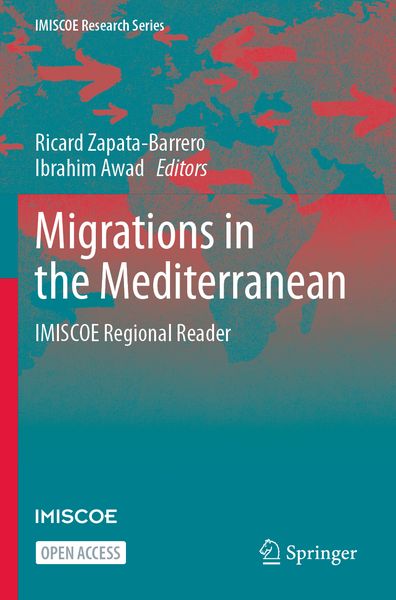
Migrations in the Mediterranean IMISCOE Regional Reader

Aus der Reihe IMISCOE Research Series

38,99 €

inkl. gesetzl. MwSt., Versandkostenfrei

Lieferung nach Hause

Beschreibung

Produktdetails

Einband

Taschenbuch

Erscheinungsdatum

22.10.2023

Herausgeber

Ricard Zapata-Barrero + weitere

Verlag

Springer

Seitenzahl

428

Maße (L/B/H)

23,5/15,5/2,4 cm

Gewicht

663 g

Auflage

1st ed. 2024

Sprache

Englisch

ISBN

978-3-031-42266-9

Beschreibung

Portrait

Ricard Zapata-Barrero is full Professor in the Department of Political and Social Sciences, Universitat Pompeu Fabra (UPF-Barcelona, Spain). His main lines of research deal with contemporary issues of liberal democracy in contexts of diversity, especially the relationship between democracy, citizenship, and immigration. He conducts theoretical and empirical research on migration and in the Mediterranean area. He is the Director of GRITIM-UPF (Interdisciplinary Research Group on Immigration), and of the Master¿s Program in Migration Studies at UPF.

Ibrahim Awad is Professor of Global Affairs and Director, Center for Migration and Refugee Studies, School of Global Affairs and Public Policy, at the American University in Cairo, Egypt. He is Chair of the Global Knowledge Partnership on Migration and Development (KNOMAD), hosted by the World Bank, Chair of the Steering Committee of the Euro-Mediterranean Research Network on International Migration (EuroMedMig) and Senior Fellow at the Migration Policy Centre (MPC) of the Graduate Institute of International and Development Studies in Geneva, Switzerland.

Produktdetails

Einband

Taschenbuch

Erscheinungsdatum

22.10.2023

Herausgeber

Verlag

Springer

Seitenzahl

428

Maße (L/B/H)

23,5/15,5/2,4 cm

Gewicht

663 g

Auflage

1st ed. 2024

Sprache

Englisch

ISBN

978-3-031-42266-9

Herstelleradresse

Springer-Verlag GmbH
Tiergartenstr. 17
69121 Heidelberg
DE

Email: [email protected]

Kundinnen und Kunden meinen

0 Bewertungen

Informationen zu Bewertungen

Zur Abgabe einer Bewertung ist eine Anmeldung im Konto notwendig. Die Authentizität der Bewertungen wird von uns nicht überprüft. Wir behalten uns vor, Bewertungstexte, die unseren Richtlinien widersprechen, entsprechend zu kürzen oder zu löschen.

Die Bewertungen sind nach Format, Anzahl Sterne und Datum sortiert.

Verfassen Sie die erste Bewertung zu diesem Artikel

Helfen Sie anderen Kund*innen durch Ihre Meinung

Kundinnen und Kunden meinen

0 Bewertungen filtern

  • Produktbild: Migrations in the Mediterranean
  • Produktbild: Migrations in the Mediterranean
  • Chapter 1. Introduction: Mediterranean Migration Studies: a research agenda for the coming years.- Part I: Geo-political Mediterranean Relations.- Chapter 2. Looking at the EU-Turkey Deal: The Implications for Migrants in Greece and Turkey.- Chapter 3. Hindering democracy through migration policies? An analysis of EU external migration policies impacts on the democratization of Morocco.- Chapter 4. Migration across the Mediterranean: Shaping Italy-Libya relations over time.- Chapter 5. (Im-)Mobility Partnerships: Challenges to EU Democracy Promotion through Mobility in the Mediterranean.- Chapter 6. The migration initiatives encouraged by the Local and Regional Networks and their effects in the Euromed cooperation.- Part II: Governance, Politics and Policies.- Chapter 7. Migrants and Refugees in the Mediterranean Cities: Reception, regulation and actors. Tunisia case study.- Chapter 8. Media, Public Opinion and Migration Policies in Euro-Mediterranean Countries: The Case of France.-Chapter 9. Gendered Asylum in the Black Mediterranean: Two Nigerian Women's Experiences of Reception in Italy.- Chapter 10. Activists Escaping Lebanon: Disruption, Burnout, and Disengagement.- Chapter 11. Ecologies of exclusion and inclusion in the Mediterranean: Seeking refuge in Lebanon.- Part III: Taxonomies of Motion and Drivers.- Chapter 12. Root Causes of Irregular Migration in the Eastern Mediterranean: The Case of Afghans and Syrians.- Chapter 13. Mobilities Among Marginalized Youth in Morocco: Precariousness, Agency and Networks.- Chapter 14. The continuity of migration drivers: A historical perspective on Spanish social transformations.- Chapter 15.: Capturing Irregular Migrations through a Macro-Sociological Lens: The harga process in twelve steps from North Africa to Europe.- Part IV: History, Cities and Social Transformations.- Chapter 16. Connecting places, connecting to place: the use of ICTs for imagining, narrating and exploring the Mediterranean city.- Chapter 17. The fenced off cities of Ceuta and Melilla: Mediterranean nodes of migrant (im)mobility.- Chapter 18. Mediterranean migrations and cities with their cultural histories and imaginaries: the case of Marseille.- Chapter 19. Infrastructure development and environmental change - a case study of forced (im)mobility in Mhamid oasis (Southern Morocco).- Part V: Economy and Labor Markets.- Chapter 20. The Political Economy of Egyptian Migration to Europe in the 2020s.- Chapter 21.  The institutional channeling of transnational economic mobilization in three Moroccan regions.- Chapter 22. 'No man's land': Reflecting on and theorizing migrant labour in the Mediterranean agriculture.- Chapter 23. Transnational Migrant Entrepreneurship Policies in the Maghreb Countries: Tunisia, Algeria, and Morocco.- Chapter 24. Concluding remarks: Applying Med-Thinking proviso to set a research agenda on Mediterranean migrations.