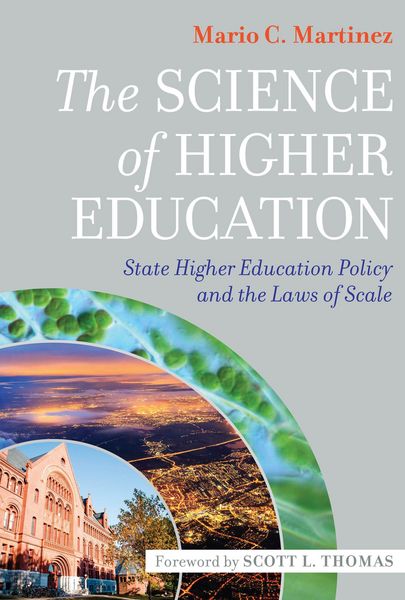
The Science of Higher Education State Higher Education Policy and the Laws of Scale
-
- Hardcover
- Taschenbuch
- eBook ausgewählt
-
Form:Einzelkauf Download
-
Sprache:Englisch
-
eBook Format:PDF
- ePUB 3 48,99 €
- PDF 48,99 € ausgewählt
48,99 €
inkl. gesetzl. MwSt.Beschreibung
Produktdetails
Format
Kopierschutz
Ja
Family Sharing
Nein
Text-to-Speech
Nein
Erscheinungsdatum
03.07.2023
Verlag
Taylor & Francis eBooksSeitenzahl
216 (Printausgabe)
Auflage
1. Auflage
Sprache
Englisch
EAN
9781000973365
Perennial conclusions from state-by-state funding-per-student analyses of underfunding and weak state commitment have become so common that they have diluted the potency of the argument to state policymakers for more higher education funding. In addition, there has been little in the way of testing or questioning the assumptions embedded in traditional funding per student analysis and its accompanying conclusions.As state legislators balance the competing needs of education, health, transportation, and public safety budgets, they increasingly ask what return on investment (ROI) they get for the funding they provide, including from higher education. The ROI language, while potentially unsettling for its corporate-like and neoliberal connotation, will persist into the foreseeable future. We must ask questions both of adequacy (How much funding should the states provide?) and benefit (What benefits do states receive for the higher education funding they provide?). The focus on traditional funding per student analysis has remained static for over forty years, indicating the need for new ideas and methods to probe questions of adequacy and benefit.The Science of Higher Education is an introduction to a new paradigm that explores state higher education funding, enrollment, completion, and supply (the number and type of institutions in a state) through the lens of what are commonly known as power laws. Power laws explain patterns in biological systems and characteristics of cities. Like cities, state higher education systems are complex adaptive systems, so it is little surprise that power laws also explain funding, enrollment, completion, and supply.The scale relationships uncovered in the Science of Higher Education suggest the potential benefits state policymakers could derive by emphasizing enrollment, completion, or capacity policies, based on economies of scale, marginal benefits, and the return state's get on enrollment and completion for the funding they provide.The various features of state higher education systems that conform to scale patterns do not alone provide definitive answers for appropriate funding levels, however. As this book addresses, policymakers need to take into account the macro forces, from demography to geography and the economy, that situate the system, as well the interactions between government and market actors that are at the core of every state higher education system and influence the outcomes it achieves.
Noch keine Bewertungen vorhanden
Verfassen Sie die erste Bewertung zu diesem Artikel
Helfen Sie anderen Kundinnen und Kunden durch Ihre Meinung.
Kurze Frage zu unserer Seite
Vielen Dank für dein Feedback
Wir nutzen dein Feedback, um unsere Produktseiten zu verbessern. Bitte habe Verständnis, dass wir dir keine Rückmeldung geben können. Falls du Kontakt mit uns aufnehmen möchtest, kannst du dich aber gerne an unseren Kund*innenservice wenden.
zum Kundenservice