
Beschreibung
Produktdetails
Einband
Taschenbuch
Erscheinungsdatum
14.10.2023
Abbildungen
XIV, 284 p.
Herausgeber
Remy Y. S. Low + weitereVerlag
SpringerSeitenzahl
284
Maße (L/B/H)
21/14,8/1,7 cm
Gewicht
391 g
Auflage
23001 Auflage 1st edition 2024
Sprache
Englisch
ISBN
978-3-031-39819-3
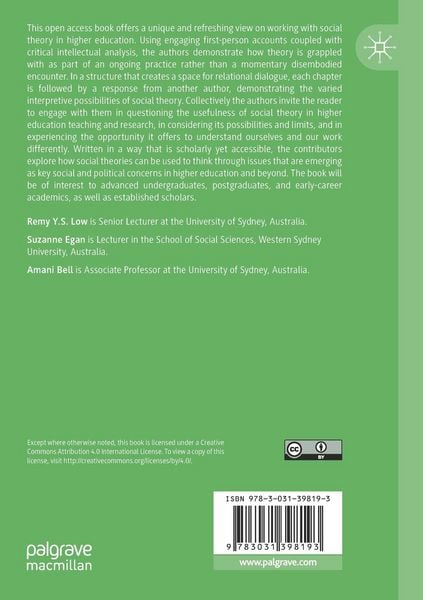
This open access book offers a unique and refreshing view on working with social theory in higher education. Using engaging first-person accounts coupled with critical intellectual analysis, the authors demonstrate how theory is grappled with as part of an ongoing practice rather than a momentary disembodied encounter. In a structure that creates a space for relational dialogue, each chapter is followed by a response from another author, demonstrating the varied interpretive possibilities of social theory. Collectively the authors invite the reader to engage with them in questioning the usefulness of social theory in higher education teaching and research, in considering its possibilities and limits, and in experiencing the opportunity it offers to understand ourselves and our work differently. Written in a way that is scholarly yet accessible, the contributors explore how social theories can be used to think through issues that are emerging as key social and political concerns in higher education and beyond. The book will be of interest to advanced undergraduates, postgraduates, and early-career academics, as well as established scholars.
Noch keine Bewertungen vorhanden
Verfassen Sie die erste Bewertung zu diesem Artikel
Helfen Sie anderen Kundinnen und Kunden durch Ihre Meinung.
Kurze Frage zu unserer Seite
Vielen Dank für dein Feedback
Wir nutzen dein Feedback, um unsere Produktseiten zu verbessern. Bitte habe Verständnis, dass wir dir keine Rückmeldung geben können. Falls du Kontakt mit uns aufnehmen möchtest, kannst du dich aber gerne an unseren Kund*innenservice wenden.
zum Kundenservice