
The nth-Order Comprehensive Adjoint Sensitivity Analysis Methodology, Volume I Overcoming the Curse of Dimensionality: Linear Systems
-
- Hardcover
- Taschenbuch ausgewählt
- eBook
-
Sprache:Englisch
148,99 €
UVP
171,19 €
inkl. gesetzl. MwSt.,
Beschreibung
Produktdetails
Einband
Taschenbuch
Erscheinungsdatum
21.07.2023
Abbildungen
XII, 362 p.
Verlag
SpringerSeitenzahl
362
Maße (L/B/H)
23,5/15,5/2,1 cm
Gewicht
569 g
Auflage
1st edition 2022
Sprache
Englisch
ISBN
978-3-030-96366-8
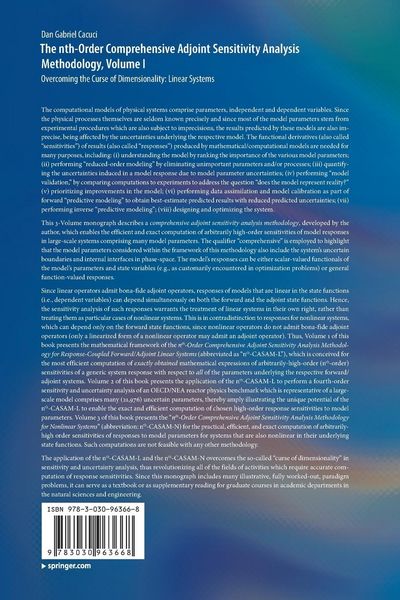
This 3-Volume monograph describes a comprehensive adjoint sensitivity analysis methodology, developed by the author, which enables the efficient and exact computation of arbitrarily high-order sensitivities of model responses in large-scale systems comprising many model parameters. The qualifier “comprehensive” is employed to highlight that the model parameters considered within the framework of this methodology also include the system’s uncertain boundaries and internal interfaces in phase-space. The model’s responses can be either scalar-valued functionals of the model’s parameters and state variables (e.g., as customarily encountered in optimization problems) or general function-valued responses.
Since linear operators admit bona-fide adjoint operators, responses of models that are linear in the state functions (i.e., dependent variables) can depend simultaneously on both the forward and the adjoint state functions. Hence, the sensitivity analysis of such responses warrants the treatment of linear systems in their own right, rather than treating them as particular cases of nonlinear systems. This is in contradistinction to responses for nonlinear systems, which can depend only on the forward state functions, since nonlinear operators do not admit bona-fide adjoint operators (only a linearized form of a nonlinear operator may admit an adjoint operator). Thus, Volume 1 of this book presents the mathematical framework of the nth-Order Comprehensive Adjoint Sensitivity Analysis Methodology for Response-Coupled Forward/Adjoint Linear Systems (abbreviated as “nth-CASAM-L”), which is conceived for the most efficient computation of exactly obtained mathematical expressions of arbitrarily-high-order (nth-order) sensitivities of a generic system response with respect to all of the parameters underlying the respective forward/adjoint systems. Volume 2 of this book presents the application of the nth-CASAM-L to perform a fourth-order sensitivity and uncertainty analysis of an OECD/NEA reactor physics benchmark which is representative of a large-scale model comprises many (21,976) uncertain parameters, thereby amply illustrating the unique potential of the nth-CASAM-L to enable the exact and efficient computation of chosen high-order response sensitivities to model parameters. Volume 3 of this book presents the “nth-Order Comprehensive Adjoint Sensitivity Analysis Methodology for Nonlinear Systems” (abbreviation: nth-CASAM-N) for the practical, efficient, and exact computation of arbitrarily-high ordersensitivities of responses to model parameters for systems that are also nonlinear in their underlying state functions. Such computations are not feasible with any other methodology.
The application of the nth-CASAM-L and the nth-CASAM-N overcomes the so-called “curse of dimensionality” in sensitivity and uncertainty analysis, thus revolutionizing all of the fields of activities which require accurate computation of response sensitivities. Since this monograph includes many illustrative, fully worked-out, paradigm problems, it can serve as a textbook or as supplementary reading for graduate courses in academic departments in the natural sciences and engineering.
Noch keine Bewertungen vorhanden
Verfassen Sie die erste Bewertung zu diesem Artikel
Helfen Sie anderen Kundinnen und Kunden durch Ihre Meinung.
Kurze Frage zu unserer Seite
Vielen Dank für dein Feedback
Wir nutzen dein Feedback, um unsere Produktseiten zu verbessern. Bitte habe Verständnis, dass wir dir keine Rückmeldung geben können. Falls du Kontakt mit uns aufnehmen möchtest, kannst du dich aber gerne an unseren Kund*innenservice wenden.
zum Kundenservice