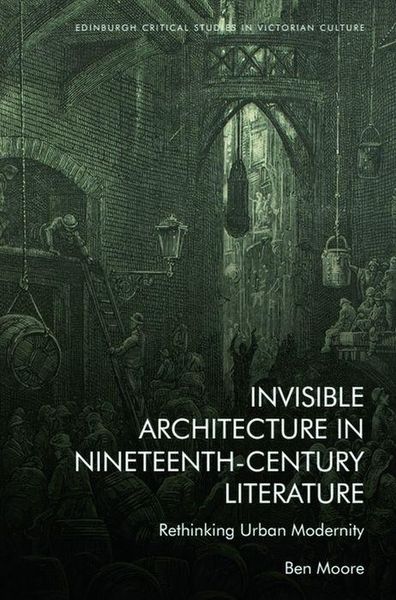
[headline]Rethinks the relationship between architecture, literature and (in)visibility in the nineteenth-century city Ben Moore presents a new approach to reading urban modernity in nineteenth-century literature, by bringing together hidden, mobile and transparent features of city space as part of a single system he calls 'invisible architecture'. Resisting narratives of the nineteenth-century as progressing from concealment to transparency, he instead argues for a dynamic interaction between these tendencies. Across two parts, this book addresses a range of apparently disparate buildings and spaces. Part I offers new readings of three writers and their cities: Elizabeth Gaskell and Manchester, Charles Dickens and London, and Émile Zola and Paris, focusing on the cellar-dwelling, the railway and river, and the department store respectively. Part II takes a broader view by analysing three spatial forms that have not usually been considered features of nineteenth-century modernity: the Gothic cathedral, the arabesque and white walls. Through these readings, the book extends our understanding of the uneven modernity of this period. [bio]Ben Moore is Assistant Professor in English Literature at the University of Amsterdam, Netherlands. He is the author of Human Tissue in the Realist Novel, 1850-1895 (2023) and Co-Editor of the Gaskell Journal. His work has appeared in journals including Victorian Literature and Culture, Modernism/modernity, Modern Language Review and the Journal of Victorian Culture, as well as in various handbooks and edited collections.
Kundinnen und Kunden meinen
0.0/5.0
0 Bewertungen
Verfassen Sie die erste Bewertung zu diesem Artikel
Helfen Sie anderen Kund*innen durch Ihre Meinung
Kurze Frage zu unserer Seite
Vielen Dank für dein Feedback
Wir nutzen dein Feedback, um unsere Produktseiten zu verbessern. Bitte habe Verständnis, dass wir dir keine Rückmeldung geben können. Falls du Kontakt mit uns aufnehmen möchtest, kannst du dich aber gerne an unseren Kund*innenservice wenden.