Apology
-
- Hardcover
- Taschenbuch ausgewählt
- eBook
- Hörbuch
-
Sprache:Englisch
-
Verlag:Binker North
- Lector House 11,99 €
- Outlook 14,90 €
- Alpha Editions 18,99 €
- The Library of Alexandria 16,99 €
- Tredition 12,90 €
- Insight Publica 9,99 €
- Les prairies numériques 21,99 €
- Sanage Publishing House 14,99 €
- Digireads.com 11,99 €
- Creative Media Partners, LLC 21,99 €
- Independently Published 9,99 €
- Binker North 14,99 € ausgewählt
- Merchant Books 13,99 €
- Double 9 Booksllp 16,99 €
- Antigonos Verlag 14,90 €
- Antiquum Novum Verlag 11,90 €
14,99 €
inkl. gesetzl. MwSt.,
Beschreibung
Produktdetails
Einband
Taschenbuch
Erscheinungsdatum
03.06.2023
Verlag
Binker NorthSeitenzahl
38
Maße (L/B/H)
22,9/15,2/0,3 cm
Gewicht
72 g
Sprache
Englisch
ISBN
978-1-77441-960-1
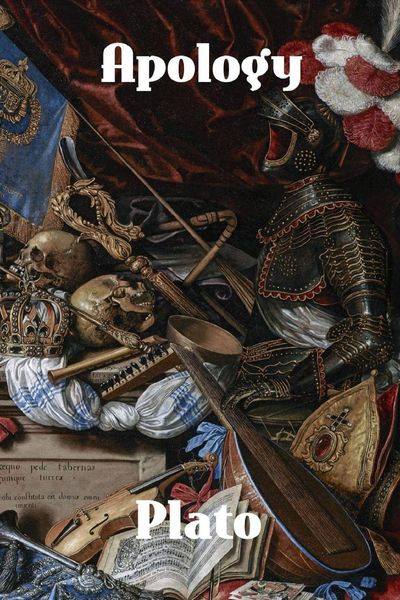
The Apology of Socrates is a Socratic dialogue of the speech of legal self-defence which Socrates (469-399 BC) spoke at his trial for impiety and corruption in 399 BC. Specifically, the Apology of Socrates is a defence against the charges of "corrupting the youth" and "not believing in the gods in whom the city believes, but in other daimonia that are novel" to Athens (24b).[2] Among the primary sources about the trial and death of the philosopher Socrates, the Apology of Socrates is the dialogue that depicts the trial, and is one of four Socratic dialogues, along with Euthyphro, Phaedo, and Crito, through which Plato details the final days of the philosopher Socrates. The Apology of Socrates begins with Socrates addressing the jury of perhaps 500 Athenian men to ask if they have been persuaded by the Orators Lycon, Anytus, and Meletus, who have accused Socrates of corrupting the young people of the city and impiety against the pantheon of Athens. The first sentence of his speech establishes the theme of the dialogue-that philosophy begins with an admission of ignorance. Socrates later clarifies that point of philosophy when he says that whatever wisdom he possesses comes from knowing that he knows nothing (23b, 29b). In the course of the trial, Socrates imitates, parodies, and corrects the Orators, his accusers, and asks the jury to judge him by the truth of his statements, not by his oratorical skill (cf. Lysias XIX 1,2,3; Isaeus X 1; Isocrates XV 79; Aeschines II 24). Socrates says he will not use sophisticated language-carefully arranged ornate words and phrases-but will speak using the common idiom of the Greek language. Socrates says that he will speak in the manner he has used in the agora and at the money tables which he states is his native tongue and the fashion of his country. Although offered the opportunity to appease the prejudices of the jury, with a minimal concession to the charges of corruption and impiety, Socrates does not yield his integrity to avoid the penalty of death. The jury condemns Socrates to death.
Noch keine Bewertungen vorhanden
Verfassen Sie die erste Bewertung zu diesem Artikel
Helfen Sie anderen Kundinnen und Kunden durch Ihre Meinung.
Kurze Frage zu unserer Seite
Vielen Dank für dein Feedback
Wir nutzen dein Feedback, um unsere Produktseiten zu verbessern. Bitte habe Verständnis, dass wir dir keine Rückmeldung geben können. Falls du Kontakt mit uns aufnehmen möchtest, kannst du dich aber gerne an unseren Kund*innenservice wenden.
zum Kundenservice