KI-Beratung Beta

Gutscheinbedingungen

**Gültig vom 23.11. bis 30.11.2026 | Gültig für nicht preisgebundene fremdsprachige Bücher | Einzelne Artikel können ausgeschlossen sein | Online auf www.bücher.de einlösbar | Click & Collect nur mit Online-Zahlung (Paypal/Kreditkarte) vorab | Nicht kombinierbar mit anderen Gutscheinen oder Preisaktionen | Nur einmal pro Einkauf einlösbar | Gutschein wird auf max. 500€ Bestellwert angerechnet | Keine Barauszahlung | Nicht gültig für Versandkosten und Services

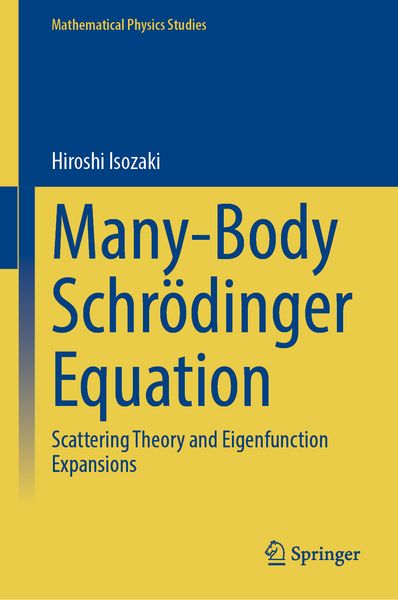
  • Produktbild: Many-Body Schrödinger Equation
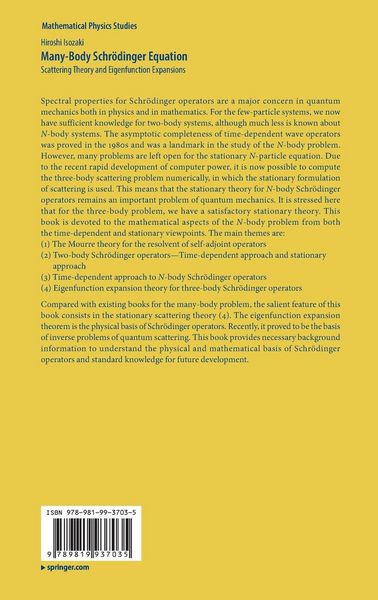
  • Produktbild: Many-Body Schrödinger Equation
- 12%

Many-Body Schrödinger Equation Scattering Theory and Eigenfunction Expansions

12% sparen

139,99 € UVP 160,49 €

inkl. gesetzl. MwSt., Versandkostenfrei


Beschreibung

Spectral properties for Schrödinger operators are a major concern in quantum mechanics both in physics and in mathematics. For the few-particle systems, we now have sufficient knowledge for two-body systems, although much less is known about N -body systems. The asymptotic completeness of time-dependent...

Beschreibung

Spectral properties for Schrödinger operators are a major concern in quantum mechanics both in physics and in mathematics. For the few-particle systems, we now have sufficient knowledge for two-body systems, although much less is known about
N
-body systems. The asymptotic completeness of time-dependent wave operators was proved in the 1980s and was a landmark in the study of the
N
-body problem. However, many problems are left open for the stationary
N
-particle equation. Due to the recent rapid development of computer power, it is now possible to compute the three-body scattering problem numerically, in which the stationary formulation of scattering is used. This means that the stationary theory for
N
-body Schrödinger operators remains an important problem of quantum mechanics. It is stressed here that for the three-body problem, we have a satisfactory stationary theory. This book is devoted to the mathematical aspects of the
N
-body problem from both the time-dependent and stationary viewpoints. The main themes are:(1) The Mourre theory for the resolvent of self-adjoint operators(2) Two-body Schrödinger operators—Time-dependent approach and stationary approach(3) Time-dependent approach to
N
-body Schrödinger operators(4) Eigenfunction expansion theory for three-body Schrödinger operatorsCompared with existing books for the many-body problem, the salient feature of this book consists in the stationary scattering theory (4). The eigenfunction expansion theorem is the physical basis of Schrödinger operators. Recently, it proved to be the basis of inverse problems of quantum scattering. This book provides necessary background information to understand the physical and mathematical basis of Schrödinger operators and standard knowledge for future development. 

Rezension

“Both in terms of its content and the manner of its presentation, the book is a very advanced monograph. Its study will benefit primarily those readers, more likely mathematicians than physicists, who will already have a good deal of knowledge on the spectral theory of partial differential operators and related subjects.” (Radosław Szmytkowski, zbMATH 1569.81001, 2026)

Produktdetails

Einband

Gebundene Ausgabe

Erscheinungsdatum

28.07.2023

Abbildungen

XVII, 399 p. 10 illus.

Verlag Springer Singapore

Produktdetails

Einband

Gebundene Ausgabe

Erscheinungsdatum

28.07.2023

Abbildungen

XVII, 399 p. 10 illus.

Verlag Springer Singapore
Seitenzahl

399

Maße (L/B/H)

24,1/16/2,9 cm

Gewicht

741 g

Auflage

2023

Sprache

Englisch

ISBN

978-981-9937-03-5

Herstelleradresse

Springer-Verlag KG
Sachsenplatz 4-6
1201 Wien
AT

Email: ProductSafety@springernature.com

Noch keine Bewertungen vorhanden

Verfassen Sie die erste Bewertung zu diesem Artikel

Helfen Sie anderen Kundinnen und Kunden durch Ihre Meinung.

Kundinnen und Kunden meinen

Bewertungen (0)

  • Produktbild: Many-Body Schrödinger Equation
  • Produktbild: Many-Body Schrödinger Equation
  • Self-Adjoint Operators and Spectra.- Two-Body Problem.- Asymptotic Completeness for Many-Body Systems.- Resolvent of Multi-Particle System.- Three-Body Problem and the Eigenfunction Expansion.- Supplement.