
KI-Beratung Beta

  • Produktbild: Emerging Federal Structures in the Post-Cold War Era
  • Produktbild: Emerging Federal Structures in the Post-Cold War Era
- 13%

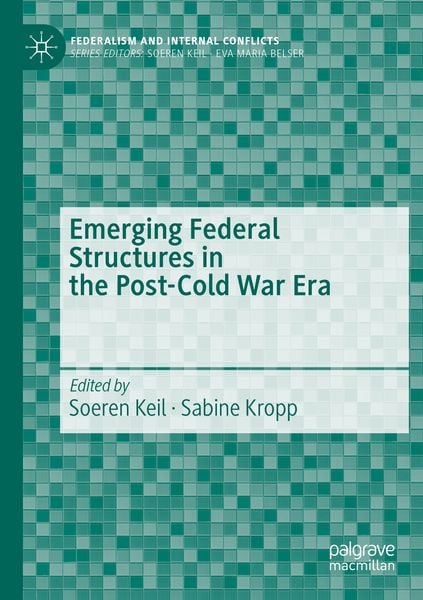
Emerging Federal Structures in the Post-Cold War Era

13% sparen

129,99 € UVP 149,79 €

inkl. gesetzl. MwSt., Versandkostenfrei


Beschreibung

This book conceives federalism not as a static institutional architecture, but as a dynamic formation always in flux. This may entail processes of federalization, but in some cases also lead to de-federalization. It looks at emerging federal structures worldwide and analyses federal structures: their...

Beschreibung

This book conceives federalism not as a static institutional architecture, but as a dynamic formation always in flux. This may entail processes of federalization, but in some cases also lead to de-federalization. It looks at emerging federal structures worldwide and analyses federal structures: their emergence, operation and categorization. The contributors highlight that the “emergence” of these federal structures has multiple facets, from the recognition of ethnic diversity to the use of federalism as a tool of conflict resolution. Identifying and categorizing processes of federalization and defederalization in a variety of cases, the book provides much needed empirical and theoretical discussion on emerging federal structures and the changing nature of federalism in the post-Cold War era.

Rezension

“This book is a significant contribution to the literature that genuinely advances our understanding of federalism. … The process-driven framework and empirical findings provide a good starting point for further studies … . I am confident that this book will be a valuable resource for scholars working on topics such as multilevel governance, substate nationalism, state-building, and conflict management in divided societies for many years to come.” (Felix Schulte, Nations and Nationalism, Vol. 29 (2), April, 2023)

Portrait


Soeren Keil
 is Academic Head of the International Research and Consulting Center of the Institute of Federalism at the University of Fribourg, Switzerland.


Sabine Kropp
 is Professor and Chair-Holder in German Politics at the Freie Universität Berlin, Germany.


Produktdetails

Einband

Taschenbuch

Erscheinungsdatum

20.05.2023

Abbildungen

XIX, 338 p. 25 illus.

Herausgeber Soeren Keil + weitere

Produktdetails

Einband

Taschenbuch

Erscheinungsdatum

20.05.2023

Abbildungen

XIX, 338 p. 25 illus.

Herausgeber
Verlag Springer
Seitenzahl

338

Maße (L/B/H)

21/14,8/2 cm

Gewicht

466 g

Auflage

23001 Auflage 1st ed. 2022

Sprache

Englisch

ISBN

978-3-030-93671-6

Herstelleradresse

Springer-Verlag GmbH
Tiergartenstr. 17
69121 Heidelberg
DE

Email: ProductSafety@springernature.com

Noch keine Bewertungen vorhanden

Verfassen Sie die erste Bewertung zu diesem Artikel

Helfen Sie anderen Kundinnen und Kunden durch Ihre Meinung.

Kundinnen und Kunden meinen

Bewertungen (0)

  • Produktbild: Emerging Federal Structures in the Post-Cold War Era
  • Produktbild: Emerging Federal Structures in the Post-Cold War Era

  • Part 1. Introduction: Theoretical and Empirical Dimensions.- Chapter 1. The Emergence and Regression of Federal Structures: Theoretical Lenses and Analytical Dimensions (Sabine Kropp and Soeren Keil).- Part 2 . Case Studies.- Chapter 2. Belgium: Federalism as a Stopover? (Petra Meier).- Chapter 3. Spain and the United Kingdom: Between Unitary State Tradition and Federalization (Paul Anderson).- Chapter 4. Federal Regression and the Authoritarian Turn in Russia (Stanislav Klimovich and Sabine Kropp).- Chapter 5. Why No Federalism? - The Challenges of Institutionalizing a Multilevel Order in Ukraine (Sabine Kropp and Jørn Holm-Hansen).- Chapter 6. The Emergence of Complex Federal Political Systems in the Western Balkans (Soeren Keil).- Chapter 7. Federalism and Conflict Resolution in Nepal and Myanmar (Michael G. Breen).- Chapter 8. India: An Emerging or Fragile Federation? (Wilfried Swenden).- Chapter 9. Learning from Iraq? - Debates on Federalism and Decentralisation for post-war Syria(Eva Maria Belser and Soeren Keil).- Chapter 10. Federalism in Ethiopia: Emergence, Progress and Challenges (Yonatan Tesfaye Fessha and BezaDessalegn).- Chapter 11. The ‘federal solution’ to diversity conflicts in South Africa and Kenya: partial at most (Nico Steytler).- Chapter 12. Institutional Instability and (De)federalizing Processes in Colombia (Kent Eaton).- Chapter 13. Federalism in the European Union (Eva G. Heidbreder).- Part 3. Concluding Remarks.- Chapter 14. Conclusion: Emergence, Operation and Categorization of Federal Structures in the Post-Cold War Era (Soeren Keil and Sabine Kropp).