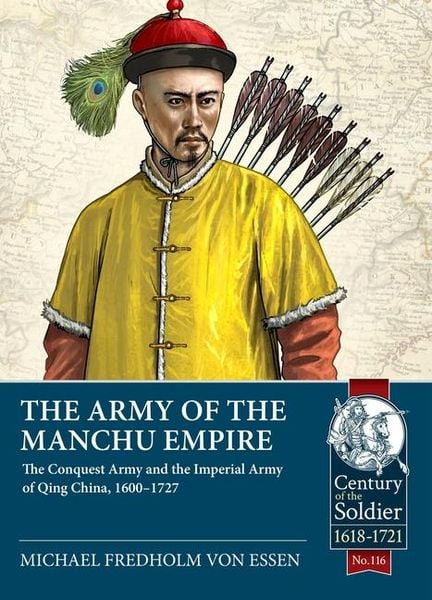
The Army of the Manchu Empire The Conquest Army and the Imperial Army of Qing China, 1600-1727
Aus der Reihe
Century of the Soldier 1618-1721
-
- Englisch ausgewählt
37,99 €
inkl. gesetzl. MwSt.,
Lieferung nach Hause
Beschreibung
Produktdetails
Einband
Taschenbuch
Erscheinungsdatum
30.04.2024
Abbildungen
138 b/w illustrations, 77 b/w photos, 20 color plates, 1 b/w map, 7 tables
Verlag
Helion & CompanySeitenzahl
272
Maße (L/B/H)
24,6/17,9/1,4 cm
Gewicht
682 g
Sprache
Englisch
ISBN
978-1-80451-347-7
New research on an army that details the military system of Qing China, which fought a variety of enemies ranging from Ming Chinese, Mongols, and Tibetans to Russians and Western Colonial armies.
This book describes and analyses the Manchu, or Qing, army in all its aspects. The emphasis lies on the Qing army in the seventeenth and early eighteenth century, because this is the time when the Manchu military system developed its own characteristics and reached maturity. Furthermore, having achieved this and in the process conquered one of the largest empires ever gained, the Qing army changed but little before c. 1850, when the Taiping War marked the beginning of the end of the Qing empire, as well as changed the character of the Manchu military system.
In its heyday, the Qing army achieved a number of significant victories. First, it conquered Ming China. The Qing consistently achieved victories against numerically superior Ming armies. The Qing military operated as combined arms armies, successfully joining the various strengths of cavalry, infantry, and artillery. The Qing army was for cultural and historical reasons particularly strong in cavalry, as could be expected from a power that had incorporated numerous Mongols into its ranks. On the strategic level, this intimate level of cooperation with steppe nomads and the deep understanding thereby achieved of steppe politics and political systems of nomad states, enabled the Qing state to extend its borders further to the north and west than any previous sedentary ruler of China.
In the tropical countries to the south of China, the Qing army experienced both victories and serious losses, especially to disease. In this they showed similarities with the various European armies of the time. The Portuguese colonial troops in southern China proved no obstacle to Qing conquests.
Perhaps the clearest indication of the versatility of the Qing military system was its successful containment of the very active Russian expansion then underway. The two treaties of Nerchinsk in 1689 and Kyakhta in 1727 delimited the Manchu-Russian border exactly where the Manchus wanted it to be, and the border selected by the Manchus remained unchallenged until the second half of the nineteenth century. Indeed, the border delimited at that time forms the backbone of the national borders of the region to this day.
In this book, Michael Fredholm von Essen presents new research on an army and military campaigns previously seldom described in English. He explains the development of the Manchu Conquest and Imperial Qing Armies and details the military system of Qing China, which until 1912 fought a variety of enemies ranging from Ming Chinese, Koreans, Mongols, Tibetans, Gurkhas, Burmese, and Vietnamese to Russians and Western Colonial armies.
This book describes and analyses the Manchu, or Qing, army in all its aspects. The emphasis lies on the Qing army in the seventeenth and early eighteenth century, because this is the time when the Manchu military system developed its own characteristics and reached maturity. Furthermore, having achieved this and in the process conquered one of the largest empires ever gained, the Qing army changed but little before c. 1850, when the Taiping War marked the beginning of the end of the Qing empire, as well as changed the character of the Manchu military system.
In its heyday, the Qing army achieved a number of significant victories. First, it conquered Ming China. The Qing consistently achieved victories against numerically superior Ming armies. The Qing military operated as combined arms armies, successfully joining the various strengths of cavalry, infantry, and artillery. The Qing army was for cultural and historical reasons particularly strong in cavalry, as could be expected from a power that had incorporated numerous Mongols into its ranks. On the strategic level, this intimate level of cooperation with steppe nomads and the deep understanding thereby achieved of steppe politics and political systems of nomad states, enabled the Qing state to extend its borders further to the north and west than any previous sedentary ruler of China.
In the tropical countries to the south of China, the Qing army experienced both victories and serious losses, especially to disease. In this they showed similarities with the various European armies of the time. The Portuguese colonial troops in southern China proved no obstacle to Qing conquests.
Perhaps the clearest indication of the versatility of the Qing military system was its successful containment of the very active Russian expansion then underway. The two treaties of Nerchinsk in 1689 and Kyakhta in 1727 delimited the Manchu-Russian border exactly where the Manchus wanted it to be, and the border selected by the Manchus remained unchallenged until the second half of the nineteenth century. Indeed, the border delimited at that time forms the backbone of the national borders of the region to this day.
In this book, Michael Fredholm von Essen presents new research on an army and military campaigns previously seldom described in English. He explains the development of the Manchu Conquest and Imperial Qing Armies and details the military system of Qing China, which until 1912 fought a variety of enemies ranging from Ming Chinese, Koreans, Mongols, Tibetans, Gurkhas, Burmese, and Vietnamese to Russians and Western Colonial armies.
Kundinnen und Kunden meinen
Verfassen Sie die erste Bewertung zu diesem Artikel
Helfen Sie anderen Kund*innen durch Ihre Meinung
Kurze Frage zu unserer Seite
Vielen Dank für dein Feedback
Wir nutzen dein Feedback, um unsere Produktseiten zu verbessern. Bitte habe Verständnis, dass wir dir keine Rückmeldung geben können. Falls du Kontakt mit uns aufnehmen möchtest, kannst du dich aber gerne an unseren Kund*innenservice wenden.
zum Kundenservice