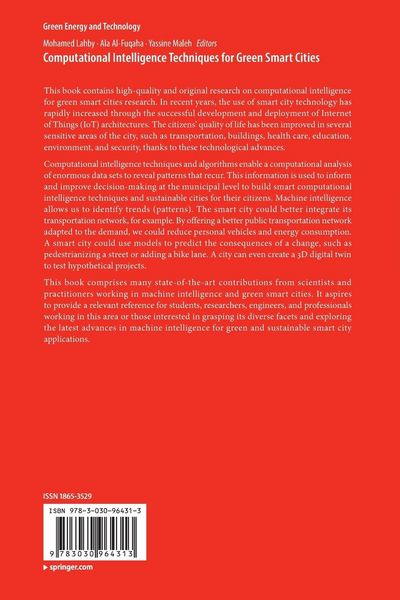
• Produktbild: Computational Intelligence Techniques for Green Smart Cities
  • Produktbild: Computational Intelligence Techniques for Green Smart Cities
- 12%

Computational Intelligence Techniques for Green Smart Cities

12% sparen

139,99 € UVP 160,49 €

inkl. gesetzl. MwSt., Versandkostenfrei

Lieferung nach Hause

Beschreibung

Produktdetails

Einband

Taschenbuch

Erscheinungsdatum

23.04.2023

Herausgeber

Mohamed Lahby + weitere

Verlag

Springer

Seitenzahl

419

Maße (L/B/H)

23,5/15,5/2,4 cm

Gewicht

658 g

Auflage

1st ed. 2022

Sprache

Englisch

ISBN

978-3-030-96431-3

Beschreibung

Portrait

Mohamed Lahby is an Associate Professor at the Higher Normal School (ENS) University Hassan II of Casablanca, Morocco. His PhD in Computer Science from the Faculty of Sciences and Technology of Mohammedia, University Hassan II of Casablanca, in 2013. His research interests are wireless communication and network, mobility management, QoS/QoE, Internet of things, Smart cities, Optimization and Machine learning. He has published more than 35 papers (book chapters, international journals, and conferences), 3 edited books, and 2 authored books. He has served and continues to serve on executive and technical program committees of numerous international conferences such as IEEE PIMRC, ICC, NTMS, IWCMC, WINCOM, ISNCC. He also serves as a referee of many prestigious Elsevier journals : Ad Hoc Networks, Applied Computing and Informatics and International journal of disaster risk reduction. He organized and participated in more than 40 conferences and workshops. He is the chair of manyinternational workshops and special sessions such as MLNGSN’19, CSPSC’19, MLNGSN’20, AI2SC ’20, WCTCP’20, CIOT’2022.

Ala Al-Fuqaha is a professor at the Computer Science department, Hamad Bin Khalifa University, Qatar. His research interests include the use of machine learning in general and deep learning in particular in support of the data-driven and self-driven management of large-scale deployments of Internet of Things and smart city infrastructure and services, Wireless Vehicular Networks, cooperation and spectrum access etiquette in cognitive radio networks, and management and planning of software defined networks. He is a senior member of the IEEE and an ABET commissioner. He serves on editorial boards of multiple journals including IEEE Communications Letter, IEEE Network Magazine, and Springer AJSE. He also served as chair, co-chair, and technical program committee member of multiple international conferences including IEEE VTC, IEEE Globecom, IEEE ICC, and IWCMC.

Yassine Maleh is an Associate Professor at the National School of Applied Sciences at Sultan Moulay Slimane University, Morocco. He received his PhD degree in Computer Science from Hassan 1st University, Morocco. He is a cybersecurity and Information Technology researcher and practitioner with industry and academic experience. He worked for the National Ports Agency in Morocco as an IT manager from 2012 to 2019. He is a Senior Member of IEEE, Member of the International Association of Engineers IAENG and The Machine Intelligence Research Labs. Dr Maleh has made contributions in the fields of information security and privacy, Internet of Things Security, Wireless and Constrained Networks Security. His research interests include Information Security and Privacy, Internet of Things, Networks Security, Information system and IT Governance. He has published over than 50 papers (Book chapters, international journals and conferences/workshops), 7 edited books and 3 authoredbooks. He is the editor in chief of the International Journal of Smart Security Technologies (IJSST). He serves as an Associate Editor for IEEE Access (2019 Impact Factor 4.098), the International Journal of Digital Crime and Forensics (IJDCF) and the International Journal of Information Security and Privacy (IJISP). He was also a Guest Editor of a special issue on Recent Advances on Cyber Security and Privacy for Cloud-of-Things of the International Journal of Digital Crime and Forensics (IJDCF), Volume 10, Issue 3, July-September 2019. He has served and continues to serve on executive and technical program committees and as a reviewer of numerous international conference and journals such as Elsevier Ad Hoc Networks, IEEE Network Magazine, IEEE Sensor Journal, ICT Express, and Springer Cluster Computing. He was the Publicity chair of BCCA 2019 and the General Chair of the MLBDACP 19 symposium. and Data Management.

Produktdetails

Einband

Taschenbuch

Erscheinungsdatum

23.04.2023

Herausgeber

Verlag

Springer

Seitenzahl

419

Maße (L/B/H)

23,5/15,5/2,4 cm

Gewicht

658 g

Auflage

1st ed. 2022

Sprache

Englisch

ISBN

978-3-030-96431-3

Herstelleradresse

Springer-Verlag GmbH
Tiergartenstr. 17
69121 Heidelberg
DE

Email: ProductSafety@springernature.com

Kundinnen und Kunden meinen

0 Bewertungen

Informationen zu Bewertungen

Zur Abgabe einer Bewertung ist eine Anmeldung im Konto notwendig. Die Authentizität der Bewertungen wird von uns nicht überprüft. Wir behalten uns vor, Bewertungstexte, die unseren Richtlinien widersprechen, entsprechend zu kürzen oder zu löschen.

Die Bewertungen sind nach Format, Anzahl Sterne und Datum sortiert.

Verfassen Sie die erste Bewertung zu diesem Artikel

Helfen Sie anderen Kund*innen durch Ihre Meinung

Kundinnen und Kunden meinen

0 Bewertungen filtern

  • Produktbild: Computational Intelligence Techniques for Green Smart Cities
  • Produktbild: Computational Intelligence Techniques for Green Smart Cities
  • Recent trends of  Artificial Intelligence Techniques.- An Overview of Smart Green Cities Based on XAI
    Machine Learning for Green Smart Health.- Deep Learning Models for Green Smart Health.- On natural language processing to attack COVID-19 pandemic.- Evolutionary Algorithms for Smart Green Transportation.- Analysis and design of the Bus Transport Network.- Traffic sign detection system for Smart City Transportation.- Green Smart Transportation solutions for combating Covid-19.- The Utilization of Forecasting Methods of Solar Radiation.- Machine learning for Green Smart Environment.- Deep learning for green smart environment.- Machine Learning & Fuzzy Technique for Environmental Time Series.- A new Fuzzy Clustering Algorithm based on Maximum Likelihood Estimation.- Optimal Environmental-Economic Scheduling of a smart home.- Smart Home Application based on Evolutionary Algorithm: a Transfer Learning Approach.- Machine learning for Green Home.- Machine learning for green smart video surveillance.- Green Learning Solutions for Human Trafficking Victims in Rural Communities During the COVID-19.- A comparative analysis on object detection accuracy of cloud-based image processing services.