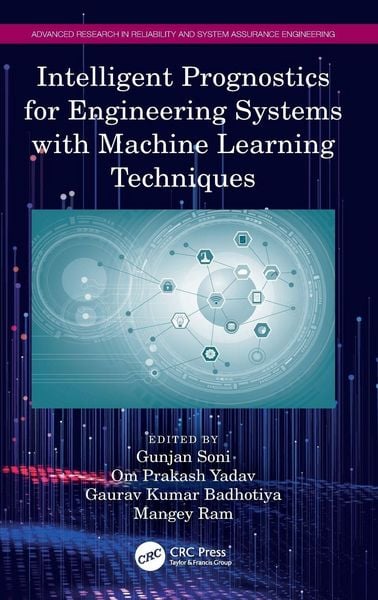
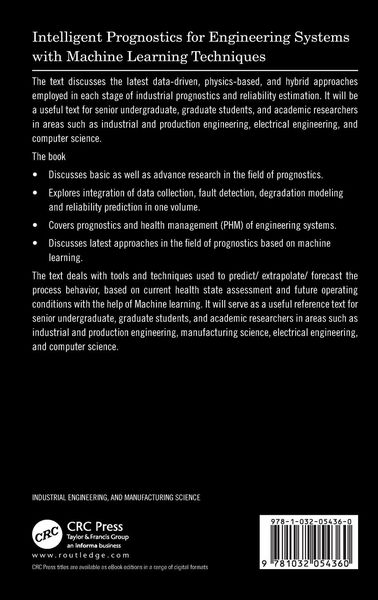
• Produktbild: Intelligent Prognostics for Engineering Systems with Machine Learning Techniques
  • Produktbild: Intelligent Prognostics for Engineering Systems with Machine Learning Techniques
- 21%

Intelligent Prognostics for Engineering Systems with Machine Learning Techniques Learning Technique

21% sparen

145,99 € UVP 186,20 €

inkl. gesetzl. MwSt., Versandkostenfrei

Lieferung nach Hause

Beschreibung

Produktdetails

Einband

Gebundene Ausgabe

Erscheinungsdatum

22.09.2023

Abbildungen

schwarz-weiss Illustrationen, farbige Illustrationen, Raster, schwarz-weiss, Zeichnungen, schwarz-weiss, Tabellen, schwarz-weiss

Herausgeber

Gunjan Soni + weitere

Verlag

Taylor & Francis

Seitenzahl

260

Maße (L/B/H)

24/16,1/1,9 cm

Gewicht

503 g

Sprache

Englisch

ISBN

978-1-03-205436-0

Beschreibung

Produktdetails

Einband

Gebundene Ausgabe

Erscheinungsdatum

22.09.2023

Abbildungen

schwarz-weiss Illustrationen, farbige Illustrationen, Raster, schwarz-weiss, Zeichnungen, schwarz-weiss, Tabellen, schwarz-weiss

Herausgeber

Verlag

Taylor & Francis

Seitenzahl

260

Maße (L/B/H)

24/16,1/1,9 cm

Gewicht

503 g

Sprache

Englisch

ISBN

978-1-03-205436-0

Herstelleradresse

Libri GmbH
Europaallee 1
36244 Bad Hersfeld
DE

Email: gpsr@libri.de

Noch keine Bewertungen vorhanden

Verfassen Sie die erste Bewertung zu diesem Artikel

Helfen Sie anderen Kundinnen und Kunden durch Ihre Meinung.

Kundinnen und Kunden meinen

Bewertungen (0)

Die Leseprobe wird geladen.
  • Produktbild: Intelligent Prognostics for Engineering Systems with Machine Learning Techniques
  • Produktbild: Intelligent Prognostics for Engineering Systems with Machine Learning Techniques
  • Chapter 1: A Bibliometric Analysis of Research on Tool Condition Monitoring
    Jeetesh Sharma, M.L. Mittal, Gunjan Soni

    1.1 Introduction
    1.2 Data Collection and Research Methodology
    1.3 Bibliometric Analysis
    1.4 Conclusion

    Chapter 2: Predicting Restoration Factor for Different Maintenance Types
    Neeraj Kumar Goyal, Tapash Kumar Das, Namrata Mohanty

    2.1 Introduction
    2.2 Proposed Model
    2.3 Case Study
    2.4 Conclusion

    Chapter 3: Measurement and Modeling of Cutting Tool Temperature during Dry Turning Operation of DSS
    P. Kumar, O.P.Yadav

    3.1. Introduction
    3.2. Materials and methods
    3.3. Results and discussion
    3.4. Empirical Modeling
    3.5. Conclusions

    Chapter 4: Leaf disease recognition: Comparative Analysis of Various Convolutional Neural Network Algorithms
    Vikas Kumar Roy, Ganpati Kumar Roy, Vasu Thakur, Nikhil Baliyan, Nupur Goyal

    4.1 Introduction
    4.2 Literature Review
    4.3 Dataset
    4.4 Methodology
    4.5 Results and discussion
    4.6 Conclusion

    Chapter 5: On the Validity of Parallel Plate Assumption for Modelling Leakage Flow past Hydraulic Piston-Cylinder Configurations
    Rishabh Gupta, Jatin Prakash, Ankur Miglani, Pavan Kumar Kankar

    5.1 Introduction
    5.2 The Leakage Flow Models
    5.3 Results and discussion
    5.4 Concluding remarks

    Chapter 6: Development of a hybrid MGWO-optimized Support vector machine approach for tool wear estimation
    N. Rajpurohit, Jeetesh Sharma, M. L. Mittal

    6.1 Introduction
    6.2 Materials and methods
    6.3 Results and discussion
    6.4 Conclusion and future work

    Chapter 7: The Energy Consumption Optimization Using Machine Learning Technique in Electrical Arc Furnaces (EAF)
    Rishabh Dwivedi, Ashutosh Mishra, Devesh Kumar, Amitkumar Patil

    7.1 Introduction:
    7.2 Literature Review
    7.3 Methodology
    7.4 Result and Discussion
    7.4.1Managerial Implications
    7.5 Conclusion Limitations and Future scope

    Chapter 8: PID based ANN control of Dynamic Systems
    A. Kharola

    8.1 Introduction
    8.2 Mathematical modeling of inverted double pendulum
    8.3 PID based ANN control of Inverted double pendulum System
    8.4 Simulation & Results Comparison
    8.5 Conclusion

    Chapter 9: Fatigue Damage Prognosis of Offshore Piping
    A. Keprate, N. Bagalkot

    9.1 Introduction
    9.2 Understanding Piping Fatigue
    9.3 Fatigue Damage Prognosis
    9.4 Case Study
    9.5 Conclusion

    Chapter 10: Minimization of Joint Angle Jerk for Industrial Manipulator based on Prognostic Behaviour
    Vaishnavi J, Bharat Singh, Ankit Vijayvargiya, Rajesh Kumar

    10.1 Introduction
    10.2 System Description
    10.3 Algorithms and Objective functions
    10.3.1 Objective Function
    10.3.2 Modified Objective Function
    10.3.3 Particle Swarm Optimization (PSO)
    10.4 Results and Discussion
    10.5 Conclusion

    Chapter 11: Estimation of bearing remaining useful life using exponential degradation model and random forest algorithm
    Pawan, Jeetesh Sharma, M. L. Mittal

    11.1 Introduction
    11.2 The proposed RUL estimate approach
    11.3 Experimental result and Discussion
    11.4 Conclusion

    Chapter 12: Machine Learning-based Predictive Maintenance for Diagnostics and Prognostics of Engineering Systems
    Ramnath Prabhu Bam, Rajesh S. Prabhu Gaonkar, Clint Pazhayidam George
    12.1 Introduction and Overview
    12.2 Diagnostics and Prognostics based on Predictive Maintenance
    12.3 Machine Learning for Predictive Maintenance
    12.4 Machine learning-based Predictive Maintenance in Engineering Systems
    12.5 Summary