Gutscheinbedingungen

**Gültig bis 10.06.2026 / Gültig für gebrauchte Bücher / Mindestbestellwert 20,00 € / Einzelne Artikel können ausgeschlossen sein / Online auf www.bücher.de.de / Nicht kombinierbar mit anderen Gutscheinen oder Preisaktionen / Nur einmal pro Einkauf einlösbar / Gutschein wird auf max. 500€ Bestellwert angerechnet / Keine Barauszahlung / Nicht gültig für Versandkosten und Services

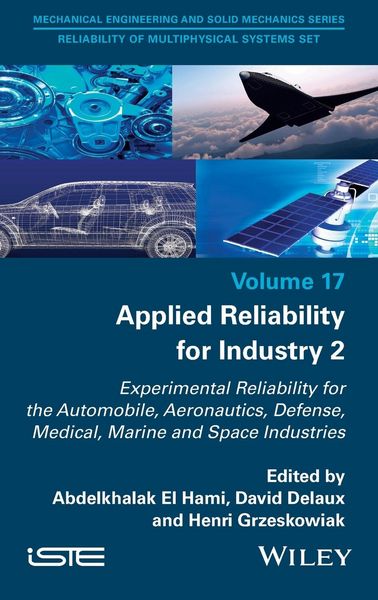
Produktbild: Applied Reliability for Industry 2

Applied Reliability for Industry 2

183,99 €

inkl. gesetzl. MwSt., Versandkostenfrei

Lieferung nach Hause

Beschreibung

Produktdetails

Einband

Gebundene Ausgabe

Erscheinungsdatum

09.05.2023

Herausgeber

Abdelkhalak El Hami + weitere

Verlag

Wiley

Seitenzahl

240

Maße (L/B/H)

24/16,1/1,8 cm

Gewicht

531 g

Sprache

Englisch

ISBN

978-1-78630-692-0

Beschreibung

Portrait

Abdelkhalak El Hami is Full Professor of Universities at INSA-Rouen-Normandie, France. He is the author/co-author of several books and is responsible for several European pedagogical projects. He is a specialist in fluid structure interaction and problems of optimization and reliability in multi-physical systems.

David Delaux is Reliability Director at Valeo and Reliability Senior Expert. An Honorary Visiting Professor at Bradford University, UK, he is also a national auditor/assessor at COFRAC (ISO 17025), President of the European Campus of Statistics Statistical Analysis For Industry (SAFI), Expert for the European Innovation Council and President of the association ASTE. He is also the former President of the European Reliability Environmental Confederation (CEEES).

Henri Grzeskowiak is a Technical Expert at Matra BAe Dynamics and MBDA (missile). He is also an auditor at COFRAC, Head of Department of Environmental Engineering (Matra & MBDA) as well as former President of the Standardization Committee for Mechanical & Climatic Environment (DGA) and of the association ASTE (France) and CEEES (Europe).

Produktdetails

Einband

Gebundene Ausgabe

Erscheinungsdatum

09.05.2023

Herausgeber

Verlag

Wiley

Seitenzahl

240

Maße (L/B/H)

24/16,1/1,8 cm

Gewicht

531 g

Sprache

Englisch

ISBN

978-1-78630-692-0

Herstelleradresse

Libri GmbH
Europaallee 1
36244 Bad Hersfeld
DE

Email: gpsr@libri.de

Kundinnen und Kunden meinen

0 Bewertungen

Informationen zu Bewertungen

Zur Abgabe einer Bewertung ist eine Anmeldung im Konto notwendig. Die Authentizität der Bewertungen wird von uns nicht überprüft. Wir behalten uns vor, Bewertungstexte, die unseren Richtlinien widersprechen, entsprechend zu kürzen oder zu löschen.

Die Bewertungen sind nach Format, Anzahl Sterne und Datum sortiert.

Verfassen Sie die erste Bewertung zu diesem Artikel

Helfen Sie anderen Kund*innen durch Ihre Meinung

Kundinnen und Kunden meinen

0 Bewertungen filtern

Die Leseprobe wird geladen.
  • Produktbild: Applied Reliability for Industry 2
  • Foreword ix
    Philippe EUDELINE

    Preface xi
    Abdelkhalak EL HAMI, David DELAUX and Henri GRZESKOWIAK

    Chapter 1 Aggravated Testing 1
    Henri GRZESKOWIAK, David DELAUX and Abdelkhalak EL HAMI

    1.1 Introduction to aggravated (or highly accelerated) testing 1

    1.2 Background 1

    1.3 General approach 3

    1.3.1 Robustness and reliability 5

    1.4 Types of products affected by aggravated tests 8

    1.5 Aeronautical sector example: effect of aging on the SOA (safe operating area) 13

    1.6 Typology of precipitated defects in HALT tests 14

    1.7 Carrying out tests with HALT machine's pneumatic hammers: inherent particularities and precautions 16

    1.8 Comparing vibration fatigue of HALT versus ALT testing 23

    1.8.1 Presentation of the adopted approach 23

    1.8.2 The fatigue damage spectrum 24

    1.8.3 Automotive case study: inverter/converter failure 28

    1.8.4 Comparison of accelerated and aggravated tests 38

    1.8.5 The standards 40

    1.9 References 41

    Chapter 2 Fatigue Damage Analysis and Reliability Optimization of Structures Subjected to Random Vibrations 47
    Ahmed YAICH and Abdelkhalak EL HAMI

    2.1 Introduction 47

    2.2 Fatigue damage analysis 48

    2.2.1 Formulations and developments 48

    2.2.2 Fatigue damage analysis strategy 51

    2.3 Reliability optimization of structures subjected to random vibrations 52

    2.3.1 Deterministic design optimization 52

    2.3.2 Reliability-based design optimization 53

    2.3.3 Reliability optimization of structures subjected to random vibrations 62

    2.4 Applications 64

    2.4.1 Description of the problem 64

    2.4.2 Results and discussion 67

    2.5 Conclusion 71

    2.6 References 72

    Chapter 3 Accelerated Testing 77
    Henri GRZESKOWIAK, David DELAUX and Abdelkhalak EL HAMI

    3.1 The different types of tests 77

    3.1.1 The calculations 78

    3.1.2 The simulations 78

    3.1.3 The tests 79

    3.1.4 Links between the three types of demonstrations 80

    3.2 General information on accelerated testing 80

    3.2.1 The experimental models 83

    3.2.2 Statistical models 83

    3.2.3 The physical models 83

    3.3 The principle, methodology and implementation of accelerated testing 83

    3.3.1 Definition and key concepts 84

    3.3.2 Evaluating the predictive reliability of a system by performing tests 86

    3.3.3 Accelerated tests (based on the physical model): example of temperature acceleration 88

    3.3.4 Evaluating the predicted reliability of a system in relation to an imposed lifetime and environmental constraints 88

    3.3.5 Humid heat 90

    3.3.6 Temperature 91

    3.3.7 Multi-stress laws 92

    3.3.8 Accelerated testing in practice 92

    3.3.9 Reliability assessment for wear-and-tear related failure mechanisms 93

    3.3.10 Conclusion of section 94

    3.4 The different phases of building a reliability validation plan 95

    3.5 Development of a corrosion environment test for automotive heat exchangers 97

    3.6 Accelerated testing standards 107

    3.7 Conclusion 109

    3.8 References 109

    Chapter 4 Collection of Standards NF 50-144-1 to 6: The Consideration of Environment in the Product Lifecycle 113
    Henri GRZESKOWIAK, David DELAUX and Abdelkhalak EL HAMI

    4.1 Introduction 113

    4.2 Presentation of AFNOR NF 50-144-1 to 6 114

    4.3 Focus on NF X50-144-3 119

    4.3.1 The four steps of the methodology 120

    4.3.2 Focus on step 3: the DBM 126

    4.3.3 Focus on step 3: illustrations of the disjointed blocks method 134

    4.3.4 Example of test customization for the A400 M aircraft 140

    4.5 References 143

    Chapter 5 Development of Vibration Specifications for Powertrain Components 145
    Marco BONATO

    5.1 Introduction 145

    5.1.1 Combustion engine vibration 146

    5.2 Types of vibration signals for validation testing 148

    5.2.1 Conventional signals used in the automotive industry 148

    5.2.2 Validation tests for engine mounted heat exchangers 148

    5.2.3 Recent developments: customizing vibration specifications 149

    5.2.4. The FFT method: test signal in PSD form and sinusoidal sweep 150

    5.2.5 The customized test method 151

    5.3 Case study: vibratory specification for a water-cooled WCAC 153

    5.3.1 Vibration signals: PSD and sinusoidal sweep 154

    5.4 Development of a signal more representative of the real-world environment 156

    5.4.1 Multi-sine sweeps over noise 157

    5.4.2 Comparison with existing methods 159

    5.4.3 Subsequent work 160

    5.5 References 160

    Chapter 6 Improving Accelerated Reliability Testing by Using Optimized Signals 163
    Jonathan MARTINO

    6.1 Introduction 164

    6.2 General considerations 165

    6.2.1 Multi-sine signals 166

    6.3 Kurtosis and CF 170

    6.3.1 Kurtosis 170

    6.3.2 Crest factor 171

    6.4 Optimization of multi-sine pseudo-random signals 172

    6.4.1 Controlling the CF by optimizing the phase shifts 172

    6.4.2 Preliminary treatment 173

    6.4.3 Analytical determination 174

    6.4.4 Numerical methods 174

    6.4.5 Stochastic distribution of signals with low CF 175

    6.4.6 Use of optimized low-peak signals for environmental testing 176

    6.4.7 Kurtosis control through non-linear manipulation 178

    6.4.8 Duality between kurtosis and CF 179

    6.5 Damage assessment 182

    6.5.1 Fatigue damage spectrum 182

    6.5.2 Reducing the test duration 186

    6.5.3 Influence of signal optimization in damage assessment 186

    6.6 Conclusion 192

    6.7 References 193

    List of Authors 197

    Index 199

    Summaries of other volumes 203