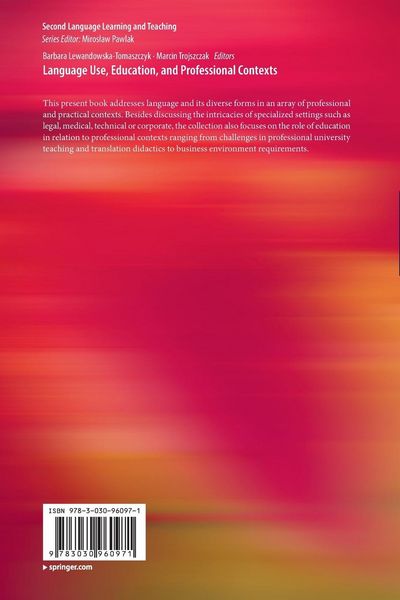
• Produktbild: Language Use, Education, and Professional Contexts
  • Produktbild: Language Use, Education, and Professional Contexts
- 13%

Language Use, Education, and Professional Contexts

13% sparen

119,99 € UVP 139,09 €

inkl. gesetzl. MwSt., Versandkostenfrei

Lieferung nach Hause

Beschreibung

Produktdetails

Einband

Taschenbuch

Erscheinungsdatum

08.04.2023

Herausgeber

Barbara Lewandowska-Tomaszczyk + weitere

Verlag

Springer

Seitenzahl

227

Maße (L/B/H)

23,5/15,5/1,4 cm

Gewicht

371 g

Auflage

1st ed. 2022

Sprache

Englisch

ISBN

978-3-030-96097-1

Beschreibung

Portrait

Barbara Lewandowska-Tomaszczyk is Professor Ordinarius Dr habil. in Linguistics and English Language at the Department of Language and Communication at the State University of Applied Sciences in Konin (Poland), formerly employed at the University of Lodz. Her research focuses on cognitive semantics and pragmatics of language contrasts, corpus linguistics and their applications in translation studies, lexicography and discourse analysis. She is invited to read papers at international conferences and to lecture and conduct seminars at universities. She publishes extensively, supervises dissertations and is also active in organizing international conferences and workshops. ORCID: 0000-0002-6836-3321

Marcin Trojszczak is PhD in Cognitive Linguistics and MA in Philosophy from the University of Lodz. He is currently working as a research assistant at the University of Bialystok (Poland) and as an assistant professor at the State University of Applied Sciences in Konin (Poland). His research focuses on metaphorical conceptualisations of cognitive and emotional processes, the role of normativity and genericity in language and cognition, in particular normative generics, and the impact of evolving translation technologies on translator training. ORCID: 0000-0003-3062-9670

Produktdetails

Einband

Taschenbuch

Erscheinungsdatum

08.04.2023

Herausgeber

Verlag

Springer

Seitenzahl

227

Maße (L/B/H)

23,5/15,5/1,4 cm

Gewicht

371 g

Auflage

1st ed. 2022

Sprache

Englisch

ISBN

978-3-030-96097-1

Herstelleradresse

Springer-Verlag GmbH
Tiergartenstr. 17
69121 Heidelberg
DE

Email: [email protected]

Kundinnen und Kunden meinen

0 Bewertungen

Informationen zu Bewertungen

Zur Abgabe einer Bewertung ist eine Anmeldung im Konto notwendig. Die Authentizität der Bewertungen wird von uns nicht überprüft. Wir behalten uns vor, Bewertungstexte, die unseren Richtlinien widersprechen, entsprechend zu kürzen oder zu löschen.

Die Bewertungen sind nach Format, Anzahl Sterne und Datum sortiert.

Verfassen Sie die erste Bewertung zu diesem Artikel

Helfen Sie anderen Kund*innen durch Ihre Meinung

Kundinnen und Kunden meinen

0 Bewertungen filtern

Weitere Artikel findest du in

  • Produktbild: Language Use, Education, and Professional Contexts
  • Produktbild: Language Use, Education, and Professional Contexts
  • 1. A Rational Activity or Rhetorical Practice?  Evaluation Practices in Legal Argumentation.- 2. Cross-Linguistic and Cross-Cultural Conceptualization of Specialized Terms in Corporate Culture.- 3. Word Association Measures, Collocation Networks and Medical English: a Corpus-assisted Study of Post-hospital Patient Information Booklets.- 4. Polish and Russian Geological Names in the Context of Linguistic Transfer – Selected Examples.- 5. Implementation of Professional Language Terminology in Polish Production Companies.- 6. Making University-Level foreign Language Education more Responsive to Professional Needs.- 7. Engineering Students' Views on ESP for Internationalization.- 8. Professional Contexts and Task-based American-Polish Student Online Cooperation.- 9. Professional Growth of EFL Teachers.- 10. Participatory Theatre as Development Tools for Higher Education during the Pandemic.-11. Challenges faced by the University Students during Covid-19 Pandemic in Poland.- 12.Linguistic Mediation in Practice - on the Professional Competencies of English Language Teachers and Translators.- 13. Translation Didactics Meets Machine Translation. 14. Directionality in Translation: Using Eye-tracking to look into the Cognitive Effort of StudentTranslators.