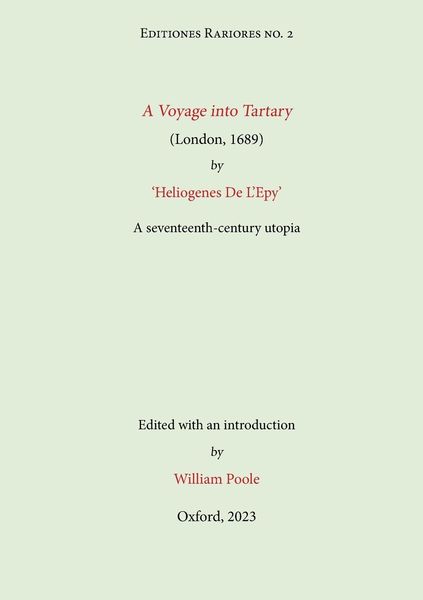
A Voyage into Tartary (London, 1689) by Heliogenes De L'Epy A seventeenth-century Utopia
-
- Englisch ausgewählt
55,99 €
inkl. gesetzl. MwSt.,
Lieferung nach Hause
Beschreibung
Produktdetails
Einband
Taschenbuch
Erscheinungsdatum
13.02.2023
Herausgeber
William PooleVerlag
William PooleSeitenzahl
170
Maße (L/B/H)
21/14,8/1,1 cm
Gewicht
335 g
Sprache
Englisch
ISBN
978-1-83822-666-4
A Voyage into Tartary (London, 1689), by a writer calling himself 'Heliogenes De L'Epy', is a hitherto unedited seventeenth-century utopia, purportedly written by a French traveller, but in all likelihood the work of a hidden English author. The text has often been mistaken over the centuries as a genuine piece of travel writing, but in reality A Voyage into Tartary is fictional throughout, and its latter half consists of a utopia of unusually radical parameters. Heliogenes recounts how he travelled far into the lands of 'Tartary' (a region chiefly overlapping with the modern Russian and Chinese lands), where he encounters an isolated but advanced civilisation living in communism and worshipping the Sun. These 'Heliopolitans' are the descendants of Greek philosophers who travelled east in the aftermath of the death of Alexander the Great, and who preserve to this day the ancient Greek language. These Sun-worshipping philosophers, however, turn out to be borderline atheists, paying homage to the Sun merely as the most powerful visible material thing, but who admit neither a Creator God in the manner of monotheistic, providential religions, nor indeed any higher non-material principle at all. They regard Christianity, when it is explained to them by Heliogenes, as obviously spurious, shelving Heliogenes' copy of the New Testament among the books of 'mythology' in their state library. As Heliogenes complains, 'All the while that I convers'd with them, I could not find that they had any Notion of God after our manner.' A Voyage into Tartary is a remarkable and almost unknown text of the period, influenced by recent writing in both English and French, including French utopian texts such as Denis Veiras's The History of the Sevarites (1675-) and Gabriel de Foigny's ¿¿La Terre Australe connue (1676). But its achievement is distinctive, as are its opening sections of pseudo-travel in Greek, Turkish, and Persian lands. It deserves to be more widely known, and to that end this editio princeps provides a fully annotated text of the only edition, prefaced by a substantial critical and textual introduction, including a discussion of the true identity of the hidden author.
Noch keine Bewertungen vorhanden
Verfassen Sie die erste Bewertung zu diesem Artikel
Helfen Sie anderen Kundinnen und Kunden durch Ihre Meinung.
Kurze Frage zu unserer Seite
Vielen Dank für dein Feedback
Wir nutzen dein Feedback, um unsere Produktseiten zu verbessern. Bitte habe Verständnis, dass wir dir keine Rückmeldung geben können. Falls du Kontakt mit uns aufnehmen möchtest, kannst du dich aber gerne an unseren Kund*innenservice wenden.
zum Kundenservice