• Produktbild: Bioaerosols Emission from Anthropogenic Sources
  • Produktbild: Bioaerosols Emission from Anthropogenic Sources

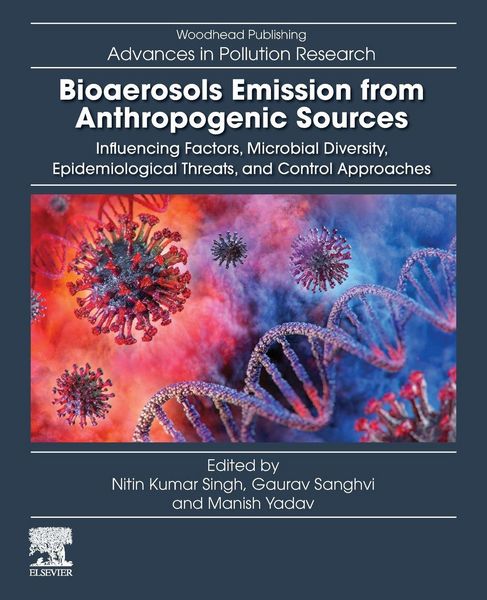
Bioaerosols Emission from Anthropogenic Sources Influencing Factors, Microbial Diversity, Epidemiological Threats, and Control Approaches

212,99 €

inkl. gesetzl. MwSt., Versandkostenfrei

Lieferung nach Hause

Beschreibung

Produktdetails

Einband

Taschenbuch

Erscheinungsdatum

10.10.2023

Herausgeber

Nitin Kumar Singh + weitere

Verlag

Elsevier

Seitenzahl

304

Maße (L/B/H)

23,5/19,1/1,6 cm

Gewicht

1000 g

Sprache

Englisch

ISBN

978-0-443-15319-8

Beschreibung

Portrait

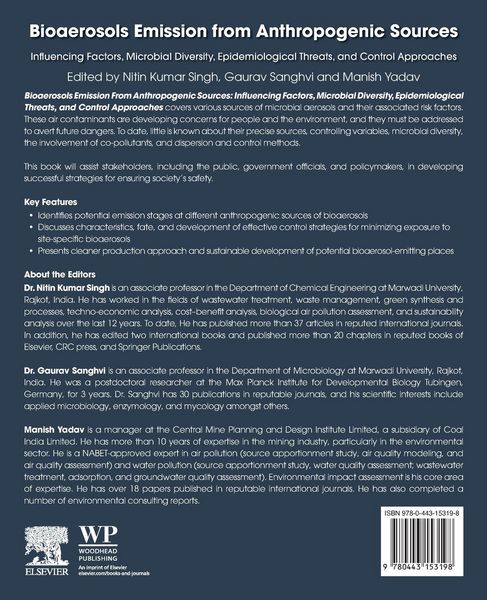
Dr. Nitin Kumar Singh is an Assistant Professor in Department of Environmental Science and Engineering at Marwadi Education Foundations Group of Institutions, Rajkot (Gujarat). He's worked in the fields of wastewater treatment, waste management, green synthesis and processes, techno-economic analysis, cost-benefit analysis, biological air pollution assessment and sustainability analysis over the past 11 years. He has over 40 papers published in international journals and conferences, and he has worked on both research and implementation initiatives. He's also received three student-focused research grants from state government departments thus far.

Dr. Gaurav Sanghvi is an Assistant Professor at Marwadi University's Department of Microbiology. Dr. Sanghvi worked as a postdoctoral researcher at the Max Planck Institute for Developmental Biology in Tubingen, Germany, for three years. He has 30 publications in reputable journals. Applied microbiology, enzymology, and mycology are among Dr. Sanghvi's scientific interests

Manish Yadav is a Deputy Manager in Central Mine Planning Design Institute Limited, a subsidiary of Coal India Limited. He has more than eight years of expertise in the mining industry, particularly in the environmental sector. He is a NABET-approved expert in air pollution (source apportionment study, air quality modeling, and air quality assessment) and water pollution (source apportionment study, air quality modeling, and air quality assessment) (Waste water treatment, adsorption, ground water quality assessment). Environmental Impact Assessment is his primary area of expertise. He has over 13 papers published in reputable international journals. He's also written a number of environmental consulting reports.

Produktdetails

Einband

Taschenbuch

Erscheinungsdatum

10.10.2023

Herausgeber

Verlag

Elsevier

Seitenzahl

304

Maße (L/B/H)

23,5/19,1/1,6 cm

Gewicht

1000 g

Sprache

Englisch

ISBN

978-0-443-15319-8

Herstelleradresse

Libri GmbH
Europaallee 1
36244 Bad Hersfeld
DE

Email: [email protected]

Kundinnen und Kunden meinen

0 Bewertungen

Informationen zu Bewertungen

Zur Abgabe einer Bewertung ist eine Anmeldung im Konto notwendig. Die Authentizität der Bewertungen wird von uns nicht überprüft. Wir behalten uns vor, Bewertungstexte, die unseren Richtlinien widersprechen, entsprechend zu kürzen oder zu löschen.

Die Bewertungen sind nach Format, Anzahl Sterne und Datum sortiert.

Verfassen Sie die erste Bewertung zu diesem Artikel

Helfen Sie anderen Kund*innen durch Ihre Meinung

Kundinnen und Kunden meinen

0 Bewertungen filtern

Die Leseprobe wird geladen.
  • Produktbild: Bioaerosols Emission from Anthropogenic Sources
  • Produktbild: Bioaerosols Emission from Anthropogenic Sources
  • 1. Bioaerosols as emerging air pollutant and sustainability indicator: Various sources, sampling strategies, characteristics, diversity, and control approaches
    2. Characteristics, emission factors, role of meteorology in dispersion, and potential health risks of wastewater treatment associated bioaerosols
    3. Bioaerosols emission from composting sites: Exposure to endotoxins and associated health issues
    4. Characteristics, size distribution, and exposure risk from bioaerosols emitted from urban and rural sanitation facilities
    5. Bioaerosols monitoring in slaughter facilities: Characteristics and distribution trends
    6. Abundance and diversity of bioaerosols in laboratories: Emission factor, survival conditions and possible health threats
    7. Landfill site bioaerosols: Characteristics, seasonal variation, and potential health hazards
    8. Airborne contamination in and around hospitals: Effect of ventilation and survival of bioaerosols
    9. Bioaerosols emissions from livestock facilities: Sources, characteristics, and distribution
    10. Role and characteristics of bioaerosols from Municipal/organic waste management facilities: Impact factors and potential health hazards
    11. Diverse quantification techniques for detection of microbial communities in bioaerosols: Experience from anthropogenic sources
    12. Epidemiological threats associated with anthropogenic sources of bioaerosols: Way forward for social sustainability
    13. Microbial communities of source specific bioaerosols, and its association with specific diseases
    Analyzing the role of bioaerosols during pandemic and/or epidemic conditions: A case study of COVID-19