Beschreibung
Produktdetails
Einband
Gebundene Ausgabe
Erscheinungsdatum
14.03.2023
Verlag
World Scientific PublishingSeitenzahl
652
Maße (L/B/H)
23,5/15,7/3,9 cm
Gewicht
1083 g
Sprache
Englisch
ISBN
978-981-12-7234-9
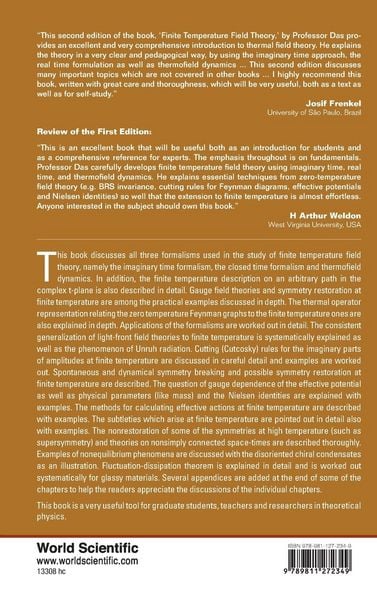
This book discusses all three formalisms used in the study of finite temperature field theory, namely the imaginary time formalism, the closed time formalism and thermofield dynamics. In addition, the finite temperature description on an arbitrary path in the complex t-plane is also described in detail. Gauge field theories and symmetry restoration at finite temperature are among the practical examples discussed in depth. The thermal operator representation relating the zero temperature Feynman graphs to the finite temperature ones are also explained in depth. Applications of the formalisms are worked out in detail. The consistent generalization of light-front field theories to finite temperature is systematically explained as well as the phenomenon of Unruh radiation. Cutting (Cutcosky) rules for the imaginary parts of amplitudes at finite temperature are discussed in careful detail and examples are worked out. Spontaneous and dynamical symmetry breaking and possible symmetry restoration at finite temperature are described. The question of gauge dependence of the effective potential as well as physical parameters (like mass) and the Nielsen identities are explained with examples. The methods for calculating effective actions at finite temperature are described with examples. The subtleties which arise at finite temperature are pointed out in detail also with examples. The nonrestoration of some of the symmetries at high temperature (such as supersymmetry) and theories on nonsimply connected space-times are described thoroughly. Examples of nonequilibrium phenomena are discussed with the disoriented chiral condensates as an illustration. Fluctuation-dissipation theorem is explained in detail and is worked out systematically for glassy materials. Several appendices are added at the end of some of the chapters to help the readers appreciate the discussions of the individual chapters. This book is a very useful tool for graduate students, teachers and researchers in theoretical physics.
Noch keine Bewertungen vorhanden
Verfassen Sie die erste Bewertung zu diesem Artikel
Helfen Sie anderen Kundinnen und Kunden durch Ihre Meinung.
Kurze Frage zu unserer Seite
Vielen Dank für dein Feedback
Wir nutzen dein Feedback, um unsere Produktseiten zu verbessern. Bitte habe Verständnis, dass wir dir keine Rückmeldung geben können. Falls du Kontakt mit uns aufnehmen möchtest, kannst du dich aber gerne an unseren Kund*innenservice wenden.
zum Kundenservice