KI-Beratung Beta

Produktbild: Fault Lines After COVID-19
- 12%

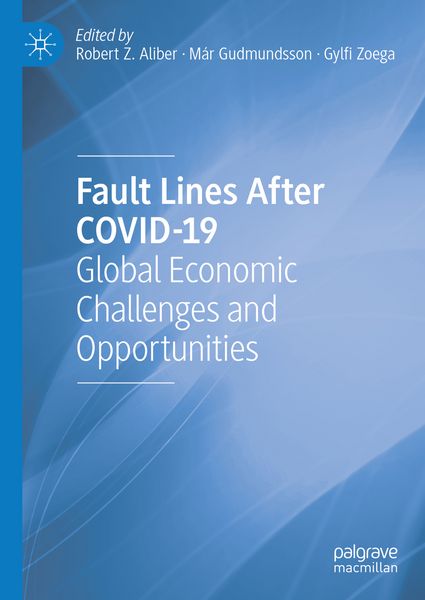
Fault Lines After COVID-19 Global Economic Challenges and Opportunities

12% sparen

149,99 € UVP 171,19 €

inkl. gesetzl. MwSt., Versandkostenfrei


Beschreibung

This book explores the central economic and political issues defining the modern world. With contributions from a number of world renowned economists, a range of topical debates are discussed in an accessible and practical manner. The topics discussed include the current economic and political backdrop,...

Beschreibung

This book explores the central economic and political issues defining the modern world. With contributions from a number of world renowned economists, a range of topical debates are discussed in an accessible and practical manner. The topics discussed include the current economic and political backdrop, global economic shifts, challenges within central banking and financial integration, the international monetary and financial system, and geopolitical tensions. Particular attention is given to the transition to a low carbon economy, the perils of public debt, the post-COVID-19 recovery, and the conflict in Ukraine.

This book aims to envisage the economic challenges and opportunities that will be faced in the years to come. It will be relevant to students, researchers, and policymakers interested in economic policy and the political economy.

Portrait


Robert Z. Aliber
is Professor Emeritus at the University of Chicago. He has written extensively about exchange rates and cross border investment inflows. He developed the Center for Studies in International Finance at the University of Chicago and was the founding chair of the Committee for Public Policy Studies. He published
The International
Money Game
in 1974 and brought out three editions of
Manias
,
Panics, and Crashes
. Amongst his other books are
Money, Banking, and the Economy
and
The Multinational Paradigm
.

Gylfi Zoega
is a Professor of Economics at the University of Iceland and Birkbeck College, London. He has written on the financial crisis in Iceland and taken part in the recovery effort as a member of the Monetary Policy Committee of its central bank. His research is focused on unemployment, economic growth, and financial turbulence. He co-edited
Preludes to the Icelandic Financial Crisis
and
The 2008Global Financial Crisis in Retrospect
with Robert Z. Aliber and recently published
Dynamism
with Hian Teck Hoon and Edmund Phelps.

Már Gudmundsson
was the Governor of the Central Bank of Iceland from 2009 to 2019, the Deputy Head of the Monetary and Economic Department at the Bank for International Settlements (BIS) 2004-2009, and the Chief Economist of the Central Bank of Iceland 1994-2004. His published research includes cross-border financial integration, exchange rate regimes, financial stability, monetary policy, and pensions. He has recently been contributing to SEACEN´s project on challenges and options in managing capital flows.

Produktdetails

Einband

Gebundene Ausgabe

Erscheinungsdatum

27.09.2023

Abbildungen

XXIV, 356 p.

Herausgeber Robert Z. Aliber + weitere

Produktdetails

Einband

Gebundene Ausgabe

Erscheinungsdatum

27.09.2023

Abbildungen

XXIV, 356 p.

Herausgeber
Verlag Springer
Seitenzahl

356

Maße (L/B/H)

21,6/15,3/2,6 cm

Gewicht

569 g

Auflage

2023

Sprache

Englisch

ISBN

978-3-031-26481-8

Herstelleradresse

Springer-Verlag GmbH
Europaplatz 3
69115 Heidelberg
DE

Email: ProductSafety@springernature.com

Noch keine Bewertungen vorhanden

Verfassen Sie die erste Bewertung zu diesem Artikel

Helfen Sie anderen Kundinnen und Kunden durch Ihre Meinung.

Kundinnen und Kunden meinen

Bewertungen (0)

  • Produktbild: Fault Lines After COVID-19

  • 1. What next for the global economy: Could negative supply shocks disrupt fragile systems?.- 2. Deep historical roots, culture choice and the New World Order.- 3. Growth without democracy: Has China’s time of rapid growth come to an end?.- 4. Coping with international monetary instability.- 5. Dollar funding stresses in China.- 6. Four challenges faced by central banks in the post-Covid world.- 7. How the flows change when interest rates are normalized: Risks to economic and financial stability.- 8. Policies for macroeconomic and financial stability in small, open and financially integrated economies.- 9. The transition to a low carbon economy.- 10. Denunciations and Information Gathering – How and When Are They Effective?.- 10. The perils of public debt.- 11. The Fed’s swap lines: Narrow circle, broad effect?.- 12. Bond market crisis and the international lender of last resort.- 13. Building the plumbing of global commerce: resilience and fragility in the cross-border payments system.- 14. Mimicking the West: Russia’s rationale for wars, state recognitions, and border changes.- 15. Different choices, divergent paths: Poland and Ukraine.- 16. Economic consequences of global tensions.