Gutscheinbedingungen

**Gültig vom 20.07.2026 bis 22.07.2026 | Gültig für nicht preisgebundene fremdsprachige Bücher | Einzelne Artikel können ausgeschlossen sein | Nicht kombinierbar mit anderen Gutscheinen oder Preisaktionen | Nur einmal pro Einkauf einlösbar | Gutschein wird auf max. 500€ Bestellwert angerechnet | Keine Barauszahlung | Nicht gültig für Versandkosten und Services

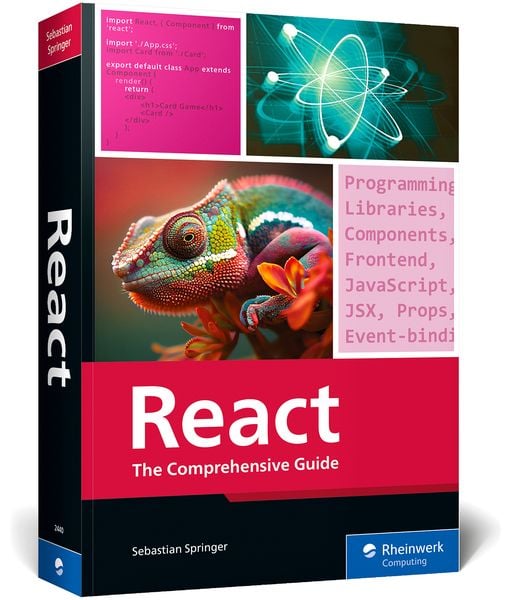
Produktbild: React

React The Comprehensive Guide

Aus der Reihe Rheinwerk Computing

59,95 €

inkl. gesetzl. MwSt., Versandkostenfrei

Lieferung nach Hause

Beschreibung

Produktdetails

Einband

Taschenbuch

Erscheinungsdatum

07.11.2023

Verlag

Rheinwerk Publishing

Seitenzahl

676

Maße (L/B/H)

25,1/17,9/4,1 cm

Gewicht

1429 g

Auflage

1

Sprache

Englisch

ISBN

978-1-4932-2440-1

Beschreibung

Produktdetails

Einband

Taschenbuch

Erscheinungsdatum

07.11.2023

Verlag

Rheinwerk Publishing

Seitenzahl

676

Maße (L/B/H)

25,1/17,9/4,1 cm

Gewicht

1429 g

Auflage

1

Sprache

Englisch

ISBN

978-1-4932-2440-1

Herstelleradresse

Rheinwerk Verlag GmbH
Rheinwerkallee 4
53227 Bonn
DE

Email: service@rheinwerk-verlag.de

Noch keine Bewertungen vorhanden

Verfassen Sie die erste Bewertung zu diesem Artikel

Helfen Sie anderen Kundinnen und Kunden durch Ihre Meinung.

Kundinnen und Kunden meinen

Bewertungen (0)

  • Produktbild: React
  • ... Foreword ... 21

    ... Preface ... 23

    ... Structure of the Book ... 24

    ... Download the Code Samples ... 25

    ... Acknowledgments ... 25

    1 ... Getting Started with React ... 27

    1.1 ... What Is React? ... 27

    1.2 ... Why React? ... 32

    1.3 ... The Most Important Terms and Concepts of the React World ... 34

    1.4 ... A Look into the React Universe ... 40

    1.5 ... Thinking in React ... 41

    1.6 ... Code Examples ... 42

    1.7 ... Summary ... 43

    2 ... The First Steps in the Development Process ... 45

    2.1 ... Quick Start ... 45

    2.2 ... Playgrounds for React ... 46

    2.3 ... Local Development ... 49

    2.4 ... Getting Started with Developing in React ... 52

    2.5 ... The Structure of the Application ... 66

    2.6 ... Troubleshooting in a React Application ... 68

    2.7 ... Building the Application ... 71

    2.8 ... Summary ... 71

    3 ... Basic Principles of React ... 73

    3.1 ... Preparation ... 73

    3.2 ... Getting Started with the Application ... 74

    3.3 ... Function Components ... 78

    3.4 ... JSX: Defining Structures in React ... 84

    3.5 ... Props: Information Flow in an Application ... 95

    3.6 ... Local State ... 100

    3.7 ... Event Binding: Responding to User Interactions ... 102

    3.8 ... Immutability ... 110

    3.9 ... Summary ... 113

    4 ... A Look Behind the Scenes: Further Topics ... 115

    4.1 ... The Lifecycle of a Component ... 115

    4.2 ... The Lifecycle of a Function Component with the Effect Hook ... 116

    4.3 ... Server Communication ... 126

    4.4 ... Container Components ... 137

    4.5 ... Higher-Order Components ... 142

    4.6 ... Render Props ... 146

    4.7 ... Context ... 150

    4.8 ... Fragments ... 158

    4.9 ... Summary ... 159

    5 ... Class Components ... 161

    5.1 ... Class Components in React ... 161

    5.2 ... Basic Structure of a Class Component ... 162

    5.3 ... Props in a Class Component ... 163

    5.4 ... State: The State of the Class Component ... 166

    5.5 ... The Component Lifecycle ... 169

    5.6 ... Error Boundaries ... 179

    5.7 ... Using the Context API in a Class Component ... 183

    5.8 ... Differences between Function and Class Components ... 185

    5.9 ... Summary ... 186

    6 ... The Hooks API of React ... 187

    6.1 ... A First Overview ... 188

    6.2 ... “useReducer”: The Reducer Hook ... 190

    6.3 ... “useCallback”: Memoizing Functions ... 197

    6.4 ... “useMemo”: Memoizing Objects ... 198

    6.5 ... “useRef”: References and Immutable Values ... 200

    6.6 ... “useImperativeHandle”: Controlling Forward Refs ... 202

    6.7 ... “useLayoutEffect”: The Synchronous Alternative to “useEffect” ... 205

    6.8 ... “useDebugValue”: Debugging Information in React Developer Tools ... 206

    6.9 ... “useDeferredValue”: Performing Updates According to Priority ... 207

    6.10 ... “useTransition”: Lowering the Priority of Operations ... 210

    6.11 ... “useId”: Creating Unique Identifiers ... 212

    6.12 ... Library Hooks ... 213

    6.13 ... Custom Hooks ... 214

    6.14 ... Rules of Hooks: Things to Consider ... 215

    6.15 ... Changing over to Hooks ... 217

    6.16 ... Summary ... 218

    7 ... Type Safety in React Applications with TypeScript ... 219

    7.1 ... What Is the Benefit of a Type System? ... 219

    7.2 ... The Different Type Systems ... 220

    7.3 ... Type Safety in a React Application with Flow ... 220

    7.4 ... Using TypeScript in a React Application ... 225

    7.5 ... TypeScript and React ... 231

    7.6 ... Summary ... 242

    8 ... Styling React Components ... 245

    8.1 ... CSS Import ... 245

    8.2 ... Inline Styling ... 253

    8.3 ... CSS Modules ... 255

    8.4 ... CSS in JavaScript Using Emotion ... 257

    8.5 ... Tailwind ... 266

    8.6 ... Summary ... 268

    9 ... Securing a React Application through Testing ... 271

    9.1 ... Getting Started with Jest ... 272

    9.2 ... Testing Helper Functions ... 287

    9.3 ... Snapshot Testing ... 289

    9.4 ... Testing Components ... 294

    9.5 ... Dealing with Server Dependencies ... 299

    9.6 ... Summary ... 303

    10 ... Forms in React ... 305

    10.1 ... Uncontrolled Components ... 305

    10.2 ... Controlled Components ... 318

    10.3 ... File Uploads ... 328

    10.4 ... Form Validation Using React Hook Form ... 334

    10.5 ... Summary ... 345

    11 ... Component Libraries in a React Application ... 347

    11.1 ... Installing and Integrating Material UI ... 347

    11.2 ... List Display with the “Table” Component ... 348

    11.3 ... Grids and Breakpoints ... 358

    11.4 ... Icons ... 361

    11.5 ... Deleting Data Records ... 363

    11.6 ... Creating New Data Records ... 369

    11.7 ... Editing Data Records ... 376

    11.8 ... Summary ... 381

    12 ... Navigating Within an Application: The Router ... 383

    12.1 ... Installation and Integration ... 383

    12.2 ... Navigating in the Application ... 385

    12.3 ... “NotFound” Component ... 390

    12.4 ... Testing the Routing ... 392

    12.5 ... Conditional Redirects ... 396

    12.6 ... Dynamic Routes ... 400

    12.7 ... Summary ... 406

    13 ... Creating Custom React Libraries ... 407

    13.1 ... Creating a Custom Component Library ... 407

    13.2 ... Integrating the Library ... 415

    13.3 ... Testing the Library ... 419

    13.4 ... Storybook ... 422

    13.5 ... Summary ... 425

    14 ... Central State Management Using Redux ... 427

    14.1 ... The Flux Architecture ... 427

    14.2 ... Installing Redux ... 431

    14.3 ... Configuring the Central Store ... 431

    14.4 ... Handling Changes to the Store Using Reducers ... 435

    14.5 ... Linking Components and the Store ... 438

    14.6 ... Describing Changes with Actions ... 444

    14.7 ... Creating and Editing Data Records ... 448

    14.8 ... Summary ... 453

    15 ... Handling Asynchronicity and Side Effects in Redux ... 455

    15.1 ... Middleware in Redux ... 455

    15.2 ... Redux with Redux Thunk ... 457

    15.3 ... Generators: Redux Saga ... 473

    15.4 ... State Management Using RxJS: Redux Observable ... 491

    15.5 ... JSON Web Token for Authentication ... 498

    15.6 ... Summary ... 507

    16 ... Server Communication Using GraphQL and the Apollo Client ... 509

    16.1 ... Introduction to GraphQL ... 509

    16.2 ... Apollo: A GraphQL Client for React ... 514

    16.3 ... Apollo Client Devtools ... 526

    16.4 ... Local State Management Using Apollo ... 527

    16.5 ... Authentication ... 532

    16.6 ... Summary ... 534

    17 ... Internationalization ... 535

    17.1 ... Using react-i18next ... 535

    17.2 ... Using Placeholders ... 544

    17.3 ... Formatting Values ... 546

    17.4 ... Singular and Plural ... 551

    17.5 ... Summary ... 553

    18 ... Universal React Apps with Server-Side Rendering ... 555

    18.1 ... How Does Server-Side Rendering Work? ... 556

    18.2 ... Implementing Server-Side Rendering ... 557

    18.3 ... Server-Side Rendering Using Next.js ... 569

    18.4 ... Summary ... 574

    19 ... Performance ... 577

    19.1 ... The Callback Hook ... 577

    19.2 ... Pure Components ... 580

    19.3 ... “React.memo” ... 581

    19.4 ... “React.lazy”: “Suspense” for Code Splitting ... 584

    19.5 ... Suspense for Data Fetching ... 591

    19.6 ... Virtual Tables ... 599

    19.7 ... Summary ... 603

    20 ... Progressive Web Apps ... 605

    20.1 ... Features of a Progressive Web App ... 605

    20.2 ... Initializing the Application ... 606

    20.3 ... Installability ... 606

    20.4 ... Offline Capability ... 618

    20.5 ... Tools for Development ... 628

    20.6 ... Summary ... 629

    21 ... Native Apps with React Native ... 631

    21.1 ... The Structure of React Native ... 631

    21.2 ... Installing React Native ... 631

    21.3 ... Displaying an Overview List ... 636

    21.4 ... Debugging in the Simulated React Native Environment ... 648

    21.5 ... Editing Data Records ... 650

    21.6 ... Publishing ... 657

    21.7 ... Summary ... 658

    ... The Author ... 661

    ... Index ... 663