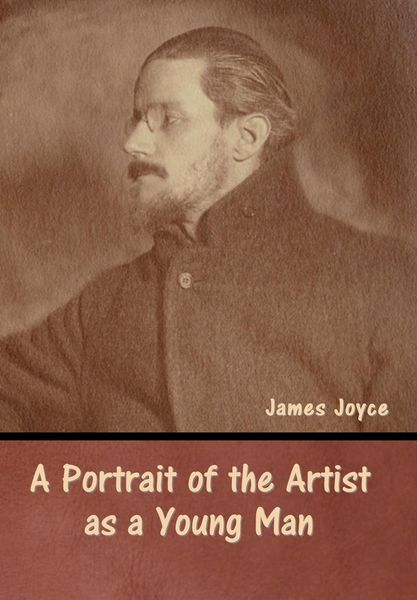

A Portrait of the Artist as a Young Man
-
- Hardcover ausgewählt
- Taschenbuch
- eBook
- Hörbuch
-
Sprache:Englisch
-
Verlag:Bibliotech Pr
- Knopf Doubleday Publishing Group 18,99 €
- Outlook 46,90 €
- Wilder Publications 31,99 €
- Tredition 22,90 €
- Lushena Books 54,99 €
- Bibliotech Pr 29,99 € ausgewählt
- Random House N.Y. 24,99 €
- Macmillan Publishers International 13,99 €
- Creative Media Partners, LLC 37,99 €
- Simon & Brown 27,99 €
- Ingram Publishers Services 21,99 €
- BigfontBooks 25,99 €
- Flame Tree 11,49 €
- Chiltern Publishing 24,99 €
- Gröls Verlag 21,90 €
29,99 €
inkl. gesetzl. MwSt.,
Lieferung nach Hause
Beschreibung
Produktdetails
Einband
Gebundene Ausgabe
Erscheinungsdatum
09.01.2023
Verlag
Bibliotech PrSeitenzahl
194
Maße (L/B/H)
22,9/15,2/1,6 cm
Gewicht
408 g
Sprache
Englisch
EAN
9798888304143
A Portrait of the Artist as a Young Man is the first novel of Irish writer James Joyce. A Künstlerroman written in a modernist style, it traces the religious and intellectual awakening of young Stephen Dedalus, Joyce's fictional alter ego, whose surname alludes to Daedalus, Greek mythology's consummate craftsman. Stephen questions and rebels against the Catholic and Irish conventions under which he has grown, culminating in his self-exile from Ireland to Europe. The work uses techniques that Joyce developed more fully in Ulysses (1922) and Finnegans Wake (1939).
A Portrait began life in 1904 as Stephen Hero-a projected 63-chapter autobiographical novel in a realistic style. After 25 chapters, Joyce abandoned Stephen Hero in 1907 and set to reworking its themes and protagonist into a condensed five-chapter novel, dispensing with strict realism and making extensive use of free indirect speech that allows the reader to peer into Stephen's developing consciousness. American modernist poet Ezra Pound had the novel serialised in the English literary magazine The Egoist in 1914 and 1915, and published as a book in 1916 by B. W. Huebsch of New York. The publication of A Portrait and the short story collection Dubliners (1914) earned Joyce a place at the forefront of literary modernism.
The novel is a Bildungsroman and captures the essence of character growth and understanding of the world around him. The novel mixes third-person narrative with free indirect speech, which allows both identification with and distance from Stephen. The narrator refrains from judgement. The omniscient narrator of the earlier Stephen Hero informs the reader as Stephen sets out to write "some pages of sorry verse," while Portrait gives only Stephen's attempts, leaving the evaluation to the reader.
The novel is written primarily as a third-person narrative with minimal dialogue until the final chapter. This chapter includes dialogue-intensive scenes alternately involving Stephen, Davin and Cranly. An example of such a scene is the one in which Stephen posits his complex Thomist aesthetic theory in an extended dialogue. Joyce employs first-person narration for Stephen's diary entries in the concluding pages of the novel, perhaps to suggest that Stephen has finally found his own voice and no longer needs to absorb the stories of others. Joyce fully employs the free indirect style to demonstrate Stephen's intellectual development from his childhood, through his education, to his increasing independence and ultimate exile from Ireland as a young man. The style of the work progresses through each of its five chapters, as the complexity of language and Stephen's ability to comprehend the world around him both gradually increase. The book's opening pages communicate Stephen's first stirrings of consciousness when he is a child. Throughout the work language is used to describe indirectly the state of mind of the protagonist and the subjective effect of the events of his life.
The writing style is notable also for Joyce's omission of quotation marks: he indicates dialogue by beginning a paragraph with a dash, as is commonly used in French, Spanish or Russian publications.
A film version adapted for the screen by Judith Rascoe and directed by Joseph Strick was released in 1977. It features Bosco Hogan as Stephen Dedalus and T. P. McKenna as Simon Dedalus. John Gielgud plays Father Arnall, the priest whose lengthy sermon on Hell terrifies the teenage Stephen.
The first stage version was produced by Léonie Scott-Matthews at Pentameters Theatre in 2012 using an adaptation by Tom Neill.
Hugh Leonard's stage work Stephen D is an adaptation of A Portrait of the Artist as a Young Man and Stephen Hero. It was first produced at the Gate Theatre during the Dublin Theatre Festival of 1962. ... (wikipedia.org)
Kundinnen und Kunden meinen
Verfassen Sie die erste Bewertung zu diesem Artikel
Helfen Sie anderen Kund*innen durch Ihre Meinung
Kurze Frage zu unserer Seite
Vielen Dank für dein Feedback
Wir nutzen dein Feedback, um unsere Produktseiten zu verbessern. Bitte habe Verständnis, dass wir dir keine Rückmeldung geben können. Falls du Kontakt mit uns aufnehmen möchtest, kannst du dich aber gerne an unseren Kund*innenservice wenden.
zum Kundenservice