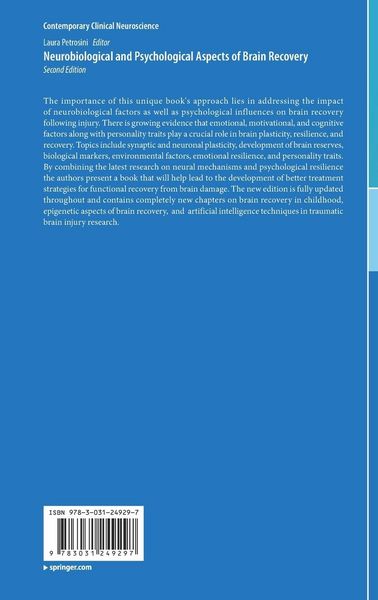
• Produktbild: Neurobiological and Psychological Aspects of Brain Recovery
  • Produktbild: Neurobiological and Psychological Aspects of Brain Recovery
- 19%

Neurobiological and Psychological Aspects of Brain Recovery

19% sparen

189,99 € UVP 235,39 €

inkl. gesetzl. MwSt., Versandkostenfrei

Lieferung nach Hause

Beschreibung

Produktdetails

Einband

Gebundene Ausgabe

Erscheinungsdatum

07.06.2023

Herausgeber

Laura Petrosini

Verlag

Springer

Seitenzahl

406

Maße (L/B/H)

24,1/16/2,9 cm

Gewicht

811 g

Auflage

Second Edition 2023

Sprache

Englisch

ISBN

978-3-031-24929-7

Beschreibung

Portrait

Laura Petrosini, PhD, is Professor Emeritus of Psychophysiology at the University "Sapienza" of Rome and is responsible for the Lab of Experimental and Behavioral Neurophysiology at Santa Lucia Foundation in Rome. Neuronal and psychological approaches to brain functioning are her specific areas of interest.

Produktdetails

Einband

Gebundene Ausgabe

Erscheinungsdatum

07.06.2023

Herausgeber

Laura Petrosini

Verlag

Springer

Seitenzahl

406

Maße (L/B/H)

24,1/16/2,9 cm

Gewicht

811 g

Auflage

Second Edition 2023

Sprache

Englisch

ISBN

978-3-031-24929-7

Herstelleradresse

Springer-Verlag GmbH
Tiergartenstr. 17
69121 Heidelberg
DE

Email: [email protected]

Kundinnen und Kunden meinen

0 Bewertungen

Informationen zu Bewertungen

Zur Abgabe einer Bewertung ist eine Anmeldung im Konto notwendig. Die Authentizität der Bewertungen wird von uns nicht überprüft. Wir behalten uns vor, Bewertungstexte, die unseren Richtlinien widersprechen, entsprechend zu kürzen oder zu löschen.

Die Bewertungen sind nach Format, Anzahl Sterne und Datum sortiert.

Verfassen Sie die erste Bewertung zu diesem Artikel

Helfen Sie anderen Kund*innen durch Ihre Meinung

Kundinnen und Kunden meinen

0 Bewertungen filtern

  • Produktbild: Neurobiological and Psychological Aspects of Brain Recovery
  • Produktbild: Neurobiological and Psychological Aspects of Brain Recovery
  • Chapter 1: Understanding the Mechanisms of Dendritic Arbor Development: Integrated Experimental and Computational Approaches.- Chapter 2: Autophagy Mechanisms for Brain Recovery. Keep It Clean, Keep It Alive.- Chapter 3: Environmental enrichment and functional plasticity in the hippocampus, an update on the mechanisms involved.- Chapter 4: Translatable Models of Brain and Cognitive Reserve.- Chapter 5: Cognitive Reserve: A Life-Course Perspective.- Chapter 6: Neural Correlates of Brain Reserve: A Neuroimaging Perspective.- Chapter 7: Non-pharmacological Approaches Based on Mind-Body Medicine to Enhancement of Cognitive and Brain Reserve in Humans.- Chapter 8: Roles of Synaptic Plasticity in Functional Recovery After Brain Injury.- Chapter 9: Integrated Methods of Neuromodulation for Guiding Recovery Following Stroke.- Chapter 10: Resilience in Brain Networks After Stroke.- Chapter 11: Epigenetics and brain plasticity:back to function.- Chapter 12: Functional Role of Physical Exercise and Omega-3 Fatty Acids on Depression and Mood Disorders.- Chapter 13: BRAIN RECOVERY IN CHILDHOOD: THE INTERACTION BETWEEN DEVELOPMENTAL PLASTICITY AND REGENERATIVE MECHANISMS.- Chapter 14: Estrogen Neuroprotective Activity After Stroke and Spinal Cord Injury.- Chapter 15: Making Meaning of Acquired Brain Injury: Resources for Functional Recovery.- Chapter 16: An Update on Premorbid Personality Traits and Brain Recovery - Another Aspect of Resilience.- Chapter 17: Psychological Aspects of Recovery After Brain Injury: A Focus on Psychodynamic Factors.- Chapter 18: Artificial Intelligence applications for Traumatic Brain Injury research and clinical management.