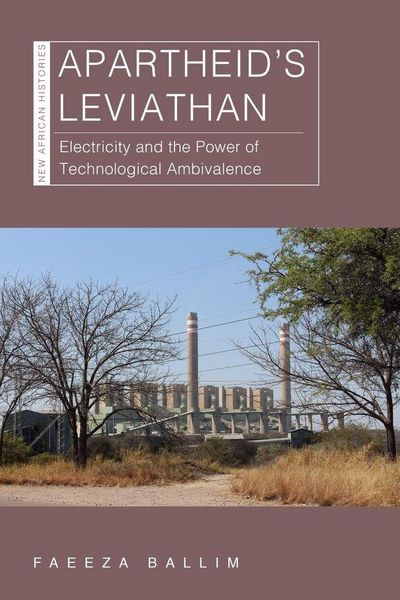
Apartheid's Leviathan Electricity and the Power of Technological Ambivalence
-
- Englisch ausgewählt
28,99 €
UVP
35,00 €
inkl. gesetzl. MwSt.,
Lieferung nach Hause
Beschreibung
Produktdetails
Einband
Taschenbuch
Erscheinungsdatum
25.04.2023
Abbildungen
1 black-and-white illustration
Verlag
Ohio University PressSeitenzahl
176
Maße (L/B/H)
22,7/15/1,2 cm
Gewicht
272 g
Sprache
Englisch
ISBN
978-0-8214-2518-3
A fascinating study that shows how the intersection of technology and politics has shaped South African history since the 1960s.
This book details the development of an interconnected technological system of a coal mine and of the Matimba and Medupi power stations in the Waterberg, a rural region of South Africa near the country's border with Botswana. South Africa's state steel manufacturing corporation, Iscor, which has since been privatized, developed a coal mine in the region in the 1970s. This set the stage for the national electricity provider, Eskom, to build coal-fueled power stations in the Waterberg.
Faeeza Ballim follows the development of these technological systems from the late 1960s, a period of heightened repression as the apartheid government attempted to realize its vision of racial segregation, to the deeply fraught construction of the Medupi power station in postapartheid South Africa. The Medupi power station was planned toward the end of the first decade of the twenty-first century as a measure to alleviate the country's electricity shortage, but the continued delay of its completion and the escalation of its costs meant that it failed to realize those ambitions while public frustration and electricity outages grew.
By tracing this story, this book highlights the importance of technology to our understanding of South African history. This characterization challenges the idea that the technological state corporations were proxies for the apartheid government and highlights that their activities in the Waterberg did not necessarily accord with the government's strategic purposes. While a part of the broader national modernization project under apartheid, they also set the stage for worker solidarity and trade union organization in the Waterberg and elsewhere in the country. This book also argues that the state corporations, their technology, and their engineers enjoyed ambivalent relationships with the governments of their time, relationships that can be characterized as both autonomous and immersive. In the era of democracy, while Eskom has been caught up in government corruption-a major scourge to the fortunes of South Africa-it has also retained a degree of organizational autonomy and offered a degree of resistance to those who sought to further corruption.
The examination of the workings of these technological systems, and the state corporations responsible for them, complicates conventional understandings of the transition from the authoritarian rule of apartheid to democratic South Africa, which coincided with the transition from state-led development to neoliberalism. This book is an indispensable case study on the workings of industrial and political power in Africa and beyond.
Noch keine Bewertungen vorhanden
Verfassen Sie die erste Bewertung zu diesem Artikel
Helfen Sie anderen Kundinnen und Kunden durch Ihre Meinung.
Kurze Frage zu unserer Seite
Vielen Dank für dein Feedback
Wir nutzen dein Feedback, um unsere Produktseiten zu verbessern. Bitte habe Verständnis, dass wir dir keine Rückmeldung geben können. Falls du Kontakt mit uns aufnehmen möchtest, kannst du dich aber gerne an unseren Kund*innenservice wenden.
zum Kundenservice