
Foundation Models for Natural Language Processing Pre-trained Language Models Integrating Media
-
- Englisch ausgewählt
48,99 €
inkl. gesetzl. MwSt.,
Lieferung nach Hause
Beschreibung
Produktdetails
Einband
Gebundene Ausgabe
Erscheinungsdatum
24.05.2023
Verlag
SpringerSeitenzahl
436
Maße (L/B/H)
24,1/16/3 cm
Gewicht
846 g
Auflage
1st ed. 2023
Sprache
Englisch
ISBN
978-3-031-23189-6
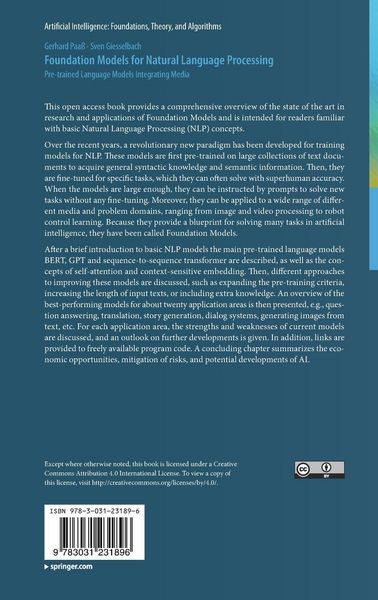
This open access book provides a comprehensive overview of the state of the art in research and applications of Foundation Models and is intended for readers familiar with basic Natural Language Processing (NLP) concepts.
Over the recent years, a revolutionary new paradigm has been developed for training models for NLP. These models are first pre-trained on large collections of text documents to acquire general syntactic knowledge and semantic information. Then, they are fine-tuned for specific tasks, which they can often solve with superhuman accuracy. When the models are large enough, they can be instructed by prompts to solve new tasks without any fine-tuning. Moreover, they can be applied to a wide range of different media and problem domains, ranging from image and video processing to robot control learning. Because they provide a blueprint for solving many tasks in artificial intelligence, they have been called Foundation Models.
After a brief introduction to basic NLP models the main pre-trained language models BERT, GPT and sequence-to-sequence transformer are described, as well as the concepts of self-attention and context-sensitive embedding. Then, different approaches to improving these models are discussed, such as expanding the pre-training criteria, increasing the length of input texts, or including extra knowledge. An overview of the best-performing models for about twenty application areas is then presented, e.g., question answering, translation, story generation, dialog systems, generating images from text, etc. For each application area, the strengths and weaknesses of current models are discussed, and an outlook on further developments is given. In addition, links are provided to freely available program code. A concluding chapter summarizes the economic opportunities, mitigation of risks, and potential developments of AI.
Kundinnen und Kunden meinen
Verfassen Sie die erste Bewertung zu diesem Artikel
Helfen Sie anderen Kund*innen durch Ihre Meinung
Kurze Frage zu unserer Seite
Vielen Dank für dein Feedback
Wir nutzen dein Feedback, um unsere Produktseiten zu verbessern. Bitte habe Verständnis, dass wir dir keine Rückmeldung geben können. Falls du Kontakt mit uns aufnehmen möchtest, kannst du dich aber gerne an unseren Kund*innenservice wenden.
zum Kundenservice