KI-Beratung Beta

  • Produktbild: A Behavioral Economics Approach to Interactive Information Retrieval
  • Produktbild: A Behavioral Economics Approach to Interactive Information Retrieval
Band 48 - 12%

A Behavioral Economics Approach to Interactive Information Retrieval Understanding and Supporting Boundedly Rational Users

Aus der Reihe Information Retrieval
12% sparen

149,99 € UVP 171,19 €

inkl. gesetzl. MwSt., Versandkostenfrei


Beschreibung

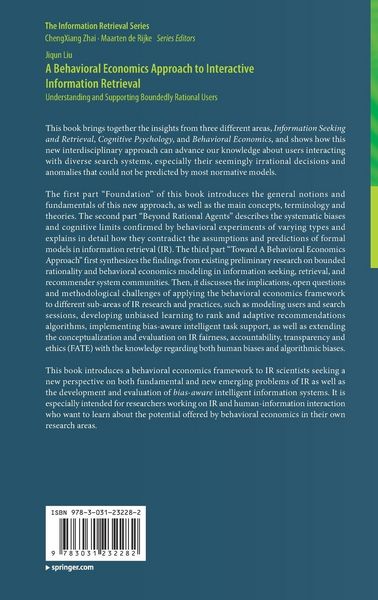
This book brings together the insights from three different areas,  Information Seeking and Retrieval ,  Cognitive Psychology , and  Behavioral Economics , and shows how this new interdisciplinary approach can advance our knowledge about users interacting with diverse search systems, especially their...

Beschreibung

This book brings together the insights from three different areas, 
Information Seeking and Retrieval
, 
Cognitive Psychology
, and 
Behavioral Economics
, and shows how this new interdisciplinary approach can advance our knowledge about users interacting with diverse search systems, especially their seemingly irrational decisions and anomalies that could not be predicted by most normative models.
The first part “Foundation” of this book introduces the general notions and fundamentals of this new approach, as well as the main concepts, terminology and theories. The second part “Beyond Rational Agents” describes the systematic biases and cognitive limits confirmed by behavioral experiments of varying types and explains in detail how they contradict the assumptions and predictions of formal models in information retrieval (IR). The third part “Toward A Behavioral Economics Approach” first synthesizes the findings from existing preliminaryresearch on bounded rationality and behavioral economics modeling in information seeking, retrieval, and recommender system communities. Then, it discusses the implications, open questions and methodological challenges of applying the behavioral economics framework to different sub-areas of IR research and practices, such as modeling users and search sessions, developing unbiased learning to rank and adaptive recommendations algorithms, implementing bias-aware intelligent task support, as well as extending the conceptualization and evaluation on IR fairness, accountability, transparency and ethics (FATE) with the knowledge regarding both human biases and algorithmic biases.
This book introduces a behavioral economics framework to IR scientists seeking a new perspective on both fundamental and new emerging problems of IR as well as the development and evaluation of 
bias-aware
 intelligent information systems. It is especially intended for researchers working on IR and human-information interaction who want to learn about the potential offered by behavioral economics in their own research areas.

Produktdetails

Einband

Gebundene Ausgabe

Erscheinungsdatum

18.02.2023

Abbildungen

XVI, 211 p. 1 illus.

Verlag Springer

Produktdetails

Einband

Gebundene Ausgabe

Erscheinungsdatum

18.02.2023

Abbildungen

XVI, 211 p. 1 illus.

Verlag Springer
Seitenzahl

211

Maße (L/B/H)

24,1/16/1,8 cm

Gewicht

460 g

Auflage

23001 Auflage 1st edition 2023

Sprache

Englisch

ISBN

978-3-031-23228-2

Herstelleradresse

Springer-Verlag GmbH
Europaplatz 3
69115 Heidelberg
DE

Email: ProductSafety@springernature.com

Noch keine Bewertungen vorhanden

Verfassen Sie die erste Bewertung zu diesem Artikel

Helfen Sie anderen Kundinnen und Kunden durch Ihre Meinung.

Kundinnen und Kunden meinen

Bewertungen (0)

  • Produktbild: A Behavioral Economics Approach to Interactive Information Retrieval
  • Produktbild: A Behavioral Economics Approach to Interactive Information Retrieval

  • - 
    Part I Foundation.
    - 1. Introduction. - 2. Formally Modeling Users in Information Retrieval. - 3. From Rational Agent to Human with Bounded Rationality. - 
    Part II Beyond Rational Agents
    . - 4. Bounded Rationality in Decision-Making Under Uncertainty. - 5. Back to the Fundamentals: Extend the Rational Assumptions. - 
    Part III Toward a Behavioral Economics Approach
    . - 6. Behavioral Economics in IR. - 7. Implications and New Directions for IR Research and Practices. - 8. Conclusion.