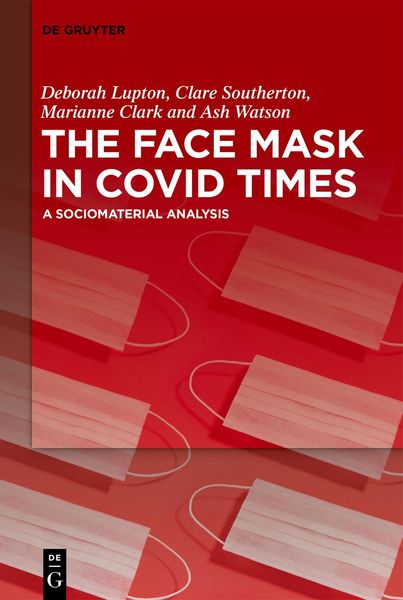
The Face Mask In COVID Times A Sociomaterial Analysis
-
- Hardcover
- Taschenbuch ausgewählt
- eBook
-
Sprache:Englisch
18,99 €
inkl. gesetzl. MwSt.,
Beschreibung
Produktdetails
Einband
Taschenbuch
Erscheinungsdatum
19.12.2022
Abbildungen
17 col. ill.
Verlag
De GruyterSeitenzahl
102
Maße (L/B/H)
23/15,5/0,7 cm
Gewicht
337 g
Auflage
1
Sprache
Englisch
ISBN
978-3-11-111665-5
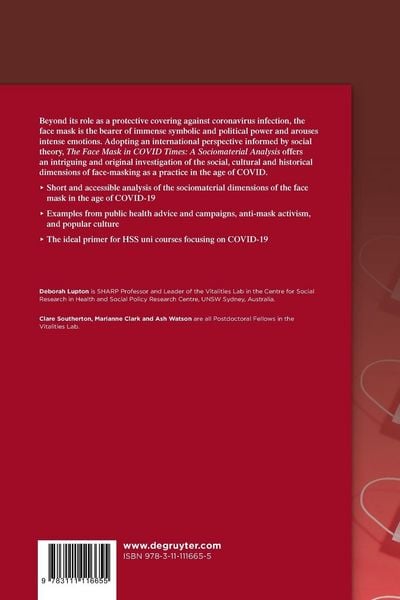
The simple fabric face mask is a key agent in the fight against the global spread of COVID-19. However, beyond its role as a protective covering against coronavirus infection, the face mask is the bearer of powerful symbolic and political power and arouses intense emotions. Adopting an international perspective informed by social theory,
The Face Mask in COVID Times: A Sociomaterial Analysis
offers an intriguing and original investigation of the social, cultural and historical dimensions of face-masking as a practice in the age of COVID.
Rather than Beck’s ‘risk society’, we are now living in a ‘COVID society’, the long-term effects of which have yet to be experienced or imagined. Everything has changed. The COVID crisis has generated novel forms of sociality and new ways of living and moving through space and time. In this new world, the face mask has become a significant object, positioned as one of the key ways people can protect themselves and others from infection with the coronavirus. The face mask is rich with symbolic meaning as well as practical value. In the words of theorist Jane Bennett, the face mask has acquired a new ‘thing-power’ as it is coming together with human bodies in these times of uncertainty, illness and death.
The role of the face mask in COVID times has been the subject of debate and dissension, arousing strong feelings. The historical and cultural contexts in which face masks against COVID contagion are worn (or not worn) are important to consider. In some countries, such as Japan and other East Asian nations, face mask wearing has a long tradition. Full or partial facial coverings, such as veiling, is common practice in regions such as the Middle East. In many other countries, including most countries in the Global North, most people, beyond health care workers, have little or no experience of face masks. They have had to learn how to make sense of face masking as a protective practice and how to incorporate face masks into their everyday practices and routines.
Face masking practices have become highly political. The USA has witnessed protests against face mask wearing that rest on ‘sovereign individualism’, a notion which is highly specific to the contemporary political climate in that country. Face masks have also been worn to make political statements: bearing anti-racist statements, for example, but also Trump campaign support. Meanwhile, celebrities and influencers have sought to advocate for face mask wearing as part of their branding, while art makers, museums, designers and novelty fashion manufacturers have identified the opportunity to profit from this sudden new market. Face masks have become a fashion item as well as a medical device: both a way of signifying the wearer’s individuality and beliefs and their ethical stance in relation to the need to protect their own and others’ health.
The Face Mask in COVID Times: A Sociomaterial Analysis
provides a short and accessible analysis of the sociomaterial dimensions of the face mask in the age of COVID-19. The book presents seven short chapters and an epilogue. We bring together sociomaterial theoretical perspectives with compelling examples from public health advice and campaigns, anti-mask activism as well as popular culture (news reports, blog posts, videos, online shopping sites, art works) to illustrate our theoretical points, and use Images to support our analysis.
Noch keine Bewertungen vorhanden
Verfassen Sie die erste Bewertung zu diesem Artikel
Helfen Sie anderen Kundinnen und Kunden durch Ihre Meinung.
Kurze Frage zu unserer Seite
Vielen Dank für dein Feedback
Wir nutzen dein Feedback, um unsere Produktseiten zu verbessern. Bitte habe Verständnis, dass wir dir keine Rückmeldung geben können. Falls du Kontakt mit uns aufnehmen möchtest, kannst du dich aber gerne an unseren Kund*innenservice wenden.
zum Kundenservice