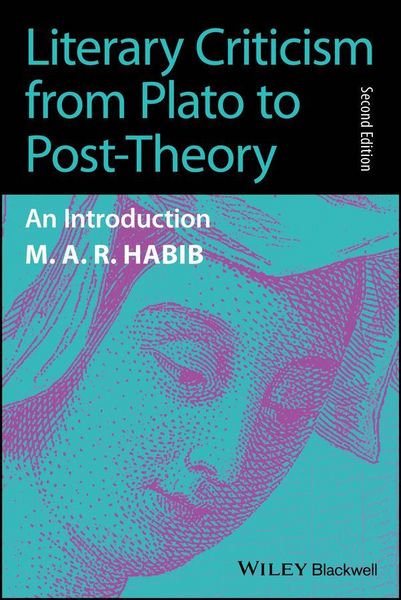
Literary Criticism from Plato to Post-Theory An Introduction
-
- Taschenbuch ausgewählt
- eBook
-
Sprache:Englisch
53,99 €
inkl. gesetzl. MwSt.,
Lieferung nach Hause
Beschreibung
Produktdetails
Einband
Taschenbuch
Erscheinungsdatum
04.11.2025
Verlag
John Wiley & SonsSeitenzahl
400
Maße (L/B/H)
22,8/15,2/2,5 cm
Gewicht
574 g
Auflage
2. Auflage
Sprache
Englisch
ISBN
978-1-394-18887-1
Provides a comprehensive account of the evolution of literary criticism from antiquity to the present
Spanning more than two millennia of intellectual history, Literary Criticism from Plato to Post-Theory: An Introduction offers the most thorough and accessible survey of Western literary theory available today. M.A.R. Habib presents a lucid and detailed chronological account of key movements, texts, and thinkers-from Plato and Aristotle to posthumanism and digital studies-making complex ideas intelligible without sacrificing scholarly rigor. This second edition is expanded to address the rapidly evolving landscape of contemporary criticism, including new and revised chapters on affect theory, cognitive literary studies, gender theory, world literature, and digital humanities.
For students and scholars of literature, theory, and cultural studies, Literary Criticism from Plato to Post-Theory provides indispensable insight into how literary criticism has responded to-and helped shape-major intellectual and political developments throughout history. With clear attention to philosophical foundations and cultural context, Habib explores not just what key theorists believed, but why their ideas emerged when they did and how they continue to resonate today.
Enabling readers to trace the deep roots and dynamic shifts in literary thought with clarity and critical depth, Literary Criticism from Plato to Post-Theory:
- Situates literary theory within historical and philosophical developments across cultures and eras
- Emphasizes contextualization, helping readers understand criticism in relation to its time and place
- Introduces lesser-known thinkers alongside canonical figures, offering a broad intellectual spectrum
- Highlights the connections between literary criticism and political, cultural, and social change
- Bridges classical traditions and emerging technologies/ media in literary analysis
- Encourages close textual reading while maintaining attention to philosophical underpinnings
Ideal for use alongside anthologies or as a stand alone text, Literary Criticism from Plato to Post-Theory: An Introduction, Second Edition remains a foundational resource for understanding the traditions and transformations of literary criticism. It is ideal for undergraduate and graduate students taking courses in English, comparative literature, cultural studies, or critical theory. It is particularly suited to core courses such as Introduction to Literary Theory, Foundations of Criticism, and World Literature in English, Liberal Arts, and Interdisciplinary Humanities programs.
Kundinnen und Kunden meinen
Verfassen Sie die erste Bewertung zu diesem Artikel
Helfen Sie anderen Kund*innen durch Ihre Meinung
Kurze Frage zu unserer Seite
Vielen Dank für dein Feedback
Wir nutzen dein Feedback, um unsere Produktseiten zu verbessern. Bitte habe Verständnis, dass wir dir keine Rückmeldung geben können. Falls du Kontakt mit uns aufnehmen möchtest, kannst du dich aber gerne an unseren Kund*innenservice wenden.
zum Kundenservice