Gutscheinbedingungen

**Gültig bis 10.06.2026 / Gültig für gebrauchte Bücher / Mindestbestellwert 20,00 € / Einzelne Artikel können ausgeschlossen sein / Online auf www.bücher.de.de / Nicht kombinierbar mit anderen Gutscheinen oder Preisaktionen / Nur einmal pro Einkauf einlösbar / Gutschein wird auf max. 500€ Bestellwert angerechnet / Keine Barauszahlung / Nicht gültig für Versandkosten und Services

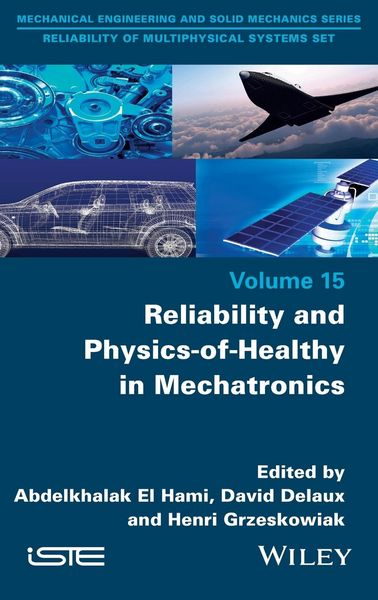
  • Produktbild: Reliability and Physics-Of-Healthy in Mechatronics
  • Produktbild: Reliability and Physics-Of-Healthy in Mechatronics

Reliability and Physics-Of-Healthy in Mechatronics

183,99 €

inkl. gesetzl. MwSt., Versandkostenfrei

Lieferung nach Hause

Beschreibung

Produktdetails

Einband

Gebundene Ausgabe

Erscheinungsdatum

12.01.2023

Herausgeber

Abdelkhalak El Hami + weitere

Verlag

Wiley

Seitenzahl

320

Maße (L/B/H)

24/16,1/2,2 cm

Gewicht

651 g

Sprache

Englisch

ISBN

978-1-78630-881-8

Beschreibung

Portrait

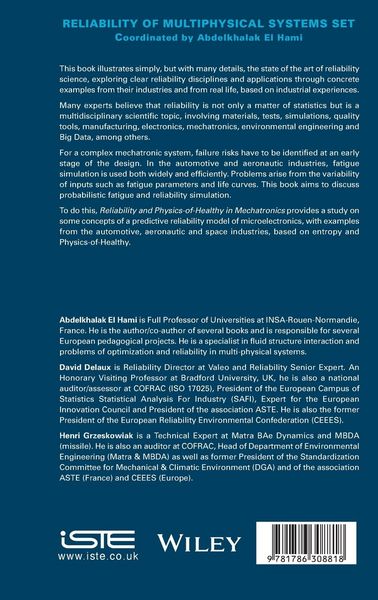
Abdelkhalak El Hami is Full Professor of Universities at INSA-Rouen-Normandie, France. He is the author/co-author of several books and is responsible for several European pedagogical projects. He is a specialist in fluid structure interaction and problems of optimization and reliability in multi-physical systems.

David Delaux is Reliability Director at Valeo and Reliability Senior Expert. An Honorary Visiting Professor at Bradford University, UK, he is also a national auditor/assessor at COFRAC (ISO 17025), President of the European Campus of Statistics Statistical Analysis For Industry (SAFI), Expert for the European Innovation Council and President of the association ASTE. He is also the former President of the European Reliability Environmental Confederation (CEEES).

Henri Grzeskowiak is a Technical Expert at Matra BAe Dynamics and MBDA (missile). He is also an auditor at COFRAC, Head of Department of Environmental Engineering (Matra & MBDA) as well as former President of the Standardization Committee for Mechanical & Climatic Environment (DGA) and of the association ASTE (France) and CEEES (Europe).

Produktdetails

Einband

Gebundene Ausgabe

Erscheinungsdatum

12.01.2023

Herausgeber

Verlag

Wiley

Seitenzahl

320

Maße (L/B/H)

24/16,1/2,2 cm

Gewicht

651 g

Sprache

Englisch

ISBN

978-1-78630-881-8

Herstelleradresse

Libri GmbH
Europaallee 1
36244 Bad Hersfeld
DE

Email: Libri GmbH

Kundinnen und Kunden meinen

0 Bewertungen

Informationen zu Bewertungen

Zur Abgabe einer Bewertung ist eine Anmeldung im Konto notwendig. Die Authentizität der Bewertungen wird von uns nicht überprüft. Wir behalten uns vor, Bewertungstexte, die unseren Richtlinien widersprechen, entsprechend zu kürzen oder zu löschen.

Die Bewertungen sind nach Format, Anzahl Sterne und Datum sortiert.

Verfassen Sie die erste Bewertung zu diesem Artikel

Helfen Sie anderen Kund*innen durch Ihre Meinung

Kundinnen und Kunden meinen

0 Bewertungen filtern

Die Leseprobe wird geladen.
  • Produktbild: Reliability and Physics-Of-Healthy in Mechatronics
  • Produktbild: Reliability and Physics-Of-Healthy in Mechatronics
  • Preface ix

    Abdelkhalak EL HAMI, David DELAUX and Henri GRZESKOWIAK

    List of Acronyms xi

    Part 1 Entropy and Physics-of-Healthy: Some Concepts to Model Predictive Reliability of Microelectronics for Automotive, Aeronautic and Space Missions 1

    Introduction to Part 1 3

    Alain BENSOUSSAN, Joseph B. BERNSTEIN and Alain BRAVAIX

    Chapter 1 Basic Reliability Tools for SHM Protocols 11

    Alain BENSOUSSAN, Joseph B. BERNSTEIN and Alain BRAVAIX

    1.1 Introduction 11

    1.2 State-of-the-art reliability in DSM and GaN technologies and Physics-of-Healthy: thermodynamics 15

    1.2.1 COTS and emerging technologies in deep-sub-micron technologies: short overview 15

    1.3 General overview on GaN device failure mechanisms 19

    1.4 Physical reliability models applied to DSM technology 24

    1.4.1 Precautions associated with accelerated testing 33

    1.5 Reliability and probability mathematics 34

    1.5.1 Exponential distribution summary 42

    1.5.2 Normal distribution summary 42

    1.5.3 Weibull distribution summary 42

    1.5.4 Lognormal distribution summary 43

    1.6 The Sedyakin principle 47

    1.7 System reliability 49

    1.7.1 Series systems 49

    1.7.2 Parallel systems 51

    1.7.3 Complex systems 54

    1.8 Conclusion and future prospects 58

    1.9 References 60

    Chapter 2 Applied Engineering on Physics-of-Healthy and SHM of Microelectronic Equipment for Aeronautic, Space, Automotive and Transport Operations 65

    Alain BENSOUSSAN, Joseph B. BERNSTEIN and Alain BRAVAIX

    2.1 Introduction 65

    2.2 Component health monitoring: a case study for automotive and aerospace applications 68

    2.2.1 Context and particular issues for automotive applications using emerging technologies 68

    2.2.2 Predictive reliability and health monitoring methodology for new technologies 70

    2.2.3 Prognostic failure model (PFM) level 3: reliability prediction applied to DSM technologies in harsh environments 80

    2.2.4 Reliability study for DD3RL 111

    2.3 Aerospace electronics reliability: practical application of MTOL 120

    2.3.1 Standard HTOL 122

    2.3.2 Multiple mechanisms 123

    2.3.3 Acceleration factor 124

    2.3.4 Proportionality matrix solution 127

    2.4 Conclusion 132

    2.5 References 133

    Part 2 Failure and Analysis of Systems Engineering 139

    Chapter 3 Fault Tree Analysis in the Context of Systems Engineering Design Analysis 141

    Felician CAMPEAN and Ed HENSHALL

    3.1 Introduction 141

    3.1.1 Background to fault tree analysis 142

    3.1.2 Functional basis of fault tree analysis 144

    3.1.3 Case study: electric bicycle drive system 145

    3.2 System-level analysis 146

    3.2.1 Function analysis and decomposition 146

    3.2.2 System-level function fault tree development 150

    3.3 Subsystem-level analysis 152

    3.3.1 Subsystem-level function decomposition 152

    3.3.2 Subsystem-level function fault tree development 158

    3.4 Component-level analysis 160

    3.4.1 Component-level function decomposition 160

    3.4.2 Component-level function fault tree development 165

    3.5 Initial analysis of FFT and further decomposition 167

    3.5.1 Analysis of failure events associated with the connecting and branching flows 167

    3.5.2 Decomposition of the FFT to a level which facilitates design optimization 170

    3.6 eBike drive system function fault tree analysis 174

    3.6.1 Macro-level function fault tree analysis 175

    3.6.2 Function fault tree analysis based on SSFD heuristics 175

    3.6.3 Function fault tree analysis based on cut sets 185

    3.6.4 System of systems context for function fault tree analysis 188

    3.7 Relationship of FFTA to other engineering tools 191

    3.8 Discussion and conclusion 192

    3.9 References 195

    Chapter 4 Reliability for a Mature Product From the Beginning of Its Useful Life: The Different Types of Tests and Their Impact on Product Reliability 199

    Henri GRZESKOWIAK

    4.1 Introduction 199

    4.2 The product life profile 200

    4.3 The product technical specification 201

    4.4 The part (or component) engineering 203

    4.5 The performance-based requirement in design 207

    4.6 The elimination of weakness in design and technologies 208

    4.7 Uncertainty and test factors 210

    4.7.1 Environment variability 210

    4.7.2 Equipment strength variability 210

    4.7.3 Aging of equipment 210

    4.7.4 The purpose of the uncertainty factor 212

    4.7.5 The purpose of the test factor 213

    4.8 Validation of the functions 214

    4.9 Environmental stress screening and HA-ESS 215

    4.10 Conclusion 217

    4.11 Appendices 218

    4.11.1 Appendix 1: Types of tests 218

    4.11.2 Appendix 2: Frequently asked questions on reliability test types 221

    4.11.3 Appendix 3: Feasibility test 249

    4.11.4 Appendix 4: Comparison of ESS and HA-ESS 252

    4.11.5 Appendix 5: Definition of terms 256

    4.11.6 Appendix 6: About MTBF calculations based on HALT results 264

    4.12 References 265

    Chapter 5 Reliability Climatic Test for Composites Based on a Probabilistic Arrhenius Model 267

    David DELAUX, Thomas ILLING and Abdelkhalak EL HAMI

    5.1 Introduction: needs and constraints of automotive reliability 267

    5.2 Proposition of a new probabilistic Arrhenius model 271

    5.2.1 Constant Arrhenius model 271

    5.2.2 Probabilistic Arrhenius model 273

    5.3 Experimental case 283

    5.3.1 Assumptions 283

    5.3.2 Results 286

    5.3.3 Exploration 286

    5.3.4 Results and discussions 288

    5.4 Conclusion and outlook 289

    5.5 References 289

    List of Authors 293

    Index 295