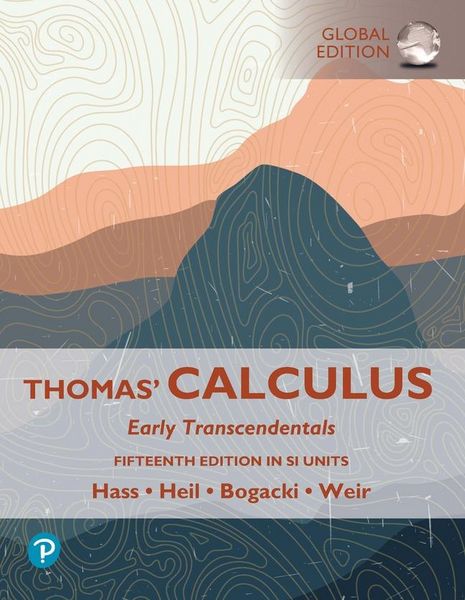
Produktbild: Thomas' Calculus

Thomas' Calculus Early Transcendentals, SI Units

114,99 €

inkl. gesetzl. MwSt., Versandkostenfrei


Beschreibung

Produktdetails

Einband

Taschenbuch

Erscheinungsdatum

01.06.2023

Verlag

Pearson Academic

Seitenzahl

1224

Maße (L/B/H)

27,6/22,7/6,5 cm

Gewicht

2477 g

Auflage

15. Auflage

Sprache

Englisch

ISBN

978-1-292-72590-1

Beschreibung

Produktdetails

Einband

Taschenbuch

Erscheinungsdatum

01.06.2023

Verlag

Pearson Academic

Seitenzahl

1224

Maße (L/B/H)

27,6/22,7/6,5 cm

Gewicht

2477 g

Auflage

15. Auflage

Sprache

Englisch

ISBN

978-1-292-72590-1

Herstelleradresse

Libri GmbH
Europaallee 1
36244 Bad Hersfeld
DE

Email: gpsr@libri.de

Noch keine Bewertungen vorhanden

Verfassen Sie die erste Bewertung zu diesem Artikel

Helfen Sie anderen Kundinnen und Kunden durch Ihre Meinung.

Kundinnen und Kunden meinen

Bewertungen (0)

  • Produktbild: Thomas' Calculus

  • 1. Functions

    • 1.1 Functions and Their Graphs

    • 1.2 Combining Functions; Shifting and Scaling Graphs

    • 1.3 Trigonometric Functions

    • 1.4 Exponential Functions

    • 1.7 Inverse Functions and Logarithms

    • Questions to Guide Your Review

    • Practice Exercises

    • Additional and Advanced Exercises

    • Technology Application Projects

    2. Limits and Continuity

    • 2.1 Rates of Change and Tangent Lines to Curves

    • 2.2 Limit of a Function and Limit Laws

    • 2.3 The Precise Definition of a Limit

    • 2.4 One-Sided Limits

    • 2.5 Limits Involving Infinity; Asymptotes of Graphs

    • 2.6 Continuity

    • Questions to Guide Your Review

    • Practice Exercises

    • Additional and Advanced Exercises

    • Technology Application Projects

    3. Derivatives

    • 3.1 Tangent Lines and the Derivative at a Point

    • 3.2 The Derivative as a Function

    • 3.3 Differentiation Rules

    • 3.4 The Derivative as a Rate of Change

    • 3.5 Derivatives of Trigonometric Functions

    • 3.6 The Chain Rule

    • 3.7 Implicit Differentiation

    • 3.8 Derivatives of Inverse Functions and Logarithms

    • 3.9 Inverse Trigonometric Functions

    • 3.10 Related Rates

    • 3.11 Linearization and Differentials

    • Questions to Guide Your Review

    • Practice Exercises

    • Additional and Advanced Exercises

    • Technology Application Projects

    4. Applications of Derivatives

    • 4.1 Extreme Values of Functions on Closed Intervals

    • 4.2 The Mean Value Theorem

    • 4.3 Monotonic Functions and the First Derivative Test

    • 4.4 Concavity and Curve Sketching

    • 4.5 Indeterminate Forms and L'Hôpital's Rule

    • 4.6 Applied Optimization

    • 4.7 Newton's Method

    • 4.8 Antiderivatives

    • Questions to Guide Your Review

    • Practice Exercises

    • Additional and Advanced Exercises

    • Technology Application Projects

    5. Integrals

    • 5.1 Area and Estimating with Finite Sums

    • 5.2 Sigma Notation and Limits of Finite Sums

    • 5.3 The Definite Integral

    • 5.4 The Fundamental Theorem of Calculus

    • 5.5 Indefinite Integrals and the Substitution Method

    • 5.6 Definite Integral Substitutions and the Area Between Curves

    • Questions to Guide Your Review

    • Practice Exercises

    • Additional and Advanced Exercises

    • Technology Application Projects

    6. Applications of Definite Integrals

    • 6.1 Volumes Using Cross-Sections

    • 6.2 Volumes Using Cylindrical Shells

    • 6.3 Arc Length

    • 6.4 Areas of Surfaces of Revolution

    • 6.5 Work and Fluid Forces

    • 6.6 Moments and Centers of Mass

    • Questions to Guide Your Review

    • Practice Exercises

    • Additional and Advanced Exercises

    • Technology Application Projects

    7. Integrals and Transcendental Functions

    • 7.1 The Logarithm Defined as an Integral

    • 7.2 Exponential Change and Separable Differential Equations

    • 7.3 Hyperbolic Functions

    • 7.4 Relative Rates of Growth

    • Questions to Guide Your Review

    • Practice Exercises

    • Additional and Advanced Exercises

    8. Techniques of Integration

    • 8.1 Using Basic Integration Formulas

    • 8.2 Integration by Parts

    • 8.3 Trigonometric Integrals

    • 8.4 Trigonometric Substitutions

    • 8.5 Integration of Rational Functions by Partial Fractions

    • 8.6 Integral Tables and Computer Algebra Systems

    • 8.7 Numerical Integration

    • 8.8 Improper Integrals

    • Questions to Guide Your Review

    • Practice Exercises

    • Additional and Advanced Exercises

    • Technology Application Projects

    9. Infinite Sequences and Series

    • 9.1 Sequences

    • 9.2 Infinite Series

    • 9.3 The Integral Test

    • 9.4 Comparison Tests

    • 9.5 Absolute Convergence; The Ratio and Root Tests

    • 9.6 Alternating Series and Conditional Convergence

    • 9.7 Power Series

    • 9.8 Taylor and Maclaurin Series

    • 9.9 Convergence of Taylor Series

    • 9.10 Applications of Taylor Series

    • Questions to Guide Your Review

    • Practice Exercises

    • Additional and Advanced Exercises

    • Technology Application Projects

    10. Parametric Equations and Polar Coordinates

    • 10.1 Parametrizations of Plane Curves

    • 10.2 Calculus with Parametric Curves

    • 10.3 Polar Coordinates

    • 10.4 Graphing Polar Coordinate Equations

    • 10.5 Areas and Lengths in Polar Coordinates

    • 10.6 Conic Sections

    • 10.7 Conics in Polar Coordinates

    • Questions to Guide Your Review

    • Practice Exercises

    • Additional and Advanced Exercises

    • Technology Application Projects

    11. Vectors and the Geometry of Space

    • 11.1 Three-Dimensional Coordinate Systems

    • 11.2 Vectors

    • 11.3 The Dot Product

    • 11.4 The Cross Product

    • 11.5 Lines and Planes in Space

    • 11.6 Cylinders and Quadric Surfaces

    • Questions to Guide Your Review

    • Practice Exercises

    • Additional and Advanced Exercises

    • Technology Application Projects

    12. Vector-Valued Functions and Motion in Space

    • 12.1 Curves in Space and Their Tangents

    • 12.2 Integrals of Vector Functions; Projectile Motion

    • 12.3 Arc Length in Space

    • 12.4 Curvature and Normal Vectors of a Curve

    • 12.5 Tangential and Normal Components of Acceleration

    • 13.6 Velocity and Acceleration in Polar Coordinates

    • Questions to Guide Your Review

    • Practice Exercises

    • Additional and Advanced Exercises

    • Technology Application Projects

    13. Partial Derivatives

    • 13.1 Functions of Several Variables

    • 13.2 Limits and Continuity in Higher Dimensions

    • 13.3 Partial Derivatives

    • 13.4 The Chain Rule

    • 13.5 Directional Derivatives and Gradient Vectors

    • 13.6 Tangent Planes and Differentials

    • 13.7 Extreme Values and Saddle Points

    • 13.8 Lagrange Multipliers

    • 13.9 Taylor's Formula for Two Variables

    • 13.10 Partial Derivatives with Constrained Variables

    • Questions to Guide Your Review

    • Practice Exercises

    • Additional and Advanced Exercises

    • Technology Application Projects

    14. Multiple Integrals

    • 14.1 Double and Iterated Integrals over Rectangles

    • 14.2 Double Integrals over General Regions

    • 14.3 Area by Double Integration

    • 14.4 Double Integrals in Polar Form

    • 14.5 Triple Integrals in Rectangular Coordinates

    • 14.6 Applications

    • 14.7 Triple Integrals in Cylindrical and Spherical Coordinates

    • 14.8 Substitutions in Multiple Integrals

    • Questions to Guide Your Review

    • Practice Exercises

    • Additional and Advanced Exercises

    • Technology Application Projects

    15. Integrals and Vector Fields

    • 15.1 Line Integrals of Scalar Functions

    • 15.2 Vector Fields and Line Integrals: Work, Circulation, and Flux

    • 15.3 Path Independence, Conservative Fields, and Potential Functions

    • 15.4 Green's Theorem in the Plane

    • 15.5 Surfaces and Area

    • 15.6 Surface Integrals

    • 15.7 Stokes' Theorem

    • 15.8 The Divergence Theorem and a Unified Theory

    • Questions to Guide Your Review

    • Practice Exercises

    • Additional and Advanced Exercises

    • Technology Application Projects

    16. First-Order Differential Equations

    • 16.1 Solutions, Slope Fields, and Euler's Method

    • 16.2 First-Order Linear Equations

    • 16.3 Applications

    • 16.4 Graphical Solutions of Autonomous Equations

    • 16.5 Systems of Equations and Phase Planes

    • Questions to Guide Your Review

    • Practice Exercises

    • Technology Application Projects

    17. Second-Order Differential Equations

    • 17.1 Second-Order Linear Equations

    • 17.2 Nonhomogeneous Linear Equations

    • 17.3 Applications

    • 17.4 Euler Equations

    • 17.5 Power-Series Solutions

    • Questions to Guide Your Review

    • Practice Exercises

    • Additional and Advanced Exercises

    • Technology Application Projects

    18. Complex Functions (online)

    • 18.1 Complex Numbers

    • 18.2 Limits and Continuity

    • 18.3 Complex Derivatives

    • 18.4 The Cauchy-Riemann Equations

    • 18.5 Complex Series

    • 18.6 Conformal Maps

    19. Fourier Series and Wavelets (online)

    • 19.1 Periodic Functions

    • 19.2 Summing Sines and Cosines

    • 19.3 Vectors and Approximation in Three and More Dimensions

    • 19.4 Approximation of Functions

    • 19.5 Advanced Topic: The Haar System and Wavelets


    Appendix A

    • A.1 Real Numbers and the Real Line

    • A.2 Graphing with Software

    • A.3 Mathematical Induction

    • A.4 Lines, Circles, and Parabolas

    • A.5 Proofs of Limit Theorems

    • A.6 Commonly Occurring Limits

    • A.7 Theory of the Real Numbers

    • A.8 The Distributive Law for Vector Cross Products

    • A.9 Probability

    • A.10 The Mixed Derivative Theorem and the Increment Theorem


    Appendix B

    • B.1 Determinants

    • B.2 Extreme Values and Saddle Points for Functions of More than Two Variables

    • B.3 The Method of Gradient Descent


    Answers to Odd-Numbered Exercises
    Applications Index
    Subject Index
    A Brief Table of Integrals
    Credits