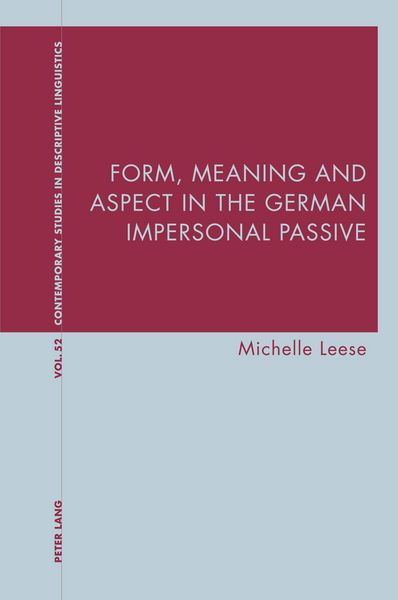
Form, Meaning and Aspect in the German Impersonal Passive
-
- Taschenbuch
- eBook ausgewählt
-
Form:Einzelkauf Download
-
Sprache:Englisch
-
eBook Format:ePUB
- PDF 71,49 €
- ePUB 71,49 € ausgewählt
71,49 €
inkl. gesetzl. MwSt.Beschreibung
Produktdetails
Format
ePUB
Kopierschutz
Ja
Family Sharing
Nein
Text-to-Speech
Ja
Erscheinungsdatum
05.09.2022
Verlag
Peter Lang Inc., International Academic PublishersSeitenzahl
324 (Printausgabe)
Dateigröße
3817 KB
Auflage
1. Auflage
Sprache
Englisch
EAN
9781800798519
«Michelle Leese's book is a must-read for those interested in the German impersonal passive. Based on an experimental study of almost 400 zero-argument passives she convincingly shows that this allegedly "exceptional" passive is the very core from which all werden-passives in their meaning as "event-focused action" are derived.»
(Petra M. Vogel, Professor of German Linguistics, University of Siegen, Germany)
«This book presents a vast amount of original data to confront a glaring weakness of the aspect analysis of the German passive: if the actional passive is telic, why is the impersonal passive of the type Es wurde getanzt atelic? The answer given is a revelation delightful in its simplicity.»
(Dr Christopher Beedham, Honorary Lecturer, Department of German, University of St Andrews, Scotland)
Actional passives are conventionally considered to be the result of a voice analysis conversion process. They are said to derive from semantically identical underlying actives, even though most passives do not contain the agent - the entity carrying out the action - that would be crucial to such a conversion. Beedham's aspect analysis offered an alternative perspective which discarded any notion of a mandatory connection to the active, and instead proposed that passive formation requires only a lexically telic verb, compositional telicity and a patient (affected entity) subject.
This book challenges both these analyses via an empirical investigation into the somewhat neglected impersonal passive in German of the type Es wurde getanzt, which, as a zero-argument, atelic construction, exists as an exception to both the voice and aspect analysis rules. Using the theoretical framework of Saussurean structuralism and Beedham's «method of exceptions and their correlations», this book presents a new, «event-focused» analysis of both this impersonal passive and the German actional passive in general; plus, it proposes that since Es wurde getanzt, as the barest form of passive and the closest realisation of the werden + ge-V-t core of all passives, is atelic, this werden-passive core too is atelic.
Noch keine Bewertungen vorhanden
Verfassen Sie die erste Bewertung zu diesem Artikel
Helfen Sie anderen Kundinnen und Kunden durch Ihre Meinung.
Kurze Frage zu unserer Seite
Vielen Dank für dein Feedback
Wir nutzen dein Feedback, um unsere Produktseiten zu verbessern. Bitte habe Verständnis, dass wir dir keine Rückmeldung geben können. Falls du Kontakt mit uns aufnehmen möchtest, kannst du dich aber gerne an unseren Kund*innenservice wenden.
zum Kundenservice