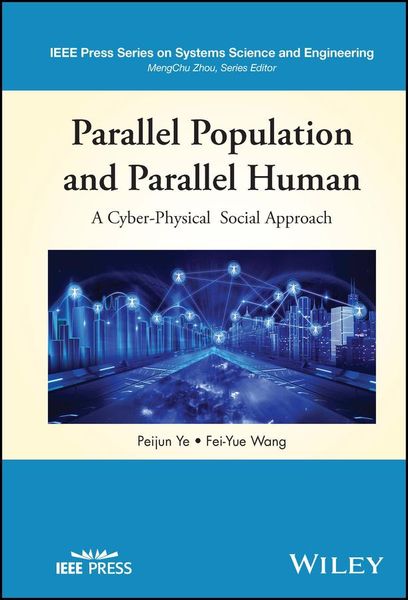
Parallel Population and Parallel Human A Cyber-Physical Social Approach
151,99 €
inkl. gesetzl. MwSt.,
Lieferung nach Hause
Beschreibung
Produktdetails
Einband
Gebundene Ausgabe
Erscheinungsdatum
27.06.2023
Verlag
John Wiley & Sons IncSeitenzahl
352
Maße (L/B/H)
22,9/15,2/2,1 cm
Gewicht
630 g
Auflage
1. Auflage
Sprache
Englisch
ISBN
978-1-394-18189-6
Parallel Population and Parallel Human
Proposes a new paradigm to investigate an individual's cognitive deliberation in dynamic human-machine interactions
Today, intelligent machines enable people to interact remotely with friends, family, romantic partners, colleagues, competitors, organizations, and others. Virtual reality (VR), augmented reality (AR), artificial intelligence (AI), mobile social media, and other technologies have been driving these interactions to an unprecedented level. As the complexity in system control and management with human participants increases, engineers are facing challenges that arise from the uncertainty of operators or users.
Parallel Population and Parallel Human: A Cyber-Physical Social Approach presents systemic solutions for modeling, analysis, computation, and management of individuals' cognition and decision-making in human-participated systems, such as the MetaVerse. With a virtual-real behavioral approach that seeks to actively prescribe user behavior through cognitive and dynamic learning, the authors present a parallel population/human model for optimal prescriptive control and management of complex systems that leverages recent advances in artificial intelligence. Throughout the book, the authors address basic theory and methodology for modeling, describe various implementation techniques, highlight potential acceleration technologies, discuss application cases from different fields, and more. In addition, the text:
* Considers how an individual's behavior is formed and how to prescribe their behavioral modes
* Describes agent-based computation for complex social systems based on a synthetic population from realistic individual groups
* Proposes a universal algorithm applicable to a wide range of social organization types
* Extends traditional cognitive modeling by utilizing a dynamic approach to investigate cognitive deliberation in highly time-variant tasks
* Presents a new method that can be used for both large-scale social systems and real-time human-machine interactions without extensive experiments for modeling
Parallel Population and Parallel Human: A Cyber-Physical Social Approach is a must-read for researchers, engineers, scientists, professionals, and graduate students who work on systems engineering, human-machine interaction, cognitive computing, and artificial intelligence.
Proposes a new paradigm to investigate an individual's cognitive deliberation in dynamic human-machine interactions
Today, intelligent machines enable people to interact remotely with friends, family, romantic partners, colleagues, competitors, organizations, and others. Virtual reality (VR), augmented reality (AR), artificial intelligence (AI), mobile social media, and other technologies have been driving these interactions to an unprecedented level. As the complexity in system control and management with human participants increases, engineers are facing challenges that arise from the uncertainty of operators or users.
Parallel Population and Parallel Human: A Cyber-Physical Social Approach presents systemic solutions for modeling, analysis, computation, and management of individuals' cognition and decision-making in human-participated systems, such as the MetaVerse. With a virtual-real behavioral approach that seeks to actively prescribe user behavior through cognitive and dynamic learning, the authors present a parallel population/human model for optimal prescriptive control and management of complex systems that leverages recent advances in artificial intelligence. Throughout the book, the authors address basic theory and methodology for modeling, describe various implementation techniques, highlight potential acceleration technologies, discuss application cases from different fields, and more. In addition, the text:
* Considers how an individual's behavior is formed and how to prescribe their behavioral modes
* Describes agent-based computation for complex social systems based on a synthetic population from realistic individual groups
* Proposes a universal algorithm applicable to a wide range of social organization types
* Extends traditional cognitive modeling by utilizing a dynamic approach to investigate cognitive deliberation in highly time-variant tasks
* Presents a new method that can be used for both large-scale social systems and real-time human-machine interactions without extensive experiments for modeling
Parallel Population and Parallel Human: A Cyber-Physical Social Approach is a must-read for researchers, engineers, scientists, professionals, and graduate students who work on systems engineering, human-machine interaction, cognitive computing, and artificial intelligence.
Kundinnen und Kunden meinen
Verfassen Sie die erste Bewertung zu diesem Artikel
Helfen Sie anderen Kund*innen durch Ihre Meinung
Kurze Frage zu unserer Seite
Vielen Dank für dein Feedback
Wir nutzen dein Feedback, um unsere Produktseiten zu verbessern. Bitte habe Verständnis, dass wir dir keine Rückmeldung geben können. Falls du Kontakt mit uns aufnehmen möchtest, kannst du dich aber gerne an unseren Kund*innenservice wenden.
zum Kundenservice